250 years after the 1775 fight on Lexington Common, the argument rages on. Did the British army fire first at the Lexington town militia “without provocation”? Or did the Americans give the first fire? According to our best-fit reconstruction, the answers are clear.
“First” is an ambiguous term. Do we mean the first shot of the morning? The first shot during the confrontation on Lexington Common? The first shot with clear intent to kill? The first shot that “did execution”, i.e. hit the enemy?
Throughout the morning hours preceding the confrontation, the Americans fired countless alarm shots which are noted in statements from both sides. These were powder-only shots intended as signals, not meant to hit the British, so arguably shouldn’t count toward any discussion about who shot first. They do serve, however, to illustrate that the “first shot” everyone argues about was not the first shot fired that day.
Who fired the first shot on the green?
The British. The best fit narrative, item #4, supported by 6 eyewitness sources and refuted by none, says this was the pistol shot from Major Pitcairn. This should be unsurprising, as the longtime Marine officer spent years aboard naval warships, where “shots across the bow” were accepted practice. (Supposedly in the 18th century, any vessel so hailed was expected to show his “colors”, i.e. declare his nationality.) Pitcairn presumably did not intend to hit anyone, although some of the Americans may have been less clear on that point, especially after more pistol shots from British officers and the volley fired by the advance guard, even if they all came from the far side of the green and no one was hit.
Which side first declared their intent to kill the other?
Again, the British. The best-fit narrative, event #23 supported by 9 eyewitness sources and refuted by none, says the second British commander (Pitcairn’s subordinate) gave the first lethal order to fire. According to eyewitnesses, the Americans never issued such an order.
Which side first fired a shot that killed or wounded the enemy?
The British again. The best-fit narrative, event #24 supported by 11 eyewitness sources and refuted by none, says the British foot soldiers did first execution when, on orders, they opened fire. (British Captain Soutar specifically says the sole American shot fired beforehand whistled by, i.e. hit no one.)
If the British fired the first shot on the green, first declared their intent to fire to kill, and drew first blood, then the only remaining ambiguity lies in the middle: Which side fired the first shot intending to hit the other? Unfortunately, this question cannot be answered without understanding the mind behind every musket. Possibly the last pistol shot from the forward British officer was intended to hit an American, or perhaps he only intended another warning shot. Possibly the American behind the stone wall fired hoping to hit a British regular, but perhaps he only intended a harmless tit-for-tat overhead reply. The record is unclear.
The British. The British. The British.
What the best-fit narrative is clear about: After firing the first shot on the green, then many more shots themselves, the British rushed at the Americans with bayonets fixed and then, in response to one ambiguous shot fired over their heads from off the field, a British officer gave the command to fire on the entire line of Americans standing right in front of them. The front company obeyed, firing over thirty muskets, hitting at leave five men (probably more).
None of which sums up to either “The Americans Fired First” or “The British Fired Back Without Orders”, today’s so-called conventional wisdom. Pitcairn, firmly in charge, fired the first warning shot himself. He then ordered systematic escalations until finally sending his men across the common. Moments later, his second-in-command ordered the first fatal fire.
Nothing in Smith’s orders from Gage required Pitcairn to confront the Lexington militia. Presumably, the British could have simply marched by.
They didn’t.
Who Fired the First American Shot?
Eyewitness statements point to one man: Woburn farmer Ebenezer Lock.
The evidence:
Eyewitnesses universally stated the first American shot did not come from a member of Captain Parker’s Lexington Militia Company.
One wounded militiaman told loyalist George Leonard “it was not the company he belonged to that fired but some of our country people that were on the other side of the road.” This location is consistent with British reports that the American shot came from behind a “hedge” (i.e. a shrub-covered stone wall) that Pitcairn himself said was east of the common, across Bedford Road.
Ebenezer’s cousin Amos said they were approaching the common along a stone wall when, from about 100 yards away, Ebenezer fired at the British.
In the 1800s, Ebenezer’s grandchildren and great-grandchildren published stories claiming he fired the first American shot of the Revolution.
So, Ebenezer Lock was in the right place at about the right time. He did not belong to Parker’s Company. And some claimed he fired it.
There is a lot more to the Ebenezer Lock story, unfortunately beyond the scope of this post. There were more Woburn men in that field that could have fired the first shot. But Ebenezer is the only one anyone said fired first, at least long and loud enough for it to be written down so we can read about it today.
How Can We Be Sure the First American Shot Came After the First British Shot?
The most straightforward evidence is arguably the stated location of the British troops when each shot was taken. British eyewitnesses consistently stated that they had crossed the common and were even “amongst” the militia” when the first American shot came. The first British shots, meanwhile, came before the advance when they were still on the far side of the common by the Lexington meetinghouse.
Hancock lived in Lexington as a boy, and small-town boys all know each other.
In April 1775, learning about Parliament’s orders for his arrest and execution, John Hancock hid out in Lexington. As one descendant of the 1775 minutemen put it, Hancock “sought shelter at such a moment among kindred and friends.” [Muzzy, p380]
Hancock’s relationships with his Lexington “kindred”, Reverend Jonas and Lucy Bowes Clark, are well documented, but who were his “friends”? A search turned up nothing concrete. I found no mentions of any interaction between Hancock and any Lexington resident other than Reverend Clark himself.
That said, John Hancock reportedly lived in Lexington as a boy, and small-town boys know each other. They attend grammar school and play together after church on Sundays. They wrestle and hunt frogs in the swamp and whatever else provincial boys did in the 1740s. Hancock may have only lived full-time in Lexington for a year or two (sources differ), but even while attending Boston Latin School he is said to have returned for summer holidays while his mother lived at the parsonage. In later years he returned to visit his “Grandmama”.
So perhaps it is no coincidence that many prominent Lexington participants on 18-19 April 1775 were men born within a year of Hancock. They knew the ordinary minister’s son before he inherited massive wealth and became the face of the patriot cause, which arguably conferred a special status no matter how little adulthood interaction occurred.
The 1912 edition of Hudson’s History shows eleven men born within a year of Hancock who still lived in Lexington in 1775. Their names are listed below along with a snippet of what they did to help the patriot leader on 18 April 1775.
Edmund Munroe
One year older than Hancock. Sources place Edmund, a French War officer, at the parsonage the night of 18 April with the guard detail organized by his younger brother. Edmund later accompanied Hancock and Adams to Woburn, then returned with Revere and Lowell. He is said to have vouched for them at Buckman Tavern when they went to fetch the trunk of Provincial Congress Papers. [Canavan]
Some (including Canavan) have speculated Edmund had wavering loyalty to the patriot cause, but more likely he simply kept his activities quiet until the war broke out. He is said to have drafted the rules for the Lexington Militia Company and captained a detachment of the alarm list within weeks of the fight. Not the activities of a Crown loyalist.
Francis Brown
One year younger than Hancock, Francis also guarded the parsonage on the night of 18 April. He then helped spread the alarm and accompanied Hancock and Adams to Woburn with Edmund and William Munro. He returned in time for the fight, where he fended off a British sword with his musket barrel as he retreated up Bedford Road. In the afternoon he was wounded as the British retreated through Lexington. He lived with a musket ball lodged in his head for a year before having it removed. [Canavan, Hudson]
William Tidd
Six months older than Hancock, William lived two doors up Bedford Road. He served as Parker’s lieutenant in the militia. Sources suggest that, on a prearrangement with Captain Parker, Hancock summoned Tidd the moment Revere arrived to direct the spread of the alarm around Lexington.
In 1789, newly elected U.S. President George Washington visited Lexington. On his arrival, Washington first asked “Where is Leftenant Tidd, who stood with Captain Parker?” Before the trip, Washington visited Hancock (then Governor of Massachusetts) in Boston, who presumably gave him Tidd’s name. Not clear how he would have learned it otherwise. [Munroe]
Thaddeus Harrington
Three months older than Hancock, Thaddeus loaned his horse to Elijah Sanderson on the night of 18 April so he could follow the suspicious party of British officers. (Reverend Clark loaned his to Solomon Brown). Thaddeus was on the common the following morning and signed one of the depositions. [Phinney, p31]
Joshua Simonds
Eight months older than Hancock, Joshua was in charge of the militia’s magazine stores in the meetinghouse gallery. After filling powder horns as the British approached, he prepared to blow up the remaining powder, with himself and the meetinghouse, “rather than to have it fall into the hands of the enemy.” [Simonds]
Four More Documented Militiamen
One year younger, John Bridge Jr was on the common the morning of April 19 and served with William Tidd as a lieutenant under Parker in June. Joseph Mason, the town clerk and later schoolmaster, was on the common. He was six months older than Hancock. Benjamin Merriam (five months younger) and Bill Smith (one year older) are on militia lists. [Hudson]
The Two Conspicuously Absent
The only Lexington men Hancock’s age absent from fight records are two French War veterans, Henry Harrington and David Fisk. Both made contributions during the revolution. Henry had combat experience. Henry’s seven brothers were all on the common.
Henry arguably was, too, just didn’t want his name on a list the British might compare with those who took loyalty oaths to the King during their military service.
The same (admittedly speculative) argument goes for David Fisk.
How Close Was Hancock to These Men?
It’s one thing to conclude Hancock had known many Lexington men for decades. We can even argue that some of Lexington’s loyalty to the patriot cause stemmed from personal connections with John Hancock and his family.
Beyond that, little is known. What nicknames did they call each other? Did they get along or argue? Did they occasionally meet for drinks at Buckman Tavern? Did one of these men give Hancock the “fine salmon” that famously left Lexington with him?
Unfortunately, without records we can only speculate.
Sources:
Canavan, M. J., “The Canavan Papers”, 1912
Hudson, Charles, “History of Lexington”, 2nd Edition, Two Volumes, 1912
Munroe, Sally, “Washington’s Visit to Lexington Nov 5 1789”, Lexington Historical Society Proceedings, Vol I, 1889, p xxxvi – xlii
Muzzey, A. B.: “Battle of Lexington”, New England Historical and Genealogical Register, p377-393, October 1877
Phinney, Elias, “History of the Battle of Lexington”, 1825
Simonds, Eli, “Echoes of the Lexington Bell”, Boston Globe, 17 July 1895
The British officer who ordered his troops to fire a lethal volley at the militia might not have been Pitcairn, but instead the second field officer known to be present: Major Edward Mitchell.
American narratives of the Lexington fight have always placed Major Pitcairn at the front of the British troops, wielding his sword as he commanded them to fire on Parker’s militia. Over the past century, such accounts have come into question to the point that the historical moment may, someday soon, disappear from the record entirely.
But what if the only problem is that the Americans named the wrong officer? New research suggests the man mistakenly called “Major Pitcairn” may have instead been the other British field officer known to be present.
His name was Major Edward Mitchell.
Two British Commanders in the Lexington Fight
American eyewitnesses consistently, and from the very beginning, noted the presence of multiple British “commanders” on Lexington Common when the first shots were fired, even if no deposition or narrative overly focused on the point.
Within days of what locals referred to afterward simply as “the fight”, spectator Thomas Price Willard—the new town schoolmaster—signed a deposition that included this statement: “the commanding officers said something, what I know not; but upon that the [British] Regulars ran. . .”[1] His statement documented a moment uncorroborated at that time by other eyewitnesses. Willard’s testimony goes notably uncontested, however, as others don’t touch on what happened before the British advance, nor bother to differentiate between commanders and the some two dozen subordinate British officers present.[2]
Many eyewitnesses didn’t even presume to distinguish between officers and private soldiers. Benjamin Tidd and Joseph Abbott said, “some of the regulars who were mounted on horses”. Levi Harrington and Levi Mead said the same, adding, “which we took to be officers.” Similarly, Elijah Sanderson said, “I heard one of the regulars, who I took to be an officer, say ‘Damn them, we will have them.’”[3]
Other than Willard, only three witnesses—militiaman John Robbins and spectators Thomas Fessenden and William Draper—reported seeing “officers” without any qualification. Of these, only Draper mentions a commander, stating, “the commanding officer of the troops (as I took him) gave the command to the troops ‘Fire! Fire! Damn you, fire!’ and immediately they fired.”[4]
Whether Draper’s “commanding officer” was one of the “commanding officers” reported by Willard is impossible to conclude from the 1775 depositions alone. Yet the existence of more than one officer acting like a commander, at least in the eyes of Willard, stands undisputed. As for the identity of the officers, the American depositions—all signed the week of 24 April 1775—notably include no names.
In early May, 1775, a loyalist printer published General Thomas Gage’s “Circumstantial Account” of the Lexington fight. The general’s statement names the two senior officers in charge of the Concord expedition: “Lieutenant Colonel Smith of the 10th Regiment” and “Major Pitcairn” of the Marines. The account stated Pitcairn was present on the common but remained mute on Smith’s whereabouts.[5] Separately, however, the patriot newspaper Essex Gazette published several intercepted letters from British soldiers, one of which said, “Col. Smyth of the 10th Regiment ordered us to rush on them with our bayonets fixed.”[6]
Piecing these sources together (likely with others), Lexington eyewitnesses matched—incorrectly, it turned out[7]—the names of two senior British officers in the newspapers to the two “commanders” they saw on their village green.
Several subsequent accounts of the Lexington fight specifically name both “Smith” and “Pitcairn”:
In 1776, Reverend Jonas Clark’s stated “three officers (supposed to be Col. Smith, Major Pitcairn, and another officer)” shouted orders to disarm and disperse and “the second of these officers. . . fired his pistol towards the militia as they were dispersing.”[8]
In 1825, William Munro, one of the surviving militiamen, stated: “Maj. Pitcairn advanced and, after a moment’s conversation with Col. Smith, he advanced with his troops and . . . he [Pitcairn] said to his men “Fire, damn you, fire!”.[9]
In 1846, spectator Levi Harrington’s also named both Smith and Pitcairn. Harrington, like Munro, names Pitcairn as the officer who rode forward ahead of the troops.[10]
Clearly, schoolmaster Willard was not the only man in Lexington who thought he saw two commanders. Also, the fact that Clark, Munro, and Harrington all assign the same names to the two commanding officers suggests broad agreement in Lexington about who was ultimately in charge. The commander they believed to be most senior, whom they called “Lt. Colonel Smith”, stayed back while the subordinate of the two, “Major Pitcairn”, advanced with the troops and ordered them to fire.
William Munro’s 1825 statement also serves to link the two events reported independently in 1775 by Thomas Price Willard and William Draper. One of the “commanding officers” Willard saw was the same “commanding officer” Draper reported at the head of the troops giving the order fire.
Notably, these eyewitness statements are separated by decades, an indication the “two commander narrative” persisted in Lexington long into the 1800s. As late as 1886, a letter from A.B. Muzzey names the Lexington citizens who played Smith and Pitcairn in the town’s 1822 reenactment, without any indication the presence of both commanders in the “sham fight” was out of the ordinary either when it happened or at the time of Muzzey’s writing.[11]
The Eroding “Two Commander” Narrative
While all of Lexington accepted the presence of two British commanders at the time of the fight, doubts remained as to their identity. William Tidd’s 1824 affidavit says that, once the fight began, he fired his musket at an officer “presumed to be Major Pitcairn”. Tidd knew he shot at the officer who issued the order to fire moments before, yet fifty years later, remained uncertain about the man’s name.[12]
The ambiguity resulted in variations across published narratives of the time. Elias Phinney’s 1825 mentions only “commander Lt. Col. Smith”[13], while an account published in the Boston News Letter the following year names only Pitcairn.[14] Everett’s 1835 address refers only to “the commanders of the British forces.”[15] In 1851, Frothingham wrote Major Pitcairn was “among the officers” giving orders, but names no others.[16]
Lt. Colonel Smith thus fades from the story, and with good reason. None of the British sources placed him on the common at the time of the fight, and his own 1775 report to Gage, which finally found its way into MHS Proceedings records in 1876, confirmed he wasn’t there when the shooting started.[17]
Unfortunately, as Smith departed the narrative, so did the existence of a second “commander”. Varney (1895) still placed Major Pitcairn at the head of the troops, brandishing his sword and giving an order to fire, as does Ellen Chase in 1910 and Frank Coburn in 1912. But none mention a second commander who gave the initial order to disperse, or with whom “Pitcairn” conversed shortly before the final advance.[18]
Once historians determined Major Pitcairn was unequivocally in charge, perhaps they concluded eyewitnesses reporting a second commander—still in the minority—misinterpreted or misremembered what they saw. Or perhaps, since all still agreed on the kernel of the story—the King’s troops fired on orders from Major Pitcairn—no one thought the second commander required identification.
Then came the apologists.
Beginning in the late 1800s, additional British eyewitness accounts came to light containing fresh perspectives of the revolution’s opening skirmish. If taken together with American accounts, they had the potential to greatly clarify the events of 19 April. Unfortunately, so far, they have done the opposite.
These new sources corroborated the first British reports, none of which place Pitcairn at the front of the troops as the Americans claimed. Ensign Henry DeBerniere said Pitcairn “ordered our light infantry to advance and disarm them, which they were doing. . .”, suggesting Pitcairn himself did not advance.[19] DeBerniere’s statement, in the hands of American historians since the late 1700s, agrees with an account from Lieutenant William Sutherland first published in 1927 that reads, “the Gentlemen [officers] who were on horseback rode amongst them [the militia], at which time I heard Major Pitcairn’s voice call out ‘Soldiers don’t fire’. . .”[20], implying the major was somewhere behind the officers at the front, not with them.
Historians have seen little reason to reconcile these conflicting British statements with their American counterparts. If patriotic spirit dismissed inconvenient British sources for the first 150 years, since World War I the situation has reversed; over the past century most scholars have shown little regard for the Lexington eyewitnesses. Harold Murdock thought the 1820s affidavits published by Phinney and Ripley, however rich in detail, were best “reserved for appendices and illustrative notes, and not included in the body of any historical work”. Arthur Tourtellot called them “the long-winded recollections of old men”.[21]
As a result of these biases, the documented second British commander—his actions, his identity, even his existence—has gone completely uninvestigated. Tourtellot’s 1959 Lexington and Concord has Pitcairn firmly in command, not from the front but from the west side of the green.
The gaping hole in Tourtellot’s narrative is wider than all his predecessors. Where none of the American accounts described the events that precipitated the order to fire, with Tourtellot the order never comes. The action jumps directly from the British troops lined up by the meetinghouse on the east side by Buckman Tavern to the melee after the first shots. What happened in between? Tourtellot provides only guesses (yet somehow still felt confident the fight was beyond Pitcairn’s ability to control).[22]
Later narratives have followed suit. Hackett-Fischer’s 1993 retelling places Pitcairn on the field where Tourtellot does, then fades from definitive action into a jumbled list of eyewitness statements and nebulous conjecture. Pitcairn possibly rode forward. Or perhaps that was someone else entirely. If someone shouted “Fire!”, the King’s troops didn’t obey. The narrative explodes into white noise and the static of endless possibilities until, after the first shots erupt, the British regulars charge ahead “without orders”.[23]
Open Questions
Despite these reduced and sometimes revisionist narratives, discrepancies remain.
One key example: The placement of Major Pitcairn by Tourtellot and Hackett Fischer on the west of the meetinghouse originated with a 1775 statement attributed to spectator Levi Harrington by Reverend Gordon, that the field commander “rode round the meetinghouse and came towards the company that way.[24]
No British source corroborates any such movement to Major Pitcairn. Pitcairn’s own report to Gage states that, after the fight began, “several shots were fired from a meeting house on our left,”[25] presumably a reference to Pitcairn’s own position on Bedford Road near Buckman Tavern during the fight.[26]
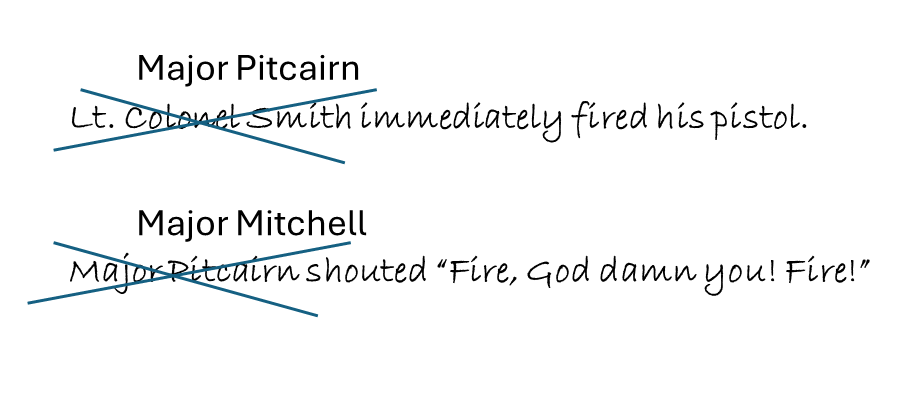
This location not only agrees with every British source, but also with the original American statements that the senior commander they called “Smith” did not advance with the troops. And all British sources agreed Pitcairn was the senior commander. The obvious conclusion, therefore, is that from the beginning, Lexington witnesses assigned the wrong names to the commanders they saw. Pitcairn was the officer they called “Lt. Colonel Smith” and their “Pitcairn” was somebody else.[27]
Correcting this mistake snaps both sides into sudden agreement. None of the Americans say a senior commander ordered the British troops to fire on Parker’s militia from the rear.[28] Nor do any British sources. Since there is no evidence to the contrary, at this late date we can only conclude that, as the British have said since the beginning, Pitcairn never ordered the King’s troops to fire.
But by the same logic, a British officer at the front of the troop did give the order. Dozens of Americans said so, and no British account denies it.
So, who was the officer the citizens of Lexington called “Major Pitcairn”, who rode around the meetinghouse, had a word with the real Pitcairn, then advanced with the troops? Who fired his pistol and ordered the troops to “Fire! God damn you, fire!”? Who, after the first volley of musket fire, chased Lieutenant Tidd up Bedford Road, saber in hand?
A likely answer exists. Lieutenant William Sutherland’s 1775 report includes a list of British “gentlemen” on horseback at the head of the troops on Lexington Common. Most are “company grade” officers, captains and lieutenants unlikely to have acted like a “commanding officer”. One, however, was newly promoted Major Edward Mitchell, the only other British field officer known to be present that morning, who rode right where the Americans said a “commanding officer” ordered the troops to open fire.
Who Was Major Edward Mitchell?
Edward Mitchell[29] is first found in British army records as a captain in the short-lived 120th Regiment of Foot, which organized in 1762 only to be disbanded the following year. After several years on Irish half-pay, in 1766 Mitchell traded into a captaincy in the 17th Dragoons, a regiment of light cavalry (alternatively “mounted infantry”) trained to fight with both swords and muskets whether on foot or horseback.[30]
After eight years as a dragoon captain, in January 1774 Mitchell obtained a major’s commission in Lord Percy’s 5th Regiment of Foot.[31] Shortly after, Major Mitchell and the 5th moved from Ireland to Boston to help enforce Parliament’s “Massachusetts Government Act”. When they landed in early July, 1775,[32] Mitchell was one of the most junior field officers in the Boston garrison.[33]
Mitchell must have served well, since in 1777 he promoted to Lieutenant Colonel of the 27th Foot.[34] Like Major Pitcairn and so many others, however, he did not survive the war.[35] Neither did any report he might have provided Lord Percy and General Gage about his actions on 19 April 1775.
Fortunately, others mentioned him by name.
Was Major Mitchell The Second British “Commander” in the Lexington Fight?
The first part of Major Mitchell’s activities are documented by both British[36] and American sources:
On Tuesday 18April, General Gage placed Mitchell in charge of “a small party on horseback” tasked with preventing news of Smith’s expedition from reaching Concord.[37] Mitchell’s background with the dragoons, often assigned reconnaissance and skirmishing work, made him a logical choice for the assignment.
Around ten o’clock that evening, on the road between Lexington and Concord, they made prisoners of three Lexington scouts sent to discover their business. Around two o’clock the next morning they stopped Paul Revere, who told Mitchell he “had alarmed the country all the way up, and that their boats had catched aground, and I should have 500 men there soon”.[38]
Realizing he had failed his assignment and might soon be surrounded, Mitchell decided to retreat. They released their prisoners and galloped through Lexington down the road to Boston.[39] They met up with the detachment of light infantry in the next town, Menotomy.[40]
What happened to Mitchell and his men after they met Pitcairn’s detachment remained a mystery until Sutherland’s report for General Gage came to light in the 1920s. In the margin, written by the same hand as the rest, lies the note, “It is very unlikely that our men should have fired on them [the militia] immediately as they must certainly have hurt Major Mitchell, Capts. Lumm, Cochrane, Lieuts. Baker, Thorne, & me & some other Gentlemen who were on horseback who rode in amongst them, desiring them to throw down their arms and no harm should be done them.”[41] Later in the main body of his report, Sutherland says, “some of the villains were got over the hedge, fired at us, and it was then and not before that the soldiers fired.”
Sutherland does not reveal who ordered the soldiers to fire, or even that anyone did. His report simply skips over the point, just as the American statements tactfully omit the shot fired from the “hedge”.[42] However another British officer, Captain William Soutar of the Marines, says the front light infantry company fired in response to a shout from the “leading company”, presumably a reference to the mounted officers in front. Since Soutar says the front light infantry “immediately formed and fired”, it seems reasonable to conclude they thought the “shout” was an order to fire, just as American witnesses reported the British “commanding officer” issued.
How can we be sure Mitchell was the officer at the front who gave the order to fire? We probably can’t, but several facts support the idea:
First, Major Mitchell held seniority. Excepting Sutherland himself, the other listed officers belonged to Mitchell’s party the night before and were likely still under Mitchell’s command. Assuming they looked to Mitchell for orders, Mitchell would have looked like a “commander” of the group.
Second, as the only field officer at the front, Mitchell alone could command the company grade officers standing on the ground with the private soldiers, none of whom would repeat an order to fire to their men had they come from an officer of equal or lesser rank, especially if, from behind them, they heard Pitcairn shouting the opposite moments earlier.
Third, the “commanding officer” on Lexington Common sounds like Mitchell. The man who “in a passion”[43] ordered the King’s troops to “Fire! God damn you! Fire!”, then chased William Tidd up Bedford Road, sword in hand, shouting “Stop or you are a dead man!” sounds much like the named Major Mitchell, who three hours earlier thrust a pistol against Paul Revere’s head, threatening to “blow his brains out” if he didn’t tell the truth.[44] An officer fond of the phrase “dead men”. In addition to Tidd’s statement above, militiaman Sylvanus Wood said the officer swinging his sword in front of the King’s troops shouted “Lay down your arms, you damned rebels, or you are all dead men!” And both Elijah Sanderson and Paul Revere reported that, upon their respective captures on Concord Road, an officer said they were “dead men” if they resisted.[45]
Finally, we have the field commander’s sword. William Tidd said he was chased up Bedford Road by the man “presumed to be Pitcairn”. Separately, Levi Harrington’s 1846 account said Tidd’s pursuer wielded a “sabre”, a three-foot blade carried by cavalry officers, and dragoons. Infantry officers invariably favored shorter “hangers” that didn’t drag in the dirt as they marched. Pitcairn the marine was equally unlikely to own a saber. On the other hand Major Mitchell, the former dragoon captain, was likely one of few infantry officers in Boston who owned a saber and, since he rode out from Boston, carry one the day of the fight.[46]
Is Mitchell’s senior rank subordinate only to Pitcairn, his status as a field officer, his threatening language, and his unique background as a dragoon captain enough to conclude he was the “Major Pitcairn” who ordered the British to fire on the Americans? The verdict, I suppose, depends on the jury.
Gage, General Thomas: A Circumstantial Account, 1775. See the Massachusetts Historical Society Online Collection for a digitized copy of the original broadside. The Library of Congress offers a transcript.
Gordon, Rev. William: Letter to Englishman, 17 May 1775, Reprinted by the Philadelphia Gazette 7 June 1775 (Retrieved from Newspapers.com Feb 2024).
Hackett Fischer, David: Paul Revere’s Ride, 1994.
Harrington, Bowen: An Account of the Battle of Lexington – 19 April 1775 by Levi Harrington, an Eyewitness, 1846. The Lexington Historical Society has copies of an 1859 transcript.
Murdock, Harold: The Nineteenth of April 1775, 1923.
[2] A count suggests at least twenty-five British officers. The detachment consisted of at least six infantry companies with a standard three officers each, equating to eighteen captains, lieutenants, and ensigns. While the 4th light infantry marched without its captain, at least one officer—Lt. William Sutherland—was a volunteer extra. Major Pitcairn had at least one extra officer with him—Ensign DeBerniere, acting as a guide—and possibly more. And finally, a British account places on the common the five officers who had been out all night controlling intelligence.
[7] This letter appears to be a reference to a bayonet charge ordered by Smith to clear a hill outside Concord held by American militiamen when they first arrived in at their destination, not the Lexington fight which happened before or the fight at Concord’s North Bridge, which happened afterward. See Kehoe p174.
[11] Lexington Historical Society Online Collection, Accession #8819, 17 June 1886, “Letter from A.B. Muzzey giving account of the Lexington Reenactment, 19 April 1822”: “There was Gen. Chandler who personated Maj. Pitcairn, Maj. B. G. Wellington who represented Col. Smith”
[13] Phinney, p20. Phinney’s account may have been based on the 1824 affidavit of John Munroe Jr., which mentions only Smith by name and is written in such a way that the actions of both commanders might be interpreted as coming from the same officer. See Phinney, p35-6.
[14] Boston News Letter and City Record, 3 June 1826, p281. No byline.
[18] Varney, p33; Chase, p364-367; Coburn, p63-5; Chase also presented a neutral version of the fight’s opening shots based on then newly available British sources.
[19] MHS Collections, Series 2 Vol 14, 1816, p216, “Narrative of occurrences 1775”.
[21] Murdock, 1923, p6. Tourtellot, p289: He actually said “garrulous”, which Oxford defines as “excessively talkative, especially on trivial matters”, i.e. long-winded.
[26] Remaining on the east side of the meetinghouse arguably made the most tactical sense for Pitcairn since the enemy commander, Captain Parker, also reportedly stood on the east side of his militia. If Pitcairn rode around the meetinghouse to the west side, he would have been out of earshot if Parker wanted to, for example, communicate his surrender.
[27] The origin of this error is possibly the soldier’s letter in the May 12 1775 issue of the Essex Gazette, which stated the bayonet charge occurred on Smith’s orders. Since Smith was not present, the anonymous soldier clearly conveyed faulty information, but then he did not expect his personal letter to become public record.
[28] Levi Harrington’s 1846 account says the senior commander, who he called “Smith” ordered the troops to fire over the militia’s heads, not at them.
[29] Little is certain about Mitchell’s origins. He may have belonged to the Mitchells of Castlestrange in County Roscommon, a landowning family of Irish-born Scots with many officers in their lineage, and several Edwards. Yet efforts to establish a solid link have so far proven unfruitful.
[30] British National Archives Online Collection, 29 May 1766 Letter from Earl of Hertford to Mr. Secretary Conway: “Requesting that Captain Chudleigh Morgan of the 17th Daragoons (Lt. Colonel Lord Newbattle) be permitted to exchange with Captain Edward Mitchell of the late 120th Regiment of Foot upon the Irish Establishment of half pay. Dated at Dublin Castle.”
[31] 1774 British Army Regiment Lists, 5th Regiment of Foot.
[32] Numerous sources document the arrival of Percy’s 5th in Boston. See “Rowe’s Diary” in Mass. Hist. Society Proceedings, Series 2, Vol 10, p87.
[33] 1775 British Army Regiment Lists for the eleven regiments in Boston show only Major James Ogilvie of the King’s Own had a commission dated later than Mitchell (Apr 1774 vs Jan 1774).
[34] 1779 British Army Regiment Lists, 27th Regiment of Foot, commission dated “3 Nov 1777”.
[35] Inman, George, Losses of the Military and Naval Forces Engaged in the War of the American Revolution, The Pennsylvania Magazine of History and Biography, 1903, Vol 27, No 2, p192: “27th Regiment, Lt. Col. Mitchell, On board the Beaver Prize which was lost in the Hurricane in the West Indies”. The HMS Beaver’s Prize wrecked on St. Lucia 11 Oct in the “Great Hurricane of 1780”. Seventeen crew survived. Evidently Mitchell did not.
[36] See Murdock, 1927, p27-32, “Richard’s Pope’s Book”.
[45] While its possible some occurrences of this common phrase came from other officers, not all British behaved the same. Contrast Mitchell’s “harsh” words with Revere’s statement that another British officer that night (possibly Captain Lumm, the ranking officer under Mitchell) was “much of a gentleman”, or with Stiles description of Pitcairn as “a good man in a bad cause”. No such statements about Mitchell exist.
[46] While Levi Harrington’s 1846 account may be imprecise with its details, Levi the eyewitness likely knew the difference between sabers and hangers from his father’s blacksmith shop as well as his later army service. Levi also had occasion to see the blade firsthand, since several American eyewitnesses said the commander brandished it before his order to fire.
Captain Parker had a lieutenant named William Tidd standing next to him at the start of the fight. Little has been written about him. This post summarizes findings from an initial search of known sources.
Early Life
William Tidd was born in northern Lexington in 1736, the seventh of ten children to Daniel and Hepzibah (Reed) Tidd. William’s parents descended from two original proprietors of Cambridge Farms (as Lexington was first called), John Tidd and William Reed. William took his name from his mother’s side; his grandfather William “Captain” Reed had been the town’s largest landowner, and his uncle William “Squire” Reed was a prominent town leader for the first half of William (Tidd)’s long life.[1]
William Tidd’s father Daniel served as town selectman and assessor almost as long as his brother-in-law. Daniel bore the title “Ensign”, which first appeared in 1746 town records during King George’s War, the third of four conflicts between Britain and France. Daniel is conspicuously absent from town meetings from 1743-46, so he probably served as a militia officer during those years. Daniel’s years of civil and military service set a precedent his son would later repeat.[2]
William Tidd lived his entire life on a farm off Bedford Road (now Hancock Street), two doors up from the Hancock-Clarke parsonage, about a mile north of Lexington Common. The land had once belonged to his grandmother Lydia Tidd. Daniel Tidd appears to have built the “old Tidd House” around 1730, a dignified two-story colonial that still stands today (in 2024). Affluent if not wealthy during his lifetime, William owned 75 acres of fields and woodlots at the time of his death, plus half a pew in the meetinghouse.[3]
The Seven Years War
Like many in their early twenties during the last war with France (aka the Seven Years War (1755-1762) or the French and Indian War, depending on which nation’s history book is referenced), William served in the town militia. Most records have been lost, but the name “William Tidd” appears on a 1759 list of men in Lexington’s “military company of foot” who received bayonets. Other men listed on the same roll: John Parker, Francis Brown, Jonathan Harrington, and a half-dozen more who would stand with William on Lexington Common sixteen years later.[4]
The French War took a heavy toll on the Tidd family. After the failed English campaign at Lake George in 1758, William’s 18-year-old cousin Samuel succumbed to one of the deadly diseases sweeping the camp. William’s older brother Daniel, 32, whose name appears on provincial regiment rolls, likewise did not survive the war (circumstances unknown).[5]
War with France ended for good in 1762 with British victory in North America. In 1766, William married Ruth Monroe, daughter of Ensign Robert Munro. Their marriage lasted sixty years.
Unusual for the era, they had only one daughter (also Ruth) in 1767, which suggests complications that prevented future children. I imagine William and Ruth closely examined the newborn girl’s hands and feet. William’s grandmother Reed had been born with extra fingers and toes, and it was said the condition would reappear every few generations.[6]
In the pre-revolution years, William spent most of his time farming. He and brother-in-law Daniel Harrington rented the town’s “best meadow” in 1768. He occasionally worked on Reverend Clark’s farm with his oxen. He held minor town officers: deer reeve and fence viewer, surveyor of highways and tythingman. His name appears frequently in town records related to providing clothing, food, and housing for the town poor.[7]
The Revolution
William (with several other Lexington men) had known revolutionary leader John Hancock since they were boys. After his father’s death, Hancock lived with his grandfather at the town parsonage, two doors from the Tidd farm. For some period (sources differ, but likely several years), William and John attended grammar school and Sunday services together.[8]
Thirty years later, fate would have Hancock hiding out in Lexington surrounded by his “kinsmen and friends”.[9]
In February 1775, William’s militia experience and standing in the community proved sufficient for his selection as Captain Parker’s sole lieutenant in the volunteer Lexington Militia Company. Others in town had more military experience, but had also taken loyalty oaths that, before the outbreak of hostilities, may have created unacceptable legal risk. As Edmund Munroe, a French War lieutenant from Lexington, reportedly said, “I’m with you boys. I won’t help you get into trouble. But if you do get into trouble I’ll help you get out.”[10]
Several anecdotes attest to William’s leadership. On the night of April 18, the militia drilled at his house. When Paul Revere brought news of the approaching regulars, William directed the spread of the alarm around Lexington. And as Pitcairn’s detachment approached the Common, William stood next to Captain Parker at the front of the line.[11]
Standing behind Parker and Tidd were William’s younger brother Samuel, several Reed and Tidd cousins, in-laws Samuel Hastings and Amos Marrett and the many Munros, plus other extended relatives and neighbors. As much a family meeting as any of Reverend Clarke’s Sunday services.[12]
The shooting reportedly lasted fifteen minutes.[13]
After the fight, William signed a carefully worded joint deposition stating he was one of Parker’s men already dispersing when the regulars began shooting, shots that occurred before any gun was fired “by any person in our company”.[14]
In an 1825 individual affidavit, William added:
I then retreated up the north road, and was pursued about thirty rods by an officer on horseback (supposed to be Maj. Pitcairn.) calling out to me, “Damn you, stop, or you are a dead man!”
I found I could not escape him unless I left the road. Therefore I sprang over a pair of bars, made a stand, and discharged my gun at him; upon which he immediately turned to the main body.[15]
William’s activities later in the day on April 19th are unknown, though he continued his one-year term as lieutenant of Parker’s Company during the Siege of Boston. He is named with those from Lexington who served in the 1776 campaign to White Plains. For the remainder of the war William served on town committees charged with raising men to serve in the continental army. [16]
During this time William lost his parents, both then in their early eighties.[17]
In September 1777, William paid (with others) to send an additional soldier to Bennington during the Saratoga campaign. That soldier was probably Adam Tidd, a slave purchased in 1752 by William’s father. After serving three years (at least), Adam settled in Boston a free man, married and raised a family. Adam’s son, Porter Tidd, became a popular musician and early civil-rights activist.[18]
Later Years
For the next twenty-five years, William served frequently as town selectman and/or assessor alongside several other veterans of Parker’s Company. According to 1787 town meeting records, he organized the town’s response to Shay’s Rebellion. In 1795, he oversaw the fundraising for the construction of new schoolhouses.
His only daughter married Nathan Chandler in 1785. William and Ruth soon had three grandchildren: a girl and two boys, who grew to marry into the Mulliken and Harrington and Mead families.
William finally retired from public service in 1799, succeeded by his son-in-law. The Honorable Nathan Chandler went on to serve as town selectman, representative, and state senator for the next three decades. Chandler’s eldest son followed in his father’s public service footsteps. Both sons served in the town rifle company.[19]
According to Reverend Clark’s journal, William transacted some minor farm business with the parson. Working with his oxen, selling food, etc. Wiliam also paid the minister interest on a bond held by Clark’s sister-in-law, Elizabeth Bowes, who fled Boston during the siege. Perhaps to fund her relocation Ms. Bowes sold some possessions to the Tidds, who paid in installments.
Anecdotes suggest he was known as “Master Tidd” around town. Daniel Harrington’s children (and likely many others in William’s extended family) called him “Uncle Bill”.
Years later, he was remembered by A.B. Muzzey as short of stature, with a compact frame and an erect gait, active even in old age. Children passing his farm on their way to school often found working outside.
William wore a red wool cap of a revolution veteran—possibly of the Phyrgian liberty style—to Sunday meeting. He “belonged to the old school, who kept their seats in their pews after the service and bowed to the minister as he passed out first.”[20]
William lived to see several great-grandchildren (Ruth, their great-great-grandchildren). William died in 1826, his 91st year, retaining his faculties “to a great degree” until the end. Ruth, “a fitting partner”, lived thirteen more years, to age 97.[21]
The Handshake
One moment speaks to William Tidd’s reputation more than perhaps any other on record.[22] In November 1789, a year after William stepped down as selectman, George Washington visited Lexington on his first tour of the country as its new president. Standing on the Common with the town’s new leadership and many veterans of “the fight”, Washington asked for one man by name:
“Where is Leftenant Tidd, who was next to Captain Parker?”
They brought William forward. Washington offered William “a fine grasp of the hand”. The two old soldiers, one who happened to be the first President of the United States, shared a moment in the place where, fifteen years before, a fifteen-minute firefight precipitated the existence of a great nation.
According to witnesses, neither man saw the need to speak.
Sources
Barry, John Stetson, The History of Massachusetts, The Provincial Period (Volume 2), 1857.
Calabrese, Carmin F.: Lieutenant William Tidd, Retrieved from LexingtonMinutemen.com 2024
Canavan, M.J., Canavan Papers, Three Volumes, 1912
Force, Peter, American Archives 4th Series Volume II, Undated
MMR-93: Massachusetts Muster Rolls 1749-1755, Volume 93, Microfilms on FamilySearch.org, Retrieved Jan 2024
MRR-15: Massachusetts Soldiers and Sailors of the Revolutionary War, Volume 15, 1907
Phinney, Elias: History of the Battle at Lexington, 1825
Sewall, Samuel, History of Woburn, 1868
Signatures
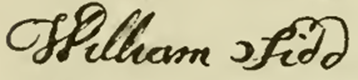
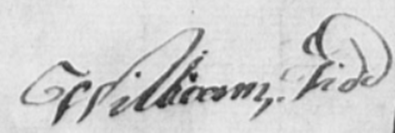
Two signatures believed to be from William Tidd’s hand survive. The first comes from Lexington’s 1780 Assessor’s Book.
The second (shown at the top of this post) comes from a 1776 oath of allegiance to the “United American Colonies”.
[1] Hudson 1868, G.R., p240-4; Hudson 1868, G.R., p191-2; Woburn and Lexington vital records, plus Ancestry.com searches, show no earlier Tidd of the name William.
[2] Hudson 1868, p403-5; Hudson 1912, Vol II, p698
[16] Hudson 1868, pp385, 388, 391-2; “William Tidd” is also listed with three years on the Continental Line, however the conflict with his town service raises the question of whether a younger cousin (born in New Braintree with the same name) filled the Lexington quota.
[18] Hudson p389; LHS Archives [71 MSS in Ledgers: Book W. p. 55, Bill of Sale for a Slave Boy]; MRR-15, p469 “Teed, Adam”, p 730 “Tidd, Adam”; Ancestry.com records; “Eastern Argus Tri Weekly,” 1833-12-09, pg. 2 [Retrieved from Newspapers.com Mar 2024]; Gosse p197-200
A records hunt connected a 1780s Continental Army soldier to the Scottish-born British regular captured after the Lexington fight.
Several captured British regulars made statements published by the Provincial Congress a week after the fight, including Private James Marr of the 4th Regiment (King’s Own) Light Infantry. Some evidence suggests this was the same James Marr who later served in the Continental Army on the patriot side. Did the Scottish-born Marr switch sides?
Facts:
In Reverend Gordon’s 1775 account of the fight, published in the Philadelphia Gazette and elsewhere, he refers to a captured regular: “one James Marr, a native of Aberdeen, in Scotland, of the 4th Regiment”.
Ancestry.com currently shows several 1750s baptism records in Scotland for “James Marr”. One from Cluny Aberdeen, 16 Apr 1757 would make James 18 the day of the fight. Another from Saint Nicolas Aberdeen, dated 28 July 1754, would make him almost twenty-one.
Revolutionary War Muster Rolls: James Marr listed with men mustered by Nathaniel Barber, Suffolk Co, Boston, June 8 1777, Capt Corey’s Company, Putnam’s regiment. Also descriptive lists dated West Point, 10, Jan 1781: James Marr, Residence: Groton, Stature: 5ft 9in, Complexion: Dark, Hair: Dark, Eyes: Grey, Age: 24 years, 1 month. Listed as a sergeant in 1781.
Ancestry.com shows no records for anyone named James Marr born in Suffolk County (Boston) or Worcester County (Groton) where the continental soldier named Marr entered service.
In the absence of any known James Marr from Massachusetts, and since the Dec 1756 birth date imputed for the “James Marr” in the 1781 West Point records aligns with an April 1757 baptism of the “James Marr” baptized in Cluny, Aberdeen, the odds seem to favor that, following his capture at Concord’s North Bridge, James Marr of the King’s Own joined the rebel cause.
It’s not clear what happened to the Massachusetts Marr after the revolution. There is no one named James Marr in the 1790 census records for Massachusetts. Several possibilities:
The 1790 New Hampshire census has a “James Marrs” living in Alstead Town, Cheshire County, with one female and one young male. Alstead was a new town, incorporated in 1763, so a revolutionary war vet might have found affordable land there.
The 1790 New York census records include a “James Marrs” in Ostego Town, Montgomery County with two men and two women.
The 1790 Maine census records include a James Marr in Gorham living with three females and one young male, which aligns with a thirtysomething veteran. However several other Marr’s lived there also, which suggests extended family.
Ancestry records show a “Sergeant James Marrs” died in Indiana in 1814. Some claim that man was from Virginia. No other death records turned up.
A look at the hasty funeral and burial service that took place amidst the April 19 crisis.
Reverend Clark’s daughter Betty described the funeral and burial of the seven Lexington men killed in the fight:
Father sent Jonas down to Grandfather Cook’s to see who was killed, seven of them my father’s parishoners, one from Woburn [Porter], all in boxes made of four large boards nailed up and, after Pa had prayed, they were put into two horse carts and took into the graveyard where your Grandfather and some of the neighbors had made a large trench as near the woods as possible and there we followed the bodies of those first slain, Father, Mother, I and the baby, there I stood and there I saw them let down into the ground. It was a little rainy but we waited to see them covered up with the clods and then for fear the British should find them, my Father thought some of the men had best cut some pine or oak bows and spread them on their place of burial so that it looked like a heap of brush.
[Extract from Letter to Niece Lucy Ware Allen, Lexington Historical Society Proceedings, Vol IV, p91-92]
Betty was eleven the day of the fight and an elderly woman when she wrote her niece in 1841, so some details may be misremembered or mischaracterized. Asa Porter was buried separately in Woburn, and all accounts say the skies were clear, not “a little rainy”as she describes. Still, her account firmly places the service and burial in time: Before the British returned from Concord.
The morning after the fight there were numerous wounded to attend to, prisoners to escort to Woburn, and families to move further from the road that the British would march down sooner or later on their return to Boston. Further straining town manpower, around mid-morning Captain Parker took some men toward Concord to meet the enemy. With all that going on, a mass burial on short notice was a lot to pull off. Who helped? Who attended?
A few related records:
In their statements, Elijah Sanderson and Sylvanus Wood said they helped carry the dead into the meetinghouse. Canavan says Robert Munroe was first brought into the home of his daughter, Anna Harrington. This was probably all accomplished by six or seven o’clock in the morning.
Lexington town meeting records show a payment to Samuel Sanderson for some or all of the coffins used in the burial. Elijah Sanderson says he went home for his gun, which his brother had taken with him and used throughout the day (presumably Samuel, a militia corporal, went with Captain Parker). It seems likely Elijah prepared the coffins Samuel later billed the town for.
According to Hudson’s history, the dead men left four widows, two living mothers and six fathers, plus numerous siblings, children, stepmothers, etc.
Betty’s closest neighbors to the parsonage included many of the families who lost men that morning: Jonas Parker, Jonathan Harrington, plus the Fisks and Tidds and Daniel Harrington.
While nothing is documented, we can speculate close family attended the funeral and burial, and some of those wielded shovels and made the brush pile. The following presents some ideas organized by family, again mostly based on Hudson’s History:
Robert Munroe
The sixty-two-year-old ensign was survived by his wife Anna Stone Munroe, sons Ebenezer and John, daughters Anna Harrington and Ruth Tidd, and numerous grandchildren. Widow Munroe’s sister, Lydia Mulliken, may have attended. Canavan says the Mullikens went to the Munroes when they evacuated their home on the great road.
John Munroe Jr took two prisoners to Jim Reed’s, but may have returned in time to attend–and help with–his father’s burial.
Sons-in-law William Tidd and Daniel Harrington may have been there, although Daniel is said (by son Levi) to have participated in Parker’s Revenge, and it’s hard to imagine the burial happening before the “middle of the forenoon”. Perhaps Harrington went and Tidd stayed to man a shovel. Or they both went. It’s not clear what Tidd’s role as militia lieutenant required that morning. He was chosen selectman the following year for the first time, so his actions on April 19 must have been remembered favorably.
Jonas Parker
The fifty-three-year-old yeoman was survived by wife Lucy (Hudson’s 1912 edition says she was also the younger sister of Robert Munroe), three teenage daughters, and sons Jonas Jr and Philemon. His father, Andrew Parker, was still living at 82. Jonas and Lucy had older children who did not live in Lexington.
Isaac Muzzy
Thirty-year-old Isaac’s immediate family consisted of father John and stepmother Rebecca Munro Muzzy, plus five sisters and three brothers.
Isaac’s new stepbrother, Ebenezer Munroe Jr (son of Jonas, not Robert) had ridden to alarm neighboring towns to show his wounded arm as proof of the fight, so less likely to have attended.
Samuel Hadley
Samuel left his young wife Betty Jones Hadley and three young children, including Samuel Jr less than a year old. His parents, Thomas and Ruth, still lived and he had many brothers and sisters, so the Hadley family may have been well represented.
John Brown
Unmarried John Brown was survived by both parents, Daniel and Anne, plus numerous brothers and sisters, although several no longer lived in Lexington.
Caleb Harrington
Unmarried Caleb may have had a small turnout, with only his father and brother (both Moses) for close relatives, plus stepmother Deborah Winship Harrington. Caleb’s sister, Elizabeth White, had a newborn babe of two weeks so perhaps did not attend.
Jonathan Harrington
Jonathan left his wife, Ruth Fisk Harrington, and an eight-year-old son who died later that year. His father Henry still lived with stepmother Abigail, and Jonathan had seven adult brothers.
Widow Harrington might have felt very alone in Lexington after Jonathan’s death. She had only lived there as an adult. Both parents were dead. She had several half-siblings, all much younger, some of whom might have lived with her on the common (something to investigate). She remarried in Boston in 1777.
This site presents original research into the early morning “fight” between the British regular army and American town militiamen in Lexington, Massachusetts on 19 April, 1775, an event marked by many as the opening of the American Revolution.
What started as a family history project has become something approaching a crusade, a quest to reconstruct a pivotal moment in New England history lately at risk of disappearing into the sands of time. The atrophy is already severe. We used to know the part of the story the patriots wanted to tell. Now even that is gone. These days, most books about the Revolution’s opening day present a laundry list of what might have happened on Lexington Common. The rest skip the first shots entirely.
Filling the growing void are wild online theories based on cherry-picked sources. Even respected journals publish pieces that favor some eyewitness statements over others. Their work, unsurprisingly, is about as satisfying as a paleontologist’s reconstruction of a dinosaur with half the bones still in the box.
The folks at the Lexington Historical Society, Lexington Minutemen, and other New England history organizations, plus the many Tidd relatives I have dragged into this world, have been enormously supportive.
Who was this nine-year-old stranger to Lexington who ran through town in the dark to rouse the militia?
Ebenezer Munroe’s 1825 affidavit states “During the night of the 18th of April of that year [1775], I was alarmed by one Micah Nagles, who stated that the British troops were on their march from Boston, and that Lieutenant Tidd requested myself and others to meet on the common as soon as possible.” [Phinney, p25]
Who was “Micah Nagles”? No one with that surname appears in Lexington Vital Records, which sent me on a hunt with a surprising conclusion: In the middle of the night, Captain Parker’s lieutenant used a nine-year-old boy to spread the alarm.
The Facts
Massachusetts Revolutionary War Muster Rolls list a “Neagls, Michael” of Lexington “Engaged March 6, 1781; term, 3 years” and includes the description: “Age, 16 years; stature, 5 ft 8 in; complexion, dark; hair, dark; eyes, dark; occupation, farmer.” [Vol 11, p299]
Malden birth records list “Neagles, Michael s. of Michael and Elizabeth, Dec 25, 1765”. The birth date coincides with the age of the 1781 Lexington soldier. [Malden Vital Records, Births, p57]
Michael Neagles Sr, a German immigrant, “was run over by a cart wheel which broke his thigh [Sept 2] and he died the Monday following, Sep 5, 1774”, so he could not have been the man who knocked on Ebenezer Munroe’s door the following spring. Note: Sep 2nd was the day after the Medford Powder Raid, so Neagles’ accident may have been tied to the mobs around Boston. [Malden Vital Records, Deaths, p362]
The mother of Michael Jr (aka “Micah”) was born Elizabeth Parker in Reading in 1737. She had a younger brother, Phineas Parker, born in 1739. [Reading Vital Records, p169-175]
In 1768 Phineas Parker of Reading married Lydia Munroe of Lexington. So, Lydia Munroe was the aunt of Micah Neagles. [Hudson 1868, G.R., p153]
Lydia died childless in 1781. Her brother, Philemon Munroe, was nominated administrator of the Neagles estate in 1782 and a “Mr. Munro” was the guardian of Micah and his sister in 1781. [Ancestry.com, Middlesex Probate Records, 1774]
These facts lead to a narrative that, following the death of Michael Senior, Elizabeth could not care for her two children, so Micah and his sister came to live with relatives in Lexington. While Phineas and Lydia were childless, an obvious choice to take the children, they do not appear in Lexington records so perhaps Lydia’s siblings stepped in. Ebenezer Munroe’s statement documents Micah’s presence on 19 April. Also, a young girl is said to have been with Mary Munroe Sanderson the night of the fight; possibly Micah’s sister.
Micah Spreads the Alarm
How did 9-year-old Micah, Munroe family ward, end up knocking on Ebenezer Munroe’s door in the middle of the night? It appears Ebenezer still lived in the house he grew up in at the end of Malt Lane, which once belong to his late father, Jonas Munroe.[1] Supposedly John Buckman bought the place after Jonas died, but Ebenezer’s mother still had her widow’s thirds in it.[2] Malt Lane was just off the common, not too far for Lieutenant Tidd to send a young boy, even one who didn’t know the town very well.
Which begs the question: How did Micah end up on Tidd’s radar in the first place? One scenario sits clearly in my imagination: Micah’s assignment came early in the alarm when militia resources were at their thinnest and, still worried about Major Mitchell’s patrol, they had not yet begun to ring the bell (which would have woken Ebenezer up). Micah had been with Sergeant Munro’s guard detail at the parsonage. Munro and the Sandersons were neighbors; he would know the Neagles children if they stayed with “Aunt Mary”. Munro’s own children were quite young, and few if any other boys lived near Munro Tavern, so 9-year-old Micah would have been a useful resource.
When Revere showed up at the parsonage, Hancock sent for Parker’s lieutenant (per an earlier agreement) who directed, at least partially, the spread of the alarm. Munro’s guards were the initial alarm riders; Francis Brown might be the only one named as both a parsonage guard (per Canavan) and an alarm rider (per John Munroe Jr.), but who else was there?
With most of Munroe’s men deployed, the rest moved to the common. Tidd spotted Micah standing there and thought of Malt Lane, with a house or two no rider had been assigned to rouse. A small job for a small boy.
Tidd sent Micah running.
[1] Hudson 1868, G.R., p151: Jonas Munroe family. Ebenezer’s father died 1765. His mother remarried John Muzzy in 1773. Ebenezer had three older brothers still living, all married, and three sisters, one married. Perhaps the two sisters lived with him, perhaps others as well.
[2] Canavan, Vol 1, p121: In 1775, John Buckman owned the late Jonas Munroe’s house, though Ebenezer’s mother still had her widow’s thirds in it. Canavan says “I think she was still living there” even though she had remarried. Either way, her unmarried children could have.
Sources:
Canavan, Michael J.: The Canavan Papers in Three Volumes, 1912
Hudson, Charles: History of the Town of Lexington, 1868, Two parts, Town History and Genealogical Register (G.R.), with pages numbered separately.
Phinney, Elias: History of the Battle at Lexington, 1825
Was detained provincial Asahel Porter shot trying to escape? Or did the British flank guard mistake him for a deserter?
One of the eight men killed in the fight was Woburn-born Asahel Porter, an unarmed noncombatant found dead by the wall of Buckman’s garden. Lexington citizens who commented on the fight said Porter, who had been taken prisoner on the road like Simon Winship, Tom Robbins, and others, was shot trying to escape. For example, John Munroe Jr. stated in his 1824 affidavit:
Asahel Porter, of Woburn, who had been taken prisoner by the British on their march to Lexington, attempted to make his escape, and was shot within a few rods of the common.
Levi Harrington’s 1846 narrative related much the same story as Munroe, suggesting it was the accepted explanation in town for Porter’s death. A different story, however, comes from “A Brief History of the Town of Stoneham, Mass,” a thirty-page pamphlet written by Silas Dean, Stoneham’s town clerk for the (entire) second half of the nineteenth century. It reads:
On the morning of the ever-memorable 19th of April, 1775, he [Porter] was desired by a neighbor, Josiah Richardson, to proceed with him towards Lexington (about three o’clock, A. M.). Somewhere on the way they discovered some British Regulars. Porter and Richardson were also seen by the Regulars, and were taken by them.
Richardson requested permission to return, and was told by the individual to go to another person, who would no doubt give him a release; but in case the second person he went to told him to run he was by the first ordered not to run; being informed that if he did run he would be shot. Richardson did as he was told to do; and though he was told to run, he walked away, and was not injured.
The reason why he was ordered to run was this: that the guard might think him a deserter, and thereby, in the discharge of their duty, shoot him.
Mr. Porter not being apprised of their artifice in telling him to run, got permission in the same way of Richardson. Having liberty to go, he sat out upon the run. On getting over a wall a short distance off, he was fired upon and received his death wound.
Dean’s pamphlet came into print in 1870, nearly a hundred years after the events of Lexington. How could Dean know something about Asahel Porter that none of the first-hand witnesses stated in the many depositions, affidavits, journal entries, and letters recorded at the time?
Unlike the men in Lexington, Dean knew Asahel Porter’s widow.
Who Was Silas Dean?
Born in 1815 in Reading, Silas Dean moved one town over to Stoneham in 1839, at age 24. Beginning in the 1840s, the back room of Dean’s cottage served as the town clerk’s office for the next fifty years. Stoneham historian William Stevens wrote:[1] “Mister Dean has always been careful, painstaking and accommodating in office, and is one of the most esteemed citizens in the area. He is considered the personification of honesty.”
Silas first joined the Congregational Church in Reading at age 16, and after joining the same in Stoneham upon moving there served as deacon for forty-five years. Between his twin roles as town clerk and church deacon, armed with an interest in history, there would have been little about Stoneham Dean didn’t know.[2]
If Dean hadn’t heard the story of Asahel Porter in Reading (there’s some reason to think he might have[3]), he probably would have heard it shortly after his arrival in Stoneham, specifically around the funeral service for Porter’s widow, Abigail Brooks Porter Pierce. Widow Porter had remarried Ephraim Pierce in 1782 and, after relocating with Pierce to Stoneham, lived there until her death in 1840, at age 83.
Widow Porter would have told any number of Stoneham residents the tragic tale of her first husband, including her three children with Pierce who outlived her, so Silas Dean would have had occasion to hear the details (such as they were known second and third hand) from any number of people.
All of which begs the next question: How would Widow Porter know the details of her husband’s death? The likely answer is the man detained with her husband who lived to tell the story Dean ultimately heard: Josiah Richardson, who happened to be the young widow’s brother-in-law.[4] Had Porter’s widow made up the story (unlikely given the tale’s many quirky and mundane details), she would arguably have fabricated one focused on her husband, not what Josiah Richardson heard and did.
Did the British Army Execute Deserters?
Unequivocally, yes. The British army executed deserters, although the only documented executions I found for 1775 were following a trial. Later, General Howe authorized field executions, but again only if approved by an officer. So, if they caught a deserter, he might not have been shot on the spot. Shooting a man suspected of deserting because he was running away, however, seems more plausible. Laws authorizing the police to shoot at fleeing suspects without evidence were widespread until a few decades ago, and probably still exist in many places.
Did Pitcairn give orders for a guard to shoot anyone running from the line? Unknown. He did, however, put out a flank guard to “prevent surprise” before they arrived at the common, so a guard was in place that could not be easily informed that Richardson and Porter were free to leave.
That said, the existence of such orders is hardly farfetched. Captain Parker threatened to shoot the first man who left his line on the common. The British regulars could have easily heard something similar, or could have thought it possible even if they hadn’t.
Shot “Escaping” or “Deserting”?
Is John Munroe’s “shot escaping” version of Porter’s death more credible than the “mistaken for a deserter” tale Dean heard from Porter’s widow? The gap between “shot escaping” and “shot as a deserter” is arguably thin, and requires one to know the mind of the man who fired the fatal musket ball, and perhaps whether Porter received permission to leave the way Richardson did. If Porter saw Richardson walk away, assumed he too could leave, and was shot because he hadn’t received proper approvals (a possible scenario), the versions become indistinguishable.
That said, the “shot escaping” narrative has a big weakness: Richardson had already been released. Why, then, would Porter need to escape? The moment Pitcairn decided to disperse Parker’s Company, the marine major had no reason to further detain anyone his troops took prisoner on the road, so if he hadn’t yet thought to release his prisoners, he would have undoubtedly approved it.
It’s not clear who actually saw the shooting, if anyone. John Munroe was on the green, where Buckman’s barn and sheds blocked the view, and then in the swamp behind Harrington’s. He never set foot on Buckman’s land during the fight. Josiah Richardson, meanwhile, might have.
Notably, Josiah Richardson and Widow Porter were not from Lexington. Neither were even from Woburn anymore. By 1775 both lived in Salem, where Richardson still resided in 1790. So there may have been limited opportunity for the men in Lexington to incorporate Richardson’s version of Porter’s death, whatever it was, into their thinking.
[1] See Stevens 1891 History of Stoneham with Biographical Sketches p192
[2] Stoneham in 1840 consisted of roughly a thousand people from a hundred (more or less) multi-generational families. Mostly farms, the population had remained stable since the revolution; most children moved west when they grew up. But after 1840 a surge in leather and shoe factories allowed children to stay and even brought in new workers.
[3] Asahel and Abigail Porter’s only son, Asahel Jr. lived in Reading until his untimely death in 1819 (age 44). Dean would have been too young to know the man, but one of his earliest memories might have been the stories that would have circulated when Asa Junior died, i.e. stories of the father who died at the outbreak of the revolution.
[4] Josiah Richardson and Asahel Porter married the Brooks sisters in a destination double wedding. See Rev Perley of Seabrook NH, Marriage Records, FamilySearch #007595558, img 204 of 629: 1773, “Oct 13 Mr Asahel Porter and Mrs Abigail Brooks, both of Salem . . . are legally married by me”. The next entry: “Oct 13, Mr Josiah Richardson and Mrs Ruth Brooks, both of Salem . . . are legally married by me”. Abigail and Ruth were both daughters of Timothy and Ruth Wyman Brooks, born in Woburn.

 The Lexington Fight