Ensign Robert Munro and the Battle of Lake George

An overlooked and misread muster roll contains a fascinating untold story.

A misread muster roll WITH aN untold story

The military record of Ensign Robert Munro, who fell in the first fatal volley fired by the British on Lexington Common on 19 April 1775, lies amidst considerable legend and lore. Some say he served with the famous Rogers’ Rangers. Others say he was the standard bearer at the 1758 Siege of Louisbourg, that he “watched the Indians” in 1762, and then, in his early sixties, served as an officer in the Lexington Militia Company in 1775.

Little of this is backed by surviving historical records.

There still exists, however, an old muster roll showing that Robert and Lexington men under his command fought in the bloodiest fight for the provincials in the entire French War: the 1755 Battle of Lake George.

The Early Life of Robert Munro

Robert Munro was born 4 May 1712, the sixth of nine children of Sergeant George and Sarah Munro. He grew up with numerous cousins in the sprawling “rope-walk” house of his Scottish-born grandfather, forced immigrant William Munro. Lexington had just become a town.

In 1737, Robert married Anna Stone. They lost their eldest son at age two, presumably to an unknown but fatal disease. Four later children, all born in the 1740s, lived to adulthood.

It’s reasonable to assume from Robert’s French War service as an officer that he gained some early soldiering experience with the provincial irregulars, perhaps during the 1740s conflicts with Spain (War of Jenkin’s Ear) and/or France (King George’s War). He was in his late twenties and early thirties during this period. Notably, a Munro cousin succumbed to disease on the trip home from Cuba in 1740, the same year Robert’s son, niece, and nephew all died within weeks. Perhaps young Robert was on the Cuba expedition, too, and carried the same fatal disease home with him

Unfortunately, since his name doesn’t appear in any known records before the 1754-1762 French War, we can only speculate.

Robert Munro in the French War

Lexington town historian Charles Hudson attempted to piece together Robert Munro’s French War a century after the fact. His published history [Hudson 1912, Vol II, p456] says of Robert:

He was a soldier in the French war, was the standard bearer at the taking of Louisburg in 1758, and was again in the service in 1762. He was also ensign of Capt. Parker’s company.

Separately, Hudson’s summary of Lexington’s French War service [Hudson 1912, Vol I, p413-19] includes “Ensign Robert Munroe” on the list of men serving in 1758 and “Robert Munroe” (no title) in 1762.

Is this information correct? The editors of the updated 1912 edition of Hudson’s history searched the surviving muster rolls and failed to find most names listed by Hudson for 1758, including Robert Munro.

There is some evidence Hudson used additional sources. For example, surviving billeting records (taverns invoiced the province for meals and lodging provided soldiers traveling to and from the New York battlefront, some of which survive in Massachusetts archives) show most names on Hudson’s list belonged to companies captained by Cambridge and Watertown men. Robert Munro’s name, however, I failed to find.

Another hint: Since Hudson lists Robert Munro as an ensign for 1758, he seems aware Robert served as an officer during the French War, at least for that year.

But let’s come back to that.

An Unread Muster Roll: Ensign Robert Munro of Peirce’s Company

While several attempts to confirm Robert Munro’s 1758 service have proven fruitless, Hudson’s 1912 edition includes this footnote:

 Ensign Robert Munroe is credited, however, in 1756, to Lincoln. 

     Hudson does not mention any 1756 service for Robert Munro in his 1868 edition, so evidently overlooked the detail. Yet it appears the 1912 editors made a critical error: The roll was prepared 18 February 1756 for the preceding year. The men listed, including Robert Munro, all served in 1755.

With the corrected year, combined with other details preserved in the roll, a remarkable story snaps into focus.

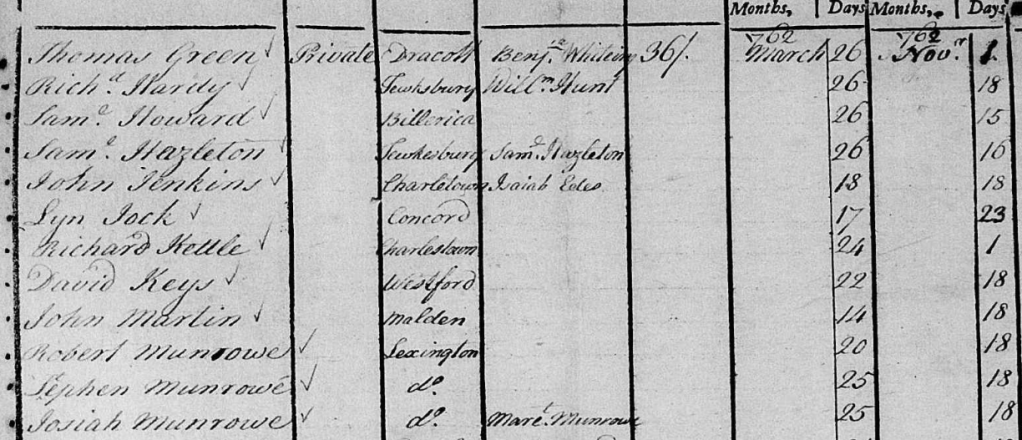
The muster roll in question survives today in volume 94, parchment 76 of the Massachusetts Colonial Records. I found a microfilmed copy at FamilySearch.org in the collection “v.93 Muster rolls (from p80); 1749-1755; v.94A – Muster rolls, 1755-1756; v.94B – Muster rolls (to p.419), 1755-1756)”, Image Group Number 7703435, image 830 of 1759.

Here is the upper left corner:
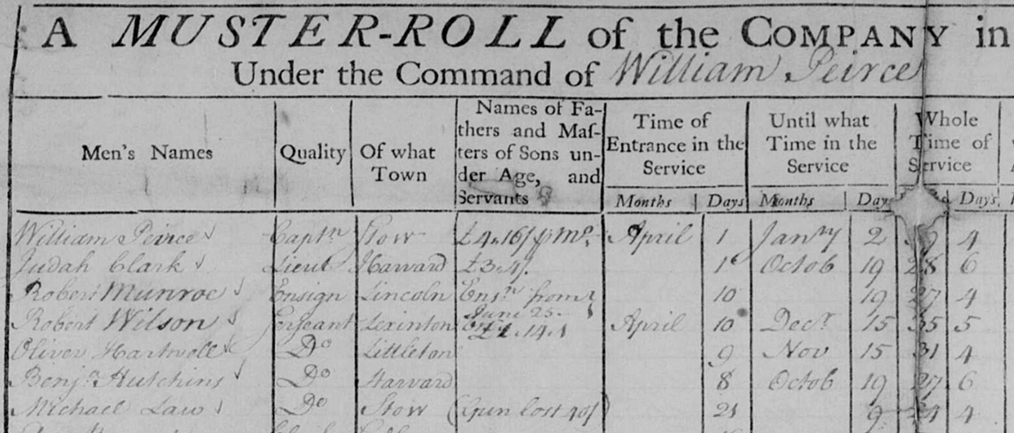
A few points to highlight:

  1. Munro was a new officer. The roll says that Robert Munro of Lincoln became the ensign of Captain William Peirce’s Company on June 25, so he received his commission that year.
  2. Peirce and Munro were family. Hudson’s history says Peirce was Munro’s cousin, the son of Joseph and Hannah Munro Peirce. Peirce was five years older than Robert. According to Hudson, Peirce lived in Lexington as a child and again as an adult before removing to Stow around 1743. The muster roll, as shown, places him in Stow in 1755.
  3. Munro recruited some soldiers. The 1755 journal of General John Winslow, who led a successful campaign in Nova Scotia that year, states that a prospective officer needed to raise 15 men for a company to earn an ensign’s commission. There are about that number of private soldiers from Middlesex towns Lincoln, Lexington, and Woburn. Since Peirce and his lieutenant were from Stow and Harvard (the latter in Worcester County), it appears Munro delivered on that requirement recruiting men from the towns near home.
  4. Lincoln, not Lexington? When William and Robert formed their company in the spring of 1755, the town of Lincoln had only existed for a few months. (The Massachusetts General Court approved in the creation of the town from parts of Concord, Lexington, and Weston during their 1754 session.) Perhaps Robert, like other Munros, owned land or even resided within the bounds of what became Lincoln at that time. Robert does not appear in Lexington town meeting records until the late 1760s, suggesting years with no involvement in Lexington affairs. He appears to have placed his Lexington land in trust for the benefit of his children (see the 1756 will of Robert’s father-in-law, Lexington selectman John Stone), so may have had no rights or obligations to the town during this time.

A possible Lincoln residence notwithstanding, Lexington appears to have continued to claim Robert as their own: A 1760 marriage record for Munro’s daughter, Anna, and Daniel Harrington contains no mention of her or her father “Ens. Robert” being from anyplace other than Lexington. And by 1767 Robert began to show up in Lexington town records, though he never held any town office. By 1775, it is generally believed he resided in Lexington’s Scotland neighborhood.

The Lexington Men In Peirce’s Company

In addition to Robert Munro as ensign, the muster roll for Peirce’s company includes five men from “Lexinton”: a sergeant, Robert Wilson, and four private soldiers: “Benj Lock”, “Robin Raymont”, “Robert Wilson”, and “Henry Herrington.”
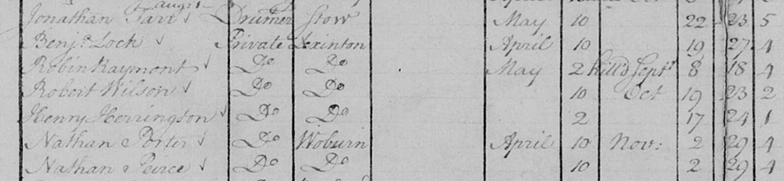
Cross-referencing these names with Hudson’s history reveals the following: Benjamin Lock was the 20-yr-old elder brother of Amos Lock (who fought 19 April 1775). Raymont was probably the colored servant “Robin” that Jonathan Raymond left to his wife Charity in his will. Robert Wilson was probably the son of the sergeant in the same company. Henry Harrington, likewise, was the 18-year-old son of a man by the same name.

So, all four privates were young men.

The muster roll and other sources combine to show the dangers of military service. Raymont is reported “killed Sept 8.” Hudson says Benjamin Lock died of an unknown camp disease in Nov 1755, a month after his 19 Oct discharge. Hudson says one of the Wilsons (father or son is unclear) served again from Lexington in 1758; after that the family disappears from town records.

Perhaps the most interesting feature of the roll is that Robin Raymont was not the only member of Peirce’s company reported killed September 8th, which leads to the obvious conclusion that Peirce’s company saw battle.

A big battle, it turns out.

The Battle of Lake George

The four men of Peirce’s company “killed” on 8 September were Corporal Simon Peirce of Lincoln, Jonathan Barnard of Lincoln, Joseph Bulkley of Littleton, and Robin Raymont of Lexington. Since a fifth man, Asa Brewer of Sudbury, is listed “died” on 5 October, it seems clear the four listed “killed” all died in combat. The roll states “gun lost” for three of the four,  supporting the idea they were killed in a place overtaken by the enemy, who stripped them of their arms.

What happened on 8 September 1755? This is the date of the Battle of Lake George, the first big encounter on the New York frontier between British and French forces. Fifteen hundred Massachusetts and Connecticut irregulars (not regular troops from Britain’s standing army), plus two hundred Mohawk allies, had camped on the banks of Lake George in upstate New York, a staging point for a planned attack on the French position at the other end of the lake.

The French came to them first. The battle—recounted in multiple sources including the diary of Lieutenant Colonel Seth Pomeroy and a published account by noncombatant Samuel Blodget—began with a morning ambush by French forces on a column of British provincials marching to Fort Edward, followed by an afternoon assault on the Provincial camp at the lake, during which the Massachusetts men gave and received heavy fire.
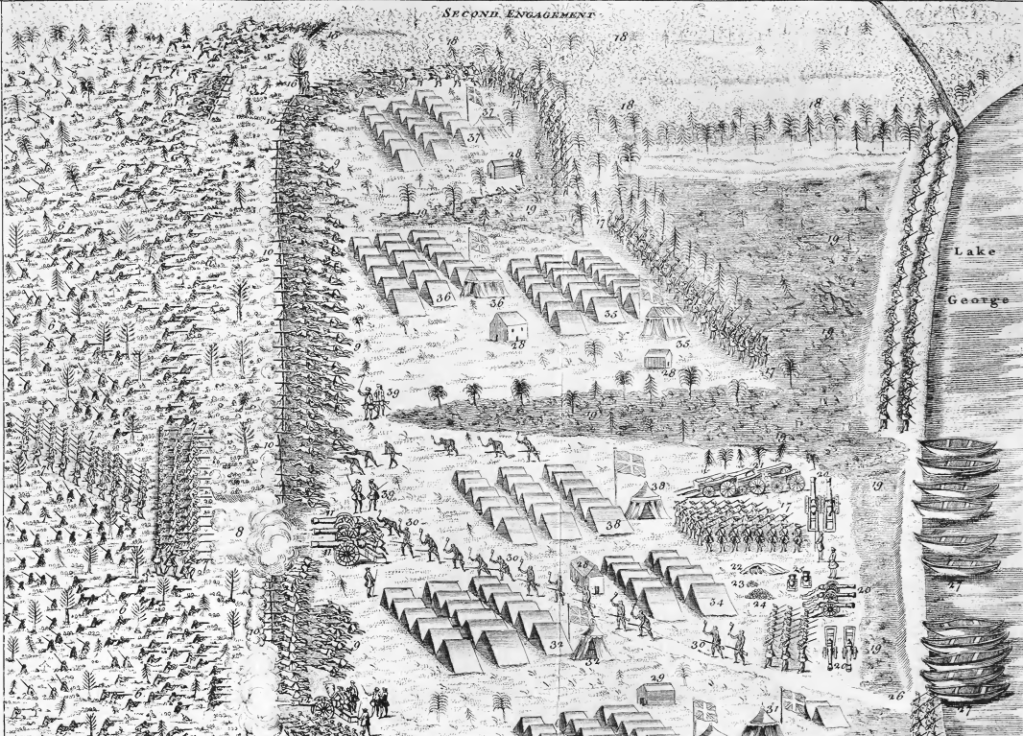
Colonel Seth Pomeroy said of it:

The Fire begun between 11 & 12 of ye clock and continued till near 5 afternoon ye most violent Fire perhaps yet ever was heard of in this country in any battle.

According to camp commander General William Johnson, the Massachusetts regiments took the worst of the onslaught. His report states:

The three regiments [of Massachusetts men] on the right supported the attack very resolutely, and kept a constant and strong fire upon the enemy.

The provincials and their native allies ultimately routed the enemy and captured the French commander. After a bloody third engagement that evening, the provincials declared the day a victory, but one costing hundreds of casualties. In total, one in five men were either killed or wounded.

Given the similar ratio of men reported killed on Peirce’s muster roll, we can assume the Lexington men held the camp’s western line with other Massachusetts companies, using a hastily constructed breastwork of fallen trees as cover for part of the afternoon, then jumping the breastwork to participate in the woods fighting (that claimed several lives at times when guns could be lost.)

No matter what else Robert Munro did during 1758 or any other year of the French War, the Lexington Militia Company had an experienced battle leader on their town common when the British regulars marched up on 19 April 1775.

What About Ensign Robert’s Later Service?

As stated earlier, Robert Munro’s 1758 service is unsupported by the surviving muster rolls, or any other contemporary document. Hudson’s note that Robert was “standard bearer at the taking of Louisbourg in 1758” is curious because that siege was conducted by the British Navy. The only New England troops present were supposedly four newly raised companies of Rogers Rangers. Major Rogers, in his journal, states himself that four of the five companies he raised in January 1758 went straight to Nova Scotia for the Louisbourg campaign under Amherst.

In a sketch of the life of Edmund Munro, another Lexington native who served as a Rogers Rangers adjutant, historian Michael J. Canavan [Canavan, Vol II, p236] says:

Four companies [of Rogers’ Rangers] were sent to Louisberg under Amherst. And Edmund’s cousin, Robert Munroe, was probably in one of these companies.

It’s unclear whether Canavan, who did his research after Hudson, arrived at this conclusion from some now unavailable source or else from deduction based on 1) Hudson statement that Robert was at Louisbourg in 1758 and 2) Knowledge that the only provincials at Louisbourg in 1758 were Rogers’ Rangers.

Is there any evidence Munro was in the Rangers at all, much less in one of these companies?

Robert Munro, Possible Ranger

The organization of British forces changed considerably after 1755. In that year, Captain Peirce formed his company under the authority of the Governor Shirley of Massachusetts. Peirce and his officers (including Munro) received commissions signed by the royal governor, who also happened to be leading a military campaign.

After 1755, disagreements between Shirley of Massachusetts and the new commander of British forces in North America, Lord Loudon, limited the involvement of provincial troops. The 3000 troops raised by Massachusetts for the 1756 campaign waited in vain for orders. Frustrated by the waste, in 1757 Massachusetts raised only 1800. So, while Peirce and Munroe may have raised another company for 1756, they likely did not for 1757.

Meanwhile, Lord Loudon’s second in command, Abercrombie, engaged with New Hampshire native Robert Rogers to build up several companies of rangers. One company in 1756 was quickly followed by a second. Two more were added by 1757, including one that came under the command of a Littleton man: Captain Charles Bulkeley. Men for Rogers’ first two companies were mostly from NH, but by 1757 Rogers was also recruiting in Massachusetts.

Names appearing in Bulkeley’s August 1757 roll [Rogers, p27] match men born in Lexington who had moved to the Littleton area: Benjamin Bridge, Josiah Hastings, Abraham Munroe, Abraham Scott, and possibly others. Bulkeley made his will that year in Halifax, so the men probably served in Nova Scotia.

Further strengthening the connection between Lexington and the Rangers: Captain Peirce’s company included two Littleton men named Bulkeley, Joseph (who was killed in the Lake George fight) and Peter (who deserted). Joseph, Peter and Captain Charles were all sons of Joseph Bulkeley of Littleton, b 1712, 1715, and 1717 respectively [Jacobus, p148]. Charles made Peter his sole heir in his 1757 will. Of the three, only Peter survived the war, married, and raised a family in Littleton. Joseph and Peter would have been 40 and 38 in 1755 when they were private soldiers in Peirce’s company, only a few years younger than Robert Munro.

Given these connections, Robert Munro might have been the first in the Lexington area to hear about Rogers Rangers. The Rangers recruited Bulkeley in Littleton Mass for 1757. Bulkeley knew local men (including brother Peter) from Peirce’s company, who may in turn have directed Roger’s recruiters to their comrades living deeper in Middlesex county.

In January 1758, Robert Rogers received orders to raise five new companies of rangers. Rogers wrote:

I immediately sent officers into the New England provinces where, by the assistance of my friends, the requested augmentation of Rangers was quickly completed, the whole five companies being ready for service by the 4th day of March. Four of these companies were sent to Louisburg to join General Amherst, and one joined the corps under my command.

The one company that joined Rogers at Crown Point included Ensign Robert’s 20-year-old cousin, Edmund Munro, who served as Rogers’ adjutant that year. I find no evidence Robert was in this company. I’ve seen assertions that Robert is named in Edmund Munro’s orderly book, but I found only an unrelated “Doctor Munro” in the copy the Lexington Historical Society provided me, so I believe this claim to be in error.

Massachusetts raised many men for the 1758 campaign in New York, but if Robert served with a provincial company his name would arguably appear in the billeting records. Since no one tried to get Massachusetts to paid for feeding him on his way to New York or back, he probably (but not definitively) never made that trip as a Massachusetts officer or private soldier.

By elimination, if Robert didn’t serve with Massachusetts, and wasn’t in the same company of rangers in New York as his cousin Edmund, the remaining option (if Robert served at all) is that Robert went to Louisburg. And only rangers went to Louisburg.

One more point suggests Hudson had access to sources we no longer enjoy: He says “Ensign Robert Munroe” served in 1758, but “Robert Munroe” in 1762. Since he was specific about the use of the title, he seems to have only used it where he had documentation. So, Hudson must have had reason to believe Robert served as an officer that year, probably the same source that told him Robert went to Louisburg.

All of which leads to the following plausible French War service for Robert Munro:

  • 1755: Documented Ensign of Peirce’s Co. Battle of Lake George.
  • 1756: Possible 2nd year with Peirce but not deployed.
  • 1757: Peirce’s co. probably not raised. Munro stays home.
  • 1758: Munro probably joined Rogers Rangers as an officer in January, before Massachusetts raised any men. Sent to Louisburg.
  • 1759: Possible 2nd year with Rogers Rangers.
  • 1760: Possible 3rd year with Rogers Rangers.
  • 1761: Rogers Rangers disbanded.
  • 1762: Documented private soldier in Whiting’s Company.
I confess so some mild skepticism about the last year. After years of service as an officer, why would Robert, at age 50, serve as a private in 1762? It seems possible Robert’s 17-year-old son Ebenezer, a minor, used his father’s name to join his cousins Stephen and Josiah without permission.

Or perhaps Robert had simply grown weary of leadership.

Sources

Blodgett, Samuel, Prospective Plan of the Battle Near Lake George, November 1755: Description and illustration.

Effingham de Forest, Louis, The Journals and Papers of Seth Pomeroy, Sometime General in the Colonial Service, 1926: Battle description, number of men killed, etc.

Hough, Franklin B., Journals of Major Robert Rogers, 1883.

Hudson, Charles, History of the Town of Lexington and Genealogical Record, 1868.

Hudson, Charles, History of the Town of Lexington, Revised and Continued by the Lexington Historical Society, 1912.

Jacobus, Donald, Bulkeley Genealogy, 1933

Johnson, Sir William, Report to Governors, Sep 9, 1755

Lexington Town Records, 1755-1778 Town Meeting Records, Tax Returns, Town of Lexington Online Archive

Munro, Edmund, Rogers Rangers Orderly Book, 1758, Lexington Historical Society

Rogers, Mary Cochrane, A Battle Fought on Snow Shoes, 1917.

Sewall, Samuel, History of Woburn, 1868.

Winslow, General John, 1755 Journal, Nova Scotia Historical Society.
Who Were John Hancock’s Lexington Friends?

Hancock lived in Lexington as a boy, and small-town boys all know each other.

In April 1775, learning about Parliament’s orders for his arrest and execution, John Hancock hid out in Lexington. As one descendant of the 1775 minutemen put it, Hancock “sought shelter at such a moment among kindred and friends.” [Muzzy, p380]

Hancock’s relationships with his Lexington “kindred”, Reverend Jonas and Lucy Bowes Clark, are well documented, but who were his “friends”? A search turned up nothing concrete. I found no mentions of any interaction between Hancock and any Lexington resident other than Reverend Clark himself.

That said, John Hancock reportedly lived in Lexington as a boy, and small-town boys know each other. They attend grammar school and play together after church on Sundays. They wrestle and hunt frogs in the swamp and whatever else provincial boys did in the 1740s. Hancock may have only lived full-time in Lexington for a year or two (sources differ), but even while attending Boston Latin School he is said to have returned for summer holidays while his mother lived at the parsonage. In later years he returned to visit his “Grandmama”.

So perhaps it is no coincidence that many prominent Lexington participants on 18-19 April 1775 were men born within a year of Hancock. They knew the ordinary minister’s son before he inherited massive wealth and became the face of the patriot cause, which arguably conferred a special status no matter how little adulthood interaction occurred.

The 1912 edition of Hudson’s History shows eleven men born within a year of Hancock who still lived in Lexington in 1775. Their names are listed below along with a snippet of what they did to help the patriot leader on 18 April 1775.

Edmund Munroe

One year older than Hancock. Sources place Edmund, a French War officer, at the parsonage the night of 18 April with the guard detail organized by his younger brother. Edmund later accompanied Hancock and Adams to Woburn, then returned with Revere and Lowell. He is said to have vouched for them at Buckman Tavern when they went to fetch the trunk of Provincial Congress Papers. [Canavan]

Some (including Canavan) have speculated Edmund had wavering loyalty to the patriot cause, but more likely he simply kept his activities quiet until the war broke out. He is said to have drafted the rules for the Lexington Militia Company and captained a detachment of the alarm list within weeks of the fight. Not the activities of a Crown loyalist.

Francis Brown

One year younger than Hancock, Francis also guarded the parsonage on the night of 18 April. He then helped spread the alarm and accompanied Hancock and Adams to Woburn with Edmund and William Munro. He returned in time for the fight, where he fended off a British sword with his musket barrel as he retreated up Bedford Road. In the afternoon he was wounded as the British retreated through Lexington. He lived with a musket ball lodged in his head for a year before having it removed. [Canavan, Hudson]

William Tidd

Six months older than Hancock, William lived two doors up Bedford Road. He served as Parker’s lieutenant in the militia. Sources suggest that, on a prearrangement with Captain Parker, Hancock summoned Tidd the moment Revere arrived to direct the spread of the alarm around Lexington.

In 1789, newly elected U.S. President George Washington visited Lexington. On his arrival, Washington first asked “Where is Leftenant Tidd, who stood with Captain Parker?” Before the trip, Washington visited Hancock (then Governor of Massachusetts) in Boston, who presumably gave him Tidd’s name. Not clear how he would have learned it otherwise. [Munroe]

Thaddeus Harrington

Three months older than Hancock, Thaddeus loaned his horse to Elijah Sanderson on the night of 18 April so he could follow the suspicious party of British officers. (Reverend Clark loaned his to Solomon Brown). Thaddeus was on the common the following morning and signed one of the depositions. [Phinney, p31]

Joshua Simonds

Eight months older than Hancock, Joshua was in charge of the militia’s magazine stores in the meetinghouse gallery. After filling powder horns as the British approached, he prepared to blow up the remaining powder, with himself and the meetinghouse, “rather than to have it fall into the hands of the enemy.” [Simonds]

Four More Documented Militiamen

One year younger, John Bridge Jr was on the common the morning of April 19 and served with William Tidd as a lieutenant under Parker in June. Joseph Mason, the town clerk and later schoolmaster, was on the common. He was six months older than Hancock. Benjamin Merriam (five months younger) and Bill Smith (one year older) are on militia lists. [Hudson]

The Two Conspicuously Absent

The only Lexington men Hancock’s age absent from fight records are two French War veterans, Henry Harrington and David Fisk. Both made contributions during the revolution. Henry had combat experience. Henry’s seven brothers were all on the common.

Henry arguably was, too, just didn’t want his name on a list the British might compare with those who took loyalty oaths to the King during their military service.

The same (admittedly speculative) argument goes for David Fisk.

How Close Was Hancock to These Men?

It’s one thing to conclude Hancock had known many Lexington men for decades. We can even argue that some of Lexington’s loyalty to the patriot cause stemmed from personal connections with John Hancock and his family.

Beyond that, little is known. What nicknames did they call each other? Did they get along or argue? Did they occasionally meet for drinks at Buckman Tavern? Did one of these men give Hancock the “fine salmon” that famously left Lexington with him?

Unfortunately, without records we can only speculate.

Sources:

Canavan, M. J., “The Canavan Papers”, 1912

Hudson, Charles, “History of Lexington”, 2nd Edition, Two Volumes, 1912

Munroe, Sally, “Washington’s Visit to Lexington Nov 5 1789”, Lexington Historical Society Proceedings, Vol I, 1889, p xxxvi – xlii

Muzzey, A. B.: “Battle of Lexington”, New England Historical and Genealogical Register, p377-393, October 1877

Phinney, Elias, “History of the Battle of Lexington”, 1825

Simonds, Eli, “Echoes of the Lexington Bell”, Boston Globe, 17 July 1895

Lieutenant William Tidd

Captain Parker had a lieutenant named William Tidd standing next to him at the start of the fight. Little has been written about him. This post summarizes findings from an initial search of known sources.

Early Life

William Tidd was born in northern Lexington in 1736, the seventh of ten children to Daniel and Hepzibah (Reed) Tidd. William’s parents descended from two original proprietors of Cambridge Farms (as Lexington was first called), John Tidd and William Reed. William took his name from his mother’s side; his grandfather William “Captain” Reed had been the town’s largest landowner, and his uncle William “Squire” Reed was a prominent town leader for the first half of William (Tidd)’s long life.[1]

William Tidd’s father Daniel served as town selectman and assessor almost as long as his brother-in-law. Daniel bore the title “Ensign”, which first appeared in 1746 town records during King George’s War, the third of four conflicts between Britain and France. Daniel is conspicuously absent from town meetings from 1743-46, so he probably served as a militia officer during those years. Daniel’s years of civil and military service set a precedent his son would later repeat.[2]

William Tidd lived his entire life on a farm off Bedford Road (now Hancock Street), two doors up from the Hancock-Clarke parsonage, about a mile north of Lexington Common. The land had once belonged to his grandmother Lydia Tidd. Daniel Tidd appears to have built the “old Tidd House” around 1730, a dignified two-story colonial that still stands today (in 2024). Affluent if not wealthy during his lifetime, William owned 75 acres of fields and woodlots at the time of his death, plus half a pew in the meetinghouse.[3]

The Seven Years War

Like many in their early twenties during the last war with France (aka the Seven Years War (1755-1762) or the French and Indian War, depending on which nation’s history book is referenced), William served in the town militia. Most records have been lost, but the name “William Tidd” appears on a 1759 list of men in Lexington’s “military company of foot” who received bayonets. Other men listed on the same roll: John Parker, Francis Brown, Jonathan Harrington, and a half-dozen more who would stand with William on Lexington Common sixteen years later.[4]

The French War took a heavy toll on the Tidd family. After the failed English campaign at Lake George in 1758, William’s 18-year-old cousin Samuel succumbed to one of the deadly diseases sweeping the camp. William’s older brother Daniel, 32, whose name appears on provincial regiment rolls, likewise did not survive the war (circumstances unknown).[5]

War with France ended for good in 1762 with British victory in North America. In 1766, William married Ruth Monroe, daughter of Ensign Robert Munro. Their marriage lasted sixty years.

Unusual for the era, they had only one daughter (also Ruth) in 1767, which suggests complications that prevented future children. I imagine William and Ruth closely examined the newborn girl’s hands and feet. William’s grandmother Reed had been born with extra fingers and toes, and it was said the condition would reappear every few generations.[6]

In the pre-revolution years, William spent most of his time farming. He and brother-in-law Daniel Harrington rented the town’s “best meadow” in 1768. He occasionally worked on Reverend Clark’s farm with his oxen. He held minor town officers: deer reeve and fence viewer, surveyor of highways and tythingman. His name appears frequently in town records related to providing clothing, food, and housing for the town poor.[7]

The Revolution

William (with several other Lexington men) had known revolutionary leader John Hancock since they were boys. After his father’s death, Hancock lived with his grandfather at the town parsonage, two doors from the Tidd farm. For some period (sources differ, but likely several years), William and John attended grammar school and Sunday services together.[8]

Thirty years later, fate would have Hancock hiding out in Lexington surrounded by his “kinsmen and friends”.[9]

In February 1775, William’s militia experience and standing in the community proved sufficient for his selection as Captain Parker’s sole lieutenant in the volunteer Lexington Militia Company. Others in town had more military experience, but had also taken loyalty oaths that, before the outbreak of hostilities, may have created unacceptable legal risk. As Edmund Munroe, a French War lieutenant from Lexington, reportedly said, “I’m with you boys. I won’t help you get into trouble. But if you do get into trouble I’ll help you get out.”[10]

Several anecdotes attest to William’s leadership. On the night of April 18, the militia drilled at his house. When Paul Revere brought news of the approaching regulars, William directed the spread of the alarm around Lexington. And as Pitcairn’s detachment approached the Common, William stood next to Captain Parker at the front of the line.[11]

Standing behind Parker and Tidd were William’s younger brother Samuel, several Reed and Tidd cousins, in-laws Samuel Hastings and Amos Marrett and the many Munros, plus other extended relatives and neighbors. As much a family meeting as any of Reverend Clarke’s Sunday services.[12]

The shooting reportedly lasted fifteen minutes.[13]

After the fight, William signed a carefully worded joint deposition stating he was one of Parker’s men already dispersing when the regulars began shooting, shots that occurred before any gun was fired “by any person in our company”.[14]

In an 1825 individual affidavit, William added:

I then retreated up the north road, and was pursued about thirty rods by an officer on horseback (supposed to be Maj. Pitcairn.) calling out to me, “Damn you, stop, or you are a dead man!”

I found I could not escape him unless I left the road. Therefore I sprang over a pair of bars, made a stand, and discharged my gun at him; upon which he immediately turned to the main body.[15]

William’s activities later in the day on April 19th are unknown, though he continued his one-year term as lieutenant of Parker’s Company during the Siege of Boston. He is named with those from Lexington who served in the 1776 campaign to White Plains. For the remainder of the war William served on town committees charged with raising men to serve in the continental army. [16]

During this time William lost his parents, both then in their early eighties.[17]

In September 1777, William paid (with others) to send an additional soldier to Bennington during the Saratoga campaign. That soldier was probably Adam Tidd, a slave purchased in 1752 by William’s father. After serving three years (at least), Adam settled in Boston a free man, married and raised a family. Adam’s son, Porter Tidd, became a popular musician and early civil-rights activist.[18]  

Later Years

For the next twenty-five years, William served frequently as town selectman and/or assessor alongside several other veterans of Parker’s Company. According to 1787 town meeting records, he organized the town’s response to Shay’s Rebellion. In 1795, he oversaw the fundraising for the construction of new schoolhouses.

His only daughter married Nathan Chandler in 1785. William and Ruth soon had three grandchildren: a girl and two boys, who grew to marry into the Mulliken and Harrington and Mead families.

William finally retired from public service in 1799, succeeded by his son-in-law. The Honorable Nathan Chandler went on to serve as town selectman, representative, and state senator for the next three decades. Chandler’s eldest son followed in his father’s public service footsteps. Both sons served in the town rifle company.[19]

According to Reverend Clark’s journal, William transacted some minor farm business with the parson. Working with his oxen, selling food, etc. Wiliam also paid the minister interest on a bond held by Clark’s sister-in-law, Elizabeth Bowes, who fled Boston during the siege. Perhaps to fund her relocation Ms. Bowes sold some possessions to the Tidds, who paid in installments.

Anecdotes suggest he was known as “Master Tidd” around town. Daniel Harrington’s children (and likely many others in William’s extended family) called him “Uncle Bill”.

Years later, he was remembered by A.B. Muzzey as short of stature, with a compact frame and an erect gait, active even in old age. Children passing his farm on their way to school often found working outside.

William wore a red wool cap of a revolution veteran—possibly of the Phyrgian liberty style—to Sunday meeting. He “belonged to the old school, who kept their seats in their pews after the service and bowed to the minister as he passed out first.”[20]

William lived to see several great-grandchildren (Ruth, their great-great-grandchildren). William died in 1826, his 91st year, retaining his faculties “to a great degree” until the end. Ruth, “a fitting partner”, lived thirteen more years, to age 97.[21]

The Handshake

One moment speaks to William Tidd’s reputation more than perhaps any other on record.[22] In November 1789, a year after William stepped down as selectman, George Washington visited Lexington on his first tour of the country as its new president. Standing on the Common with the town’s new leadership and many veterans of “the fight”, Washington asked for one man by name:

“Where is Leftenant Tidd, who was next to Captain Parker?”

They brought William forward. Washington offered William “a fine grasp of the hand”. The two old soldiers, one who happened to be the first President of the United States, shared a moment in the place where, fifteen years before, a fifteen-minute firefight precipitated the existence of a great nation.

According to witnesses, neither man saw the need to speak.

Sources

Barry, John Stetson, The History of Massachusetts, The Provincial Period (Volume 2), 1857.

Calabrese, Carmin F.: Lieutenant William Tidd, Retrieved from LexingtonMinutemen.com 2024

Canavan, M.J., Canavan Papers, Three Volumes, 1912

Force, Peter, American Archives 4th Series Volume II, Undated

Gordon, Rev. William: Letter to Englishman, 17 May 1775, Reprinted by the Philadelphia Gazette 7 June 1775 (Retrieved from Newspapers.com Feb 2024)

Gosse, Van: The First Reconstruction: Black Politics in America from the Revolution to the Civil War, 2021

Hudson, Charles: History of the Town of Lexington & Genealogical Register (G. R.), 1868

Hudson, Charles: History of the Town of Lexington, Revised and Continued by the Lexington Historical Society, 1912

LHS I: Lexington Historical Society Proceedings Vol I, 1889

MMR-93: Massachusetts Muster Rolls 1749-1755, Volume 93, Microfilms on FamilySearch.org, Retrieved Jan 2024

MRR-15: Massachusetts Soldiers and Sailors of the Revolutionary War, Volume 15, 1907

Phinney, Elias: History of the Battle at Lexington, 1825

Sewall, Samuel, History of Woburn, 1868

Signatures

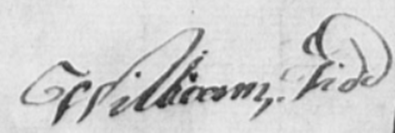
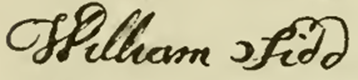
Two signatures believed to be from William Tidd’s hand survive. The first comes from Lexington’s 1780 Assessor’s Book.

The second (shown at the top of this post) comes from a 1776 oath of allegiance to the “United American Colonies”.


[1] Hudson 1868, G.R., p240-4; Hudson 1868, G.R., p191-2; Woburn and Lexington vital records, plus Ancestry.com searches, show no earlier Tidd of the name William.

[2] Hudson 1868, p403-5; Hudson 1912, Vol II, p698

[3] Hudson 1868, G.R., p38,41; Canavan, Vol 1, p14; Calabrese, p1

[4] Hudson 1912, Vol I, p417; Barry, Vol II, p235-6; Lexington Historical Society, Pew Deeds

[5] Barry, Vol II, p194-96; Sewell, p555-556; MMR-93, image #449; Hudson 1868, p243

[6] Hudson 1868, G.R., p191: Grandmother Abigail Kendall Reed polydactyly.

[7] Lexington Town Records, 1755-1778.

[8] Hudson 1912, Vol II: Men living in 1775 Lexington born within a year of John Hancock (therefore likely grammar school classmates, etc.): John Bridge, Francis Brown, David Fisk, Henry Harrington, Joseph Mason, Benjamin Merriam, Edmund Munro, Joshua Simonds, and William Tidd.

[9] A. B. Muzzey, “History of the Battle of Lexington”, Oct 1877, NEHGR.

[10] Canavan, Vol II, p268;

[11] Phinney, p37; Phinney, p36: Ebenezer Munroe stated, “Lieut. Tidd requested myself and others to meet on the common”; LHS-I, p xxxix

[12] Hudson 1868, p384; Hudson 1912, Vol II, p698

[13] See Gordon for Paul Revere’s estimate.

[14] Force p492

[15] Phinney p37-38

[16] Hudson 1868, pp385, 388, 391-2; “William Tidd” is also listed with three years on the Continental Line, however the conflict with his town service raises the question of whether a younger cousin (born in New Braintree with the same name) filled the Lexington quota.

[17] Hudson 1868, G.R., p243;

[18] Hudson p389; LHS Archives [71 MSS in Ledgers: Book W. p. 55, Bill of Sale for a Slave Boy]; MRR-15, p469 “Teed, Adam”, p 730 “Tidd, Adam”; Ancestry.com records; “Eastern Argus Tri Weekly,” 1833-12-09, pg. 2 [Retrieved from Newspapers.com Mar 2024]; Gosse p197-200

[19] Hudson 1868 p403-5; Hudson 1868, G.R., 40-41;

[20] G.W. Sampson, LHS-I, “Robert Munroe”, p39, p xxxix;

[21] 1820 Census Records, Lexington, “Nathan Chandler”; Ancestry.com records; Hudson 1868 p244

[22] Sally Munroe, LHS-I, “Washington’s Visit to Lexington”, p xxxix