A 300-year-old Lexington home might deserve a new historical marker.
On the morning of 19 April 1775, Lt. William Tidd called out the Lexington militia on news the British regular army was marching up the road. He stood on the town green beside Captain Parker as their band of “sixty or seventy” faced hundreds of trained soldiers. Once the shooting started, Tidd was one of the first handful of Americans to fire his gun.
This post presents evidence that the lieutenant’s 1775 lived a half mile up Bedford Road (now Hancock St) from the Clark home, where Hancock and Adams stayed that night, and also that the Tidd residence may well still be standing today.
First, we establish the location of the land on today’s Hancock Street once owned by Lt. Tidd’s grandmother, widow Lydia Carley Tidd.
We then establish that a house on this land was owned in 1868 by Lt. William Tidd’s grandson, Nathan Chandler, who said his grandfather Tidd lived there before him. We also present an eyewitness record stating that Tidd lived in an old colonial, not a new construction built after the Revolution.
Finally, we have a house still standing today at this location with a “Circa 1730” plaque on it. Is this the house Lt. William Tidd lived in on 19 April 1775, and perhaps for his entire life?
Here is what the record says.
Widow Tidd’s Land
According to Hudson, Lt. William Tidd’s paternal grandparents, Daniel and Lydia Carley Tidd, married 4 Dec 1694 and had two children, Daniel Jr and Mary. Daniel Sr, who is on the early Cambridge Farms proprietor lists with his father and two (of three) brothers, died 29 Feb 1996—Feb 1697 on modern calendars—leaving Lydia a widow.
Where did Lydia live? The Tidds, like most families who settled from Woburn, inhabited the northern part of Lexington. Despite her age, the young widow appears to have lived independently, since in 1699 the town granted her a license to run a public house. (This was a common practice at the time since it provided a source of income and kept widows without another trade from becoming dependent on the town for support.)
Where specifically did Lydia reside? Pages 13-14 of Michael J. Canavan’s notes on the Cambridge Farms Proprietor’s records include a 1703 report of the plan to lay out the town highway that became Hancock Street. It states that the new highway crossed the road leading from Concord to Woburn, then
“. . .through Jos. Symonds, his land, and so along Lydie Teed’s land and from there to Benj. Bates fenced on both sides and through sd [said] Bates’ land fenced on both sides to Jno. Hancock’s land and through it, fenced on both sides, and so along upon Benj. Muzzy’s land on the westerly side of Muzzy’s fence that now is until we came to Country Road by the Meeting house.”
Therefore, going north along Hancock Street from the meetinghouse, the landowners along what became Bedford Road in 1775 and Hancock Street today were: 1) Benjamin Muzzy, 2) Reverend John Hancock, 3) Benjamin Bates, and then 4) Lydia (Carley) Tidd.
It appears this Benjamin Bates owned land on both sides of Hancock Street. This appears to be the land that Jonas Parker and Dr. Joseph Fiske lived on in 1775. Lydia Tidd, by contrast, may have not owned the land on the other side of the road.
Another town meeting note from 27 February 1715, that appears to relate to planning for the road that became present-day Adams Street, shows Widow Tidd still owned the land years later. It states:
“Beginning at the town way that leads from the meetinghouse to the widow Liddia Teeds, and so to run north easterly. . .”
These notes appear to clearly place Lydia Tidd’s land one farm (Bates’) away from the Clark-Hancock Parsonage.
From Lydia Tidd to Lt. William Tidd
How do we know Lt. William Tidd resided on his grandmother’s land? The first piece of evidence comes from the process of elimination. Lydia’s only son Daniel would have inherited her property (Lydia and Daniel Sr.’s only other child, Mary, is mentioned in her grandfather 1702 will but afterwards she disappears from the record.) It is possibly no coincidence that no further references to Widow Tidds land appear in town meeting records after 1716, about the year Daniel Jr would have turned 21.
That said, Lydia Tidd lived another decade. On 31 March 1721, the town approved payment for her care of her own sister, Rachel Carley. The town approved additional payments in August 1724, Feb 1724/5, March 1725, and Jan 1725/6. Hudson’s Gen. Record, p242, says Lydia died 15 Aug 1727, age 55.
William had three brothers. The eldest, Daniel 3rd, died during the French War. Amos was also older, but for some reason worked for Parson Clark and then left town, eventually ending up in a boarding house in Hopkinton. William’s younger brother Samuel also moved away.
William, the only son left, therefore inherited his father’s home. Alone this might not be convincing, but there is fortunately a great deal of further evidence.
The Home of Lt. William Tidd’s Grandson
We can pin down Lt. William Tidd’s residence with greater certainty by working in the other direction. Hudson’s History (p42) says “The [1868] home of Mr. Nathan Chandler was originally a Tidd place.” This presumably means the Nathan Chandler living in 1868 whose father, Nathan Chandler Sr. had the same name.
Page 38 of Hudson’s Genealogical Record says Nathan Chandler Sr. married Ruth Tidd, only child of Lt. William and Ruth Tidd, who “lived on Hancock street, where Nathan Chandler [Jr] now resides, it being the homestead of his father-in-law.”
Further, page 41 says Nathan Chandler Jr, who was still living in 1868 at age 76, resided “on the old Tidd place on Hancock St. where his grandfather Tidd resided.”
So, Hudson was convinced Lt. William Tidd lived where the Chandlers did later. However, he provides no further details that would help pinpoint the location of Nathan Chandler’s house.
Fortunately, John Hales 1830 map shows “Chandler” lived on Hancock Street a little further up from the Common than present-day Revere Street. This was probably Nathan Chandler Sr, who was a state senator during those years and one of the most respected members of the community. Notably, Lt. Tidd’s widow, Ruth Munro Tidd, was still living in 1830 and probably resided with her only child, Chandler’s wife (also Ruth).
Partial Map of Lexington, John Hales, 1830
It’s worth noting the 1830 map shows two homes. We found the same two homes on H.F. Walling’s 1853 map, which shows the northerly home belonged to “N. Chandler” and the southerly home belonged to “W. Chandler”. (Nathan Jr’s brother William died in 1848, so this W. Chandler was probably William Chandler Jr, Nathan Jr’s nephew.) Therefore Lt. Tidd lived in the northerly home.
Partial Map of Lexington, H. F. Walling, 1853
A. B. Muzzey’s Description of William Tidd’s Home
A final piece of evidence that William Tidd resided there comes from A.B. Muzzey’s 1882 “Reminiscences & Memorials” [p374-5], who remembered that, for one season, he walked by William Tidd’s farm on his way to school. Both the 1830 and 1853 maps show a school on what became North Hancock Street. If A.B. Muzzy walked to that school from his father’s house on Cambridge Road, he would have walked up Hancock Street past the Tidd farm.
Notably, Muzzey described Tidd’s home as “a venerable mansion of the ancient, rectangular style.” This suggests Tidd did not live in a new home he built on his land later in life, but rather in an old colonial that was already “venerable” in the early 1800s when A.B., born in 1802, passed as a boy.
Such a home still exists today.
A House Matching All the Facts
There is a pre-revolution colonial standing on Lydia Tidd’s old land. It is privately owned, so I will not show a photo or provide an exact address, but the building in question bears a plaque “Circa 1730”.
Assuming that is true, how likely is it that a two-story colonial built on Lydia Tidd’s land within a few years of her death was not the residence of her only son, town selectman and provincial army officer Daniel Tidd? How likely is it that this then-new mansion house was not also the home Lt. William Tidd grew up in? How likely is it that, in 1775, Lt. William was not living in the house his father gave him prior to writing his 1773 will?
Muzzy and Chandler’s statements suggest Tidd almost certainly lived there later in life. Perhaps some unreviewed deeds or family letters will surface that confirm he also grew up in this house and lived there in 1775 when he was called out in the middle of the night to muster the militia.
The odds appear high that he spent most, perhaps all, of his ninety years there. Perhaps “Circa 1730” should be changed to
“The home of Lt. William Tidd, who stood beside Captain Parker on Lexington Common on 19 April 1775, and was one of the first Americans to fire back at the British in the War of Independence.”
The post explores the role British flank guards might have played in the morning fight on Lexington Common on 19 April 1775.
A Few Known Facts
The existence of regular troops flanking the main column of Smith’s forward light infantry detachment (commanded by Major Pitcairn) is documented by Lieutenant William Sutherland, the volunteer from the 38th Foot who led the front party charged with capturing any provincials they met on the road.
Sutherland’s report of the events of 19 April 1775 states that, sometime after daylight, after waiting with prisoners for some time:
We turned back [down] the road we came and found the division, who had halted in consequence of the intelligence [that armed militia awaited them at Lexington] in order to make a disposition by advancing men in front and on the flanks to prevent a surprise.
From Sutherland’s report [Murdock, p16], it seems clear that Major Pitcairn ordered flanking guards on both sides of the road and kept them there as they approached Lexington Common.
Which light infantry troops were deployed? Evidence suggests they were drawn from different companies, since Private James Marr of the King’s Own (4th) Light Infantry was part of the front party led by Lt. Sutherland of the 38th and Lt. Jesse Adair of the Marines. Perhaps the flank guard also consisted of mixed company.
What did the flank guard do? Light infantry flanking procedures are described in Townshend’s Rules and Orders for the Discipline of the Light Infantry Companies in His Majesty’s Army in Ireland [Smythies, p550]:
The Light Infantry must be careful not to fall into ambuscades when they are marching through a wood or any enclosed country and care must be taken to advance a guard, and to detach flanking parties, the flanking parties to march in front and the files to move at the distance of ten yards from each other, when either of these parties shall discover an enemy they are not to run into the main body but to take posts immediately and begin an attack . . .
From Townshend we conclude Pitcairn’s light infantry flanks were trained to deploy in two-man teams (files) spaced ten yards apart in a line at the front of the main column.
Whether they deployed on 19 April in according with Townsend’s instructions in unknown. Also procedures may have varied between regiments posted in Ireland (the 38th and 5th) and those, say, posted in Canada (the 10th), but it is hard to imagine how the instructions might have materially differed.
What Can We Deduce?
Since marching on a road was invariably easier than through woods and fields, we can imagine the flank guard had a hard time keeping up with Sutherland’s front party. Nevertheless, the final approach from Amos Muzzy’s house to Buckman Tavern supposedly included gardens, orchards and sheep pastures (not heavy woods, steep hills, or impassable rock piles) [Canavan, p123]. We can therefore assume the flanks approached Lexington Common with relative ease, arriving with or shortly after Sutherland, who reportedly first stopped 12-15 rods from Parker’s Company [Phinney, p35], evidently at the road junction below the meetinghouse.
Note: According to Sutherland, Pitcairn also deployed flankers to the left of the main column, who would have ensured no armed militia threatened from the south side of the road. Their role in the morning fight appears negligible, hence we ignore them.
The Right Flank Position
It’s notable that the right flank would have approached the rear of Buckman Tavern and the barn and stables east of Lexington Common, where they would have limited visibility of Parker’s Company. Captain Parker and his men may likewise have been unaware of their presence.
Their Orders
Communication between the main column and the flanks was limited to 1) signals, e.g. played on pipes and drums and 2) messengers. Its reasonable to assume they had different instructions from the main column, both intentionally and simply because they did not see and hear everything with the rest of the troops.
This idea raises several questions.
Did Pitcairn specifically order the flankers not to fire unless ordered (like he did the main column)? All reports suggest the main body of Pitcairn’s detachment did not load until just before reaching the common (after the flankers were ordered out). Likewise Pitcairn’s orders to hold fire unless ordered came then. Did those orders reach the flanks? Were their orders different?
Furthermore, did Pitcairn explicitly prohibit the flanks from discharging their arms if attacked? If not, it stands to reason that Townsend’s instructions to immediately engage the enemy would dictate their actions.
Finally, did the flankers have orders to shoot escaping prisoners and/or British deserters, as provincial stories imply?
Close To The Early Action
The answers to these questions, along with any role the flankers played in the fight, are undocumented. We can, however, make educated guesses on a few key points.
Sutherland’s Three “Rebel” Shots
First, the likely location of the flankers would have made it difficult if not impossible for the provincials to sneak up on Pitcairn’s men from behind the tavern. This casts doubt on Lt. Sutherland’s claim that “rebels” fired on them from the “end” of Buckman Tavern before the main engagement began. The shots he heard fired from that direction were more likely to have come from the flankers than anyone else.
Porter’s Run
Second, troops guarding Pitcairn’s right flank behind Buckman Tavern would have been in position to observe released prisoners Josiah Richardson and Asahel Porter making their way across Buckman’s land toward the trail to Woburn.
According to sources, Porter was shot and killed while running from the main column, either for attempting escape [Phinney, p36] or because he was mistaken for a British deserter [Dean, p9]. Either way, Porter’s path home would have taken him north of the road, straight past the flank guard. Cousins Amos and Ebenezer Lock found Porter shot about a hundred yards (twenty rods) from the common [Phinney, p38-9] as they approached from their Woburn homes to the north [Lock, p68-72].
Given the distance from the main column, it seems most likely the closer flankers gunned him down.
The “First Shots”
Did the flankers advance with the British on the common? This would be in accordance with their training to stay at the front of the column, which had pivoted north. So doing would place them even closer to the Lock cousins when Ebenezer fired at the British on the common [Phinney, p38-9], a shot his descendants claimed was the first of the revolution taken by an American [Bartlett, p1].
Townsend’s rules of engagement suggest the flankers were trained to immediately return fire. If they did, their gunshots may have tipped the already chaotic scene on the common over the edge into open battle.
Meanwhile, Parker’s men—Nathan Munroe and Solomon Brown, among others—were spilling over the wall onto Buckman’s land, seemingly unaware of the flank guard behind Buckman’s barn. The fact that no one was found dead on Buckman’s land supports the idea that the flankers had already discharged their weapons at the Lock cousins, and were in the process of reloading when the provincial retreat began.
While Parker’s men reportedly had time to fire a few shots, whatever reprieve they found proved short lived. Issac Muzzy was found killed behind Viles shoe shop north of Buckman’s land [Harrington, p3], either by the flankers or the King’s Own light infantry charging off the common.
What Is Certain
This is admittedly a great deal of deduction based on precious little evidence. All we know for certain is 1) British Lieutenant Sutherland reported a flank guard had been deployed, 2) our reconstruction of the fight places the early action off Lexington Common on Buckman’s land, precisely where the British right flank would have been, and 3) Light Infantry procedures dictated immediate engagement with an enemy.
All of which argues the flank guard played a role in starting the first fight of the American Revolution.
An overlooked and misread muster roll contains a fascinating untold story.
A misread muster roll WITH aN untold story
The military record of Ensign Robert Munro, who fell in the first fatal volley fired by the British on Lexington Common on 19 April 1775, lies amidst considerable legend and lore. Some say he served with the famous Rogers’ Rangers. Others say he was the standard bearer at the 1758 Siege of Louisbourg, that he “watched the Indians” in 1762, and then, in his early sixties, served as an officer in the Lexington Militia Company in 1775.
Little of this is backed by surviving historical records.
There still exists, however, an old muster roll showing that Robert and Lexington men under his command fought in the bloodiest fight for the provincials in the entire French War: the 1755 Battle of Lake George.
The Early Life of Robert Munro
Robert Munro was born 4 May 1712, the sixth of nine children of Sergeant George and Sarah Munro. He grew up with numerous cousins in the sprawling “rope-walk” house of his Scottish-born grandfather, forced immigrant William Munro. Lexington had just become a town.
In 1737, Robert married Anna Stone. They lost their eldest son at age two, presumably to an unknown but fatal disease. Four later children, all born in the 1740s, lived to adulthood.
It’s reasonable to assume from Robert’s French War service as an officer that he gained some early soldiering experience with the provincial irregulars, perhaps during the 1740s conflicts with Spain (War of Jenkin’s Ear) and/or France (King George’s War). He was in his late twenties and early thirties during this period. Notably, a Munro cousin succumbed to disease on the trip home from Cuba in 1740, the same year Robert’s son, niece, and nephew all died within weeks. Perhaps young Robert was on the Cuba expedition, too, and carried the same fatal disease home with him
Unfortunately, since his name doesn’t appear in any known records before the 1754-1762 French War, we can only speculate.
Robert Munro in the French War
Lexington town historian Charles Hudson attempted to piece together Robert Munro’s French War a century after the fact. His published history [Hudson 1912, Vol II, p456] says of Robert:
He was a soldier in the French war, was the standard bearer at the taking of Louisburg in 1758, and was again in the service in 1762. He was also ensign of Capt. Parker’s company.
Separately, Hudson’s summary of Lexington’s French War service [Hudson 1912, Vol I, p413-19] includes “Ensign Robert Munroe” on the list of men serving in 1758 and “Robert Munroe” (no title) in 1762.
Is this information correct? The editors of the updated 1912 edition of Hudson’s history searched the surviving muster rolls and failed to find most names listed by Hudson for 1758, including Robert Munro.
There is some evidence Hudson used additional sources. For example, surviving billeting records (taverns invoiced the province for meals and lodging provided soldiers traveling to and from the New York battlefront, some of which survive in Massachusetts archives) show most names on Hudson’s list belonged to companies captained by Cambridge and Watertown men. Robert Munro’s name, however, I failed to find.
Another hint: Since Hudson lists Robert Munro as an ensign for 1758, he seems aware Robert served as an officer during the French War, at least for that year.
But let’s come back to that.
An Unread Muster Roll: Ensign Robert Munro of Peirce’s Company
While several attempts to confirm Robert Munro’s 1758 service have proven fruitless, Hudson’s 1912 edition includes this footnote:
Ensign Robert Munroe is credited, however, in 1756, to Lincoln.
Hudson does not mention any 1756 service for Robert Munro in his 1868 edition, so evidently overlooked the detail. Yet it appears the 1912 editors made a critical error: The roll was prepared 18 February 1756 for the preceding year. The men listed, including Robert Munro, all served in 1755.
With the corrected year, combined with other details preserved in the roll, a remarkable story snaps into focus.
The muster roll in question survives today in volume 94, parchment 76 of the Massachusetts Colonial Records. I found a microfilmed copy at FamilySearch.org in the collection “v.93 Muster rolls (from p80); 1749-1755; v.94A – Muster rolls, 1755-1756; v.94B – Muster rolls (to p.419), 1755-1756)”, Image Group Number 7703435, image 830 of 1759.
Here is the upper left corner:
A few points to highlight:
Munro was a new officer. The roll says that Robert Munro of Lincoln became the ensign of Captain William Peirce’s Company on June 25, so he received his commission that year.
Peirce and Munro were family. Hudson’s history says Peirce was Munro’s cousin, the son of Joseph and Hannah Munro Peirce. Peirce was five years older than Robert. According to Hudson, Peirce lived in Lexington as a child and again as an adult before removing to Stow around 1743. The muster roll, as shown, places him in Stow in 1755.
Munro recruited some soldiers. The 1755 journal of General John Winslow, who led a successful campaign in Nova Scotia that year, states that a prospective officer needed to raise 15 men for a company to earn an ensign’s commission. There are about that number of private soldiers from Middlesex towns Lincoln, Lexington, and Woburn. Since Peirce and his lieutenant were from Stow and Harvard (the latter in Worcester County), it appears Munro delivered on that requirement recruiting men from the towns near home.
Lincoln, not Lexington? When William and Robert formed their company in the spring of 1755, the town of Lincoln had only existed for a few months. (The Massachusetts General Court approved in the creation of the town from parts of Concord, Lexington, and Weston during their 1754 session.) Perhaps Robert, like other Munros, owned land or even resided within the bounds of what became Lincoln at that time. Robert does not appear in Lexington town meeting records until the late 1760s, suggesting years with no involvement in Lexington affairs. He appears to have placed his Lexington land in trust for the benefit of his children (see the 1756 will of Robert’s father-in-law, Lexington selectman John Stone), so may have had no rights or obligations to the town during this time.
A possible Lincoln residence notwithstanding, Lexington appears to have continued to claim Robert as their own: A 1760 marriage record for Munro’s daughter, Anna, and Daniel Harrington contains no mention of her or her father “Ens. Robert” being from anyplace other than Lexington. And by 1767 Robert began to show up in Lexington town records, though he never held any town office. By 1775, it is generally believed he resided in Lexington’s Scotland neighborhood.
The Lexington Men In Peirce’s Company
In addition to Robert Munro as ensign, the muster roll for Peirce’s company includes five men from “Lexinton”: a sergeant, Robert Wilson, and four private soldiers: “Benj Lock”, “Robin Raymont”, “Robert Wilson”, and “Henry Herrington.”
Cross-referencing these names with Hudson’s history reveals the following: Benjamin Lock was the 20-yr-old elder brother of Amos Lock (who fought 19 April 1775). Raymont was probably the colored servant “Robin” that Jonathan Raymond left to his wife Charity in his will. Robert Wilson was probably the son of the sergeant in the same company. Henry Harrington, likewise, was the 18-year-old son of a man by the same name.
So, all four privates were young men.
The muster roll and other sources combine to show the dangers of military service. Raymont is reported “killed Sept 8.” Hudson says Benjamin Lock died of an unknown camp disease in Nov 1755, a month after his 19 Oct discharge. Hudson says one of the Wilsons (father or son is unclear) served again from Lexington in 1758; after that the family disappears from town records.
Perhaps the most interesting feature of the roll is that Robin Raymont was not the only member of Peirce’s company reported killed September 8th, which leads to the obvious conclusion that Peirce’s company saw battle.
A big battle, it turns out.
The Battle of Lake George
The four men of Peirce’s company “killed” on 8 September were Corporal Simon Peirce of Lincoln, Jonathan Barnard of Lincoln, Joseph Bulkley of Littleton, and Robin Raymont of Lexington. Since a fifth man, Asa Brewer of Sudbury, is listed “died” on 5 October, it seems clear the four listed “killed” all died in combat. The roll states “gun lost” for three of the four, supporting the idea they were killed in a place overtaken by the enemy, who stripped them of their arms.
What happened on 8 September 1755? This is the date of the Battle of Lake George, the first big encounter on the New York frontier between British and French forces. Fifteen hundred Massachusetts and Connecticut irregulars (not regular troops from Britain’s standing army), plus two hundred Mohawk allies, had camped on the banks of Lake George in upstate New York, a staging point for a planned attack on the French position at the other end of the lake.
The French came to them first. The battle—recounted in multiple sources including the diary of Lieutenant Colonel Seth Pomeroy and a published account by noncombatant Samuel Blodget—began with a morning ambush by French forces on a column of British provincials marching to Fort Edward, followed by an afternoon assault on the Provincial camp at the lake, during which the Massachusetts men gave and received heavy fire.
Colonel Seth Pomeroy said of it:
The Fire begun between 11 & 12 of ye clock and continued till near 5 afternoon ye most violent Fire perhaps yet ever was heard of in this country in any battle.
According to camp commander General William Johnson, the Massachusetts regiments took the worst of the onslaught. His report states:
The three regiments [of Massachusetts men] on the right supported the attack very resolutely, and kept a constant and strong fire upon the enemy.
The provincials and their native allies ultimately routed the enemy and captured the French commander. After a bloody third engagement that evening, the provincials declared the day a victory, but one costing hundreds of casualties. In total, one in five men were either killed or wounded.
Given the similar ratio of men reported killed on Peirce’s muster roll, we can assume the Lexington men held the camp’s western line with other Massachusetts companies, using a hastily constructed breastwork of fallen trees as cover for part of the afternoon, then jumping the breastwork to participate in the woods fighting (that claimed several lives at times when guns could be lost.)
No matter what else Robert Munro did during 1758 or any other year of the French War, the Lexington Militia Company had an experienced battle leader on their town common when the British regulars marched up on 19 April 1775.
What About Ensign Robert’s Later Service?
As stated earlier, Robert Munro’s 1758 service is unsupported by the surviving muster rolls, or any other contemporary document. Hudson’s note that Robert was “standard bearer at the taking of Louisbourg in 1758” is curious because that siege was conducted by the British Navy. The only New England troops present were supposedly four newly raised companies of Rogers Rangers. Major Rogers, in his journal, states himself that four of the five companies he raised in January 1758 went straight to Nova Scotia for the Louisbourg campaign under Amherst.
In a sketch of the life of Edmund Munro, another Lexington native who served as a Rogers Rangers adjutant, historian Michael J. Canavan [Canavan, Vol II, p236] says:
Four companies [of Rogers’ Rangers] were sent to Louisberg under Amherst. And Edmund’s cousin, Robert Munroe, was probably in one of these companies.
It’s unclear whether Canavan, who did his research after Hudson, arrived at this conclusion from some now unavailable source or else from deduction based on 1) Hudson statement that Robert was at Louisbourg in 1758 and 2) Knowledge that the only provincials at Louisbourg in 1758 were Rogers’ Rangers.
Is there any evidence Munro was in the Rangers at all, much less in one of these companies?
Robert Munro, Possible Ranger
The organization of British forces changed considerably after 1755. In that year, Captain Peirce formed his company under the authority of the Governor Shirley of Massachusetts. Peirce and his officers (including Munro) received commissions signed by the royal governor, who also happened to be leading a military campaign.
After 1755, disagreements between Shirley of Massachusetts and the new commander of British forces in North America, Lord Loudon, limited the involvement of provincial troops. The 3000 troops raised by Massachusetts for the 1756 campaign waited in vain for orders. Frustrated by the waste, in 1757 Massachusetts raised only 1800. So, while Peirce and Munroe may have raised another company for 1756, they likely did not for 1757.
Meanwhile, Lord Loudon’s second in command, Abercrombie, engaged with New Hampshire native Robert Rogers to build up several companies of rangers. One company in 1756 was quickly followed by a second. Two more were added by 1757, including one that came under the command of a Littleton man: Captain Charles Bulkeley. Men for Rogers’ first two companies were mostly from NH, but by 1757 Rogers was also recruiting in Massachusetts.
Names appearing in Bulkeley’s August 1757 roll [Rogers, p27] match men born in Lexington who had moved to the Littleton area: Benjamin Bridge, Josiah Hastings, Abraham Munroe, Abraham Scott, and possibly others. Bulkeley made his will that year in Halifax, so the men probably served in Nova Scotia.
Further strengthening the connection between Lexington and the Rangers: Captain Peirce’s company included two Littleton men named Bulkeley, Joseph (who was killed in the Lake George fight) and Peter (who deserted). Joseph, Peter and Captain Charles were all sons of Joseph Bulkeley of Littleton, b 1712, 1715, and 1717 respectively [Jacobus, p148]. Charles made Peter his sole heir in his 1757 will. Of the three, only Peter survived the war, married, and raised a family in Littleton. Joseph and Peter would have been 40 and 38 in 1755 when they were private soldiers in Peirce’s company, only a few years younger than Robert Munro.
Given these connections, Robert Munro might have been the first in the Lexington area to hear about Rogers Rangers. The Rangers recruited Bulkeley in Littleton Mass for 1757. Bulkeley knew local men (including brother Peter) from Peirce’s company, who may in turn have directed Roger’s recruiters to their comrades living deeper in Middlesex county.
In January 1758, Robert Rogers received orders to raise five new companies of rangers. Rogers wrote:
I immediately sent officers into the New England provinces where, by the assistance of my friends, the requested augmentation of Rangers was quickly completed, the whole five companies being ready for service by the 4th day of March. Four of these companies were sent to Louisburg to join General Amherst, and one joined the corps under my command.
The one company that joined Rogers at Crown Point included Ensign Robert’s 20-year-old cousin, Edmund Munro, who served as Rogers’ adjutant that year. I find no evidence Robert was in this company. I’ve seen assertions that Robert is named in Edmund Munro’s orderly book, but I found only an unrelated “Doctor Munro” in the copy the Lexington Historical Society provided me, so I believe this claim to be in error.
Massachusetts raised many men for the 1758 campaign in New York, but if Robert served with a provincial company his name would arguably appear in the billeting records. Since no one tried to get Massachusetts to paid for feeding him on his way to New York or back, he probably (but not definitively) never made that trip as a Massachusetts officer or private soldier.
By elimination, if Robert didn’t serve with Massachusetts, and wasn’t in the same company of rangers in New York as his cousin Edmund, the remaining option (if Robert served at all) is that Robert went to Louisburg. And only rangers went to Louisburg.
One more point suggests Hudson had access to sources we no longer enjoy: He says “Ensign Robert Munroe” served in 1758, but “Robert Munroe” in 1762. Since he was specific about the use of the title, he seems to have only used it where he had documentation. So, Hudson must have had reason to believe Robert served as an officer that year, probably the same source that told him Robert went to Louisburg.
All of which leads to the following plausible French War service for Robert Munro:
1755: Documented Ensign of Peirce’s Co. Battle of Lake George.
1756: Possible 2nd year with Peirce but not deployed.
1757: Peirce’s co. probably not raised. Munro stays home.
1758: Munro probably joined Rogers Rangers as an officer in January, before Massachusetts raised any men. Sent to Louisburg.
1759: Possible 2nd year with Rogers Rangers.
1760: Possible 3rd year with Rogers Rangers.
1761: Rogers Rangers disbanded.
1762: Documented private soldier in Whiting’s Company.
I confess so some mild skepticism about the last year. After years of service as an officer, why would Robert, at age 50, serve as a private in 1762? It seems possible Robert’s 17-year-old son Ebenezer, a minor, used his father’s name to join his cousins Stephen and Josiah without permission.
Or perhaps Robert had simply grown weary of leadership.
Sources
Blodgett, Samuel, Prospective Plan of the Battle Near Lake George, November 1755: Description and illustration.
Effingham de Forest, Louis, The Journals and Papers of Seth Pomeroy, Sometime General in the Colonial Service, 1926: Battle description, number of men killed, etc.
Hough, Franklin B., Journals of Major Robert Rogers, 1883.
Hudson, Charles, History of the Town of Lexingtonand Genealogical Record, 1868.
Hudson, Charles, History of the Town of Lexington, Revised and Continued by the Lexington Historical Society, 1912.
Jacobus, Donald, Bulkeley Genealogy, 1933
Johnson, Sir William, Report to Governors, Sep 9, 1755
One of the 19 April 1775 stories retold in West Cambridge—now Arlington, Mass—describes a British halt outside Cutler Tavern where a man named “Tidd” slept in a hired girl’s room. Research shows this man was probably 21-year-old John Tidd, a journeyman blacksmith from Lexington.
One of the 19 April 1775 stories retold in West Cambridge—now Arlington, Mass—describes a British halt outside Cutler Tavern where a man named “Tidd” slept in a hired girl’s room. Research shows he was probably 21-year-old John Tidd, a journeyman blacksmith from Lexington.
The Story
An 1864 version of the British halt [Smith, p18-19] says:
They [the British] paused a moment at the centre of the town. . . Mr. Cutter, who lived in the house now the westerly end of the upper tavern, looked around for his gun as he saw the soldiers open his barn doors and look at his favorite horse, but he had lent it the day before, much to his wife’s joy.
A more detailed account [Brown, p2] says the tavern keeper, William Cutler (not Cutter), actually slept through the entire British halt. This version, which comes from Cutler’s daughter, Rebecca:
. . . the yard was full of redcoats. They had started for Concord and this was their first halt. Everything was still; there was no noise except from their accoutrements. My mother [William Cutler’s wife] shut the light into a cupboard and went into an adjoining room, where the hired girl and her beau were sitting up. She found them side by side, both fast asleep.
She shook the man and told him to hold the latch, but not to slip the bolt, for fear of being heard. After almost twenty minutes of perfect quiet, the British went to the barn, as was supposed, to take the horses. There were four horses in the barn but they were unmolested.
My father was asleep, and mother had been particularly careful that he should not be wakened until the troops were out of the way. When he was roused, he called for his gun, declaring he would shoot the first man who took a horse from his stable. The gun had been lent a few days before, or serious consequences might have resulted. He went out immediately to ascertain he amount of mischief.
While in the yard, four of the officers came riding back, probably to see if anyone had been aroused, and asked for a drink of water. My father sent the man, Tidd [the hired girl’s beau], to bring water while he conversed with the officers upon the weather and where they were riding. They replied they were out to see the country. To his question, why they took the night for such an excursion, they curtly replied, “It’s none of your business, go to bed and get your rest when you can have a chance” and rode off toward Lexington.
It’s curious the man is referred to only as “Tidd.” Did Francis Brown M.D., who authored the article, know Tidd’s first name but discretion prompted him to leave it out of print. Did Rebecca Cutler (married names Tufts and then Russell) remember the surname of an employee’s boyfriend so many years later, or did Brown learn it some other way?
A records review shows only one Tidd man living in West Cambridge in 1775: 21-year-old John Tidd, a journeyman blacksmith and corporal in Benjamin Lock’s company of militia.
John Tidd Disambiguation
There were three men named “John Tidd” on 19 April militia rolls, all 2nd cousins to each other, so identifying the family of the West Cambridge man took a little effort.
The first John Tidd, the 25-year-old son of Lexington yeoman Joseph and Dorithy Stickney Tidd, belonged to Parker’s Company. He was wounded in the fight on Lexington Common.
The second was the 23-yr-old son of Medford shopkeeper Ebenezer and Elizabeth Fortner Tidd. When Ebenezer died in 1765, this John Tidd chose his uncle, Jonathan Tidd of Woburn, as guardian. On reaching adulthood he settled in Westford, where he is listed in the militia in 1775 and married in 1776 and again in 1780.
The third John Tidd, who lived in West Cambridge, was evidently the 21-year-old son of Amos and Elizabeth Smith Tidd and a nephew of Lexington’s Lieutenant William and Samuel Tidd. He was baptized on 15 July 1753, the second of seven boys.
Can we be sure the West Cambridge man was the Lexington-born son of Amos Tidd? The best link is a letter from Susannah Sanford, who was a girl in Hopkinton Mass in 1779 when John Tidd came home from the army in poor health and resided with his father there, who was then living in a part of the same house. She did not know the name of the father, but Amos Tidd was the only living father of any of the three John Tidds. So, the John Tidd who married Abigail (Susannah attended their wedding) was the son of Amos.
Other circumstantial evidence supports this conclusion. The West Cambridge John Tidd lived with Lexington-born Solomon Bowman, and his widow’s pension application lists a Lexington man as kin. The Westford John Tidd, by contrast, served with Woburn men in 1775 where guardian Jonathan Tidd was from, so more likely the son of Jonathan’s brother Ebenezer.
John Tidd, Son of Amos
John’s father, Amos, worked on the Lexington parsonage farm for much of the 1760s. Clark’s journal shows numerous dates and payments to Amos, along with entries like “Mr. Tidd’s child scalded.” Whether this was young John or one of his siblings is uncertain, but it stands to reason John would have spent much of his early childhood at the parsonage and the Tidd farm up the road. He knew Reverend Clark and his family as well as many of the young men in Parker’s company: Joseph Fisk, Joseph Comee, Ebenezer Munroe Jr, Moses Harrington, and Eli Burdoo to name a few.
Amos Tidd’s son probably attended grammar school with this young men but moved as a teenager. An 1839 letter from Charles Cutter of West Cambridge says:
John Tidd served his apprenticeship at the blacksmith’s business with Solomon Bowman in this town; and at the time of his enlistment [April 1775] was living with said Bowman.
Tidd’s master blacksmith, Solomon Bowman, was the son of Lexington’s Captain Thaddeus Bowman. John was almost 22 in April 1775, so had probably completed his apprenticeship the summer before.
Cutter’s letter is found in the war pension application filed by John Tidd’s widow, Abigail. Other documents in the collection state that John “was a blacksmith and worked as journeyman from place to place, in 1775 he was in West Cambridge”, that he served four tours in the Continental Army, that he married Abigail in 1780, and that William Chandler of Lexington was a relative. Chandler was the son of Ruth Tidd Chandler, John’s cousin.
The pension application appears to mistakenly conclude the West Cambridge John Tidd and the Westford John Tidd were the same person. They are not. The Westford man married twice and has many children on record there while the West Cambridge man, who married Abigail, moved to New York.
John Tidd on 19 April 1775
According to Brown, Rebecca Cutler said that, after the British left town:
My father then took one of his best horses and went out to arouse the people. The British had come so quietly that no one was aware of their movements. He went to the lower part of the town, and through what is now known as Belmont, Waltham, and Watertown.
In other words, Cutler rode away from the advancing British toward Cambridge, which makes sense since John Tidd was there to rouse the West Cambridge militia. Militia rolls [Smith, Cutter, and Coburn] show John Tidd was in Benjamin Lock’s company of West Cambridge militia where Bowman was lieutenant. Coburn lists Tidd as a corporal.
The logical move for Tidd would have been to run home to Bowman’s. He would have found Bowman awake; the militia lieutenant lived on the main road, had seen the regulars pass, and had even refused one a drink of water.
Smith says that, after the British marched through, Lock’s company mustered and marched to Lexington and worked “as sharpshooters” during the British afternoon retreat. Cutter [p56-7] argues they probably marched all the way to Concord and back with Thatcher’s “Old Cambridge” company.
However far they marched, they were reportedly back in West Cambridge when the British returned. Bowman fought one soldier hand to hand, knocking him down with the butt of his musket.
They might possibly have hidden in Bowman’s house waiting for the British to pass, as Mackenzie’s account states:
Some houses were forced open in which no person could be discovered, but when the column had passed numbers sallied out from some place in which they had lain concealed, fired at the rear guard, and augmented the numbers which followed us.
Where in a colonial house might armed men hide? Some period homes (including one I lived in) had a secret room built between the two chimneys accessibly only through a small door in the cellar. It’s easy to imagine Solomon Bowman and John Tidd barring themselves inside such a room while the British searched the house, then emerging afterward as Mackenzie describes.
One way or another, Bowman ended up firing on the rear guard and clubbing a regular with his musket. John Tidd was probably not far away.
John Tidd in the Revolution
John Tidd served in the Menotomy militia for the rest of 1775. They camped on Prospect Hill during the siege of Boston. Smith’s Address includes a Dec 1775 receipt for a pair of shoes John received from Captain Lock via Lt. Bowman.
He appears to have served again in 1776 from Holliston, where his father Amos then lived.
In 1777 he served from Lexington as “John Tidd Jr.” (“Jr” since cousin John Tidd, son of Joseph and Dorothy, was older). According to his pension file, he was told he would be a sergeant but, lacking the space, they offered him an artillery position. Abigail said they met in Hopkinton that year, so perhaps Amos had moved towns by then.
In 1778 he served again, discharged in early 1779. According to Susannah Sanford this was an early discharge due to poor health. He returned to Hopkinton where his father then lived, and married Abigail the following February (1780).
A note in his pension application says he served a total of 22 months in the Continental Army.
Later Years
John and Abigail had ten children. (The youngest, notably, is named Elbridge Gerry Tidd, so Hancock’s contemporary in the Committee of Safety must have made quite an impression.)
They resided in Hopkinton until the early 1800s, when they removed to upstate New York. Most of their children followed, some eventually settling in Michigan and Iowa.
John died in 1813. Abigail lived until 1854. Her frequent pension applications brought her a monthly stipend and 160 acres of bounty land.
Sources
Brown, Dr. Francis H., “The Passage of the British Troops Through Menotomy”, Arlington Advocate, 1 May 1875, p1: The most detailed description of the stop at Tuft’s Tavern run by Mr. and Mrs. William Culter. “hired girl”, “Tidd”, etc.
Clark, Reverend Jonas, Journal, 1766-1776: Numerous references to the employment of John Tidd’s father Amos through the late 1760s. “Mr. Tidd’s child scalded.”
Coburn 1912, 19 April Participants List, p76: John Tidd listed as a corporal in West Cambridge, Benjamin Locke’s company, along with Lt. Solomon Brown and Corporal Thomas Cutter, brother of Charles (see pension application). See also Smith’s 1864 Address.
Cutter, Benjamin and William R., History of the Town of Arlington, 1880, p59: “They entered the barn at the Cutler Tavern.”
French, Allen, A British Fusilier in Revolutionary Boston, 1926
Hudson 1868, G.R., p243-4: John Tidd 2nd son of Amos and Elizabeth Smith Tidd of Lexington, baptized July 1753. Amos was the son of Daniel and older brother of Lt. William Tidd.
Revolutionary War Muster Rolls: Three men living named John Tidd, all cousins, all in early 20s. In 1775, the John Tidd of Cambridge was 22 years old and stood 5ft 11in.
Revolutionary War Pension Applications (Ancestry.com) W.19.455, 1839, “Tidd John Abigail”: Abigail Tidd statement, letters from Susannah Sanford, Charles Cutter and others.
Smith, Samuel Abbot, “West Cambridge on 19 April 1775”, 1864, p18-19.
Lieutenant William Sutherland of the 38th Foot was one of four British officers wounded during the gunfight at Concord’s North Bridge. Sources conflict somewhat on the severity of his wound. How bad was it?
Lieutenant William Sutherland of the 38th Foot was one of four British officers wounded during the gunfight at Concord’s North Bridge. Sources conflict somewhat on the severity of his wound. How bad was it?
The Records
In his report written within days of the fight [Murdock 1927, p21], Sutherland says of his wound:
“I received a shot a little above my right breast which turned me half around . . . I called to Capt. Laurie that I was wounded and came off the best way I could.”
So, Sutherland was hit in the chest and made a less than gallant retreat from the field. Crawling, perhaps.
How badly was he wounded? Sutherland says the wounded officers were “put into two one-horse chairs” for the return march to Boston. Presumably he meant himself included.
Ensign Jeremy Lister of the 10th, who fought beside Sutherland that day even though they belonged to different regiments, says in his 1780s memoir [Murdock 1931, p33] that after the retreat he found “Lt. Sunderland” waiting to be loaded into a boat with the rest of the wounded for the crossing from Charlestown to Boston:
“Lt. Sunderland complained very much I believe he was in violent pain and did not expect long to survive.”
Questioned at home by friends later that night, Lister says [Murdock 1931, p34]:
“I was ask’d whether I had seen Lt Sunderland of 38th Regt when I reply’d I had and supposd by that time he was dead.”
Pressed on the issue, Lister added:
“I imagin’d from the situation he [Sutherland] appeard to me to be in when I saw him last and from his speeches, I suppos’d by that time he was no more.”
By contrast, Lieutenant Frederick Mackenzie’s report of wounded officers [French, p61] includes this line:
“38th Lieut. Sutherland . . . Breast. Slight”
I couldn’t find any further references, but even these require some reconciliation. Mackenzie notes that Sutherland’s wound was “slight” while Lister’s account places Sutherland at death’s door. How can both be true?
The Analysis
Since Sutherland was able to write his own report within a few days of the fight, promoted to captain with months, and ultimately survived the war, we can conclude his wound was not as life threatening as Lister believed on the day.
That said, Lister was the one who saw Sutherland, while Mackenzie—the adjutant of the Royal Fusiliers—merely compiled a report about men he may have barely known. It’s possible that “slight” refers to wounds that would not cause lasting disability or keep an officer from active duty. Two marine officers—Lieuts. McDonald and Potter—received the same note. Remember, this is the army where, even today, broken legs are treated with aspirin.
So, what kind of chest wound causes violent pain, looks fatal, but results in little lasting injury?
It’s possible Sutherland played up his wound, or had difficulty bearing pain, but these options appear out of character for the veteran of the French War campaigns in Germany.
Some have suggested “a little above my right breast” meant a shoulder wound. This seems unlikely. Why would Sutherland describe his own wound as he did (vs. “I received a shot in the shoulder”)? Why would Lister think a shoulder wound would kill Sutherland before the night was out?
The lieutenant’s appearance and words convinced Lister he would die. Sutherland probably thought so himself.
At the time, neither thought Sutherland had a slight wound to the shoulder.
A Fitting Explanation
What if Sutherland had broken ribs?
If a musket ball became lodged in Sutherland’s upper ribcage, cracking or breaking bones, it would cause violent pain with every breath. Observers—even Mister Simms, the surgeon’s mate from the 43rd Foot—might mistakenly assume a punctured lung, a lethal wound. A young non-doctor like Lister might easily deduce from the location of the wound and Sutherland’s suffering that the lieutenant did not have long to live.
Extract the ball with a pair of forceps, however, and both the pain and fear for Sutherland’s life quickly dissipate.
Sutherland would be sore for days but could write a report and soon resume his pre-adventure duties. Mackenzie, learning this, would be justified in writing that Sutherland’s wound was “slight”.
Sources:
French, Allen, A British Fusilier in Revolutionary Boston, 1926
No British officer features in retellings of the Lexington Fight more than Major John Pitcairn. How he is portrayed, however, has changed drastically over time.
For the first 100+ years, narratives depicted him as the villainous commander whose unprovoked order to “Fire! God damn you, fire!” precipitated a “very close, very heavy” fire that turned the running cold war into open hostilities.
These days, Pitcairn is more often cast as the anti-hero who “tried to stop the American Revolution” but was unhappily in command when the men under him “fired without orders.”
A review of the evidence suggests neither characterization is true.
Pitcairn the Villain?
With nearly every retelling through 1900, patriot narratives show Pitcairn riding across the common at the front of his troops, sword in hand, before ordering his men to fire “without provocation”. The fact that Pitcairn denied this deterred no one. In the words of historian J.D. Bell, Pitcairn was “the British officer that rural New Englanders loved to hate”.
Circumstantial evidence, however, suggests Major Edward Mitchell (not Pitcairn) ordered the regulars to open fire on the dispersing militia. For a discourse on that theory, see here.1
If the provincials indeed named the wrong officer, then perhaps the 52-year-old marine and father of ten wasn’t the murderous villain everyone thought he was. But that doesn’t explain how he suddenly became the hero of the story.
Pitcairn the Hero?
Modern retellings have increasingly argued Pitcairn was an admirable man who did everything he could to prevent the Lexington fight, and by extension stave off the whole of the American Revolution. Several facts fuel this interpretation:
Pitcairn’s report to General Gage asserted he repeatedly ordered the soldiers to hold fire and that “four or five shots” from the rebels who jumped over the wall the light infantry “began a scattered fire . . . contrary to the repeated orders of both me and the officers who were present.”
Lt. William Sutherland’s report to Gage stated that Major Pitcairn shouted “Soldiers, don’t fire! Keep your ranks and form and surround them!” moments before firing broke out.
In his diary, Lt. John Barker of the King’s Own Light Infantry Company said that after one or two shots from the rebels, “our men, without any orders, rushed in, fired and put ’em to flight”.
In addition, contemporary historians cite (to me, anyway) evidence the Marine major was well respected by provincials:
Ezra Stiles famously called Pitcairn a “good man in a bad cause.”
Another story from the Shaw family, where Pitcairn quartered in Boston, has Pitcairn averting a duel between Shaw’s son and another officer.
All this supports the notion that Pitcairn was an honorable man who lost control of the men under his command.
Yes, But. . .
Other facts undermine the “Pitcairn the Anti-War Hero” narrative:
While Pitcairn may have told his troops to hold their fire, many eyewitnesses reported the British commander immediately fired his own pistol, as did several other officers.
John Munro Jr and Levi Harrington both stated the British commander (who they mistakenly called Smith) ordered the eight-soldier advance guard to fire a warning volley over the heads of the provincials.
Not all these accounts came from provincials. Captured Private Samuel Lee told Reverend Gordon “it was the talk among the soldiers that Major Pitcairn fired his pistol then drew his sword and ordered the troops to fire”.
According to Ensign Henry DeBerniere, Pitcairn ordered the light infantry to surround and disarm the rebels. Since the light infantry had their bayonets fixed (and we know they did because a bayonet killed Jonas Parker) the provincials could be forgiven for thinking they faced a bayonet charge.
All these orders came while Pitcairn was stationed by the meetinghouse, which places them before the rebel shots that British accounts say came after the light infantry crossed the field. So before Major Mitchell shouted “Fire! God damn you, fire!”, Pitcairn played the willing aggressor. (For a fully reconstructed timeline, see here.)
Should we excuse the commander for not foreseeing how the provincials would interpret his actions? Only if we are willing to label him incompetent, and incompetent men make poor heroes.
Also, None of The Provincials Really Knew Him
Claims that the provincials respected Pitcairn also ignore several facts:
Pitcairn arrived in Massachusetts with the marines in December 1774. On the day of the fight, he had only been in Boston four months.
In a February 1775 letter to the Earl of Sandwich, Pitcairn said, “I often wish to have orders to march to Cambridge and seize those impudent rascals that have the assurance to make such resolves. . . We have no orders to do what I wish to do, and what I think may easily be done, I mean to seize them all and send them to England.”
In March, he wrote the Earl, “I am satisfied that one active campaign, a smart action, and burning two or three of their towns, will set everything to rights.”
Also in the March letter, Pitcairn reported he “lived almost night and day amongst the men in their barracks for these five or six weeks past, on purpose to keep them from that pernicious rum.”
So, Pitcairn had only been in Boston for four months when the war broke out and, according to his own report, he spent at least a third of that time in the marine barracks. Assuming he spent most of the remainder with other officers, one has to wonder whether any of the provincials knew Pitcairn at all, much less well enough to judge his character.
One could argue that, at best, Pitcairn made a favorable first (superficial) impression with a few Massachusetts men. What would those men have thought of Pitcairn had they read his letters?
More importantly for modern historians, how might these additional facts have translated into Pitcairn’s actions on Lexington Common? His letters arguably show he shared the same views held by most officers: that Gage was too lenient, that the rebels would yield quickly to a harsh yet necessary action, etc.
So, if Pitcairn tried to prevent the revolution, he did so in the same manner as many other officers: By attempting to cow the provincials into submission through overwhelming force, which is precisely the strategy he employed on Lexington Common.
A strategy that, by the end of that day, had clearly backfired.
Sources:
Kehoe, Vincent, “We Were There!”: Compilation of most eyewitness accounts, including those cited: Major Pitcairn, Lt. Barker, and Lt. Sutherland, Ensign DeBerniere, John Munro Jr, Captain William Soutar.
Publications of the Navy Records Society, Vol LXIX, The Sandwich Papers, Vol I, p57-59
Levi Harrington’s account of the fight, transcribed by his son after his death, is available from the Lexington Historical Society.
Endnotes:
Some have argued the provincials misheard and no British officer ever gave the order to open fire never happened. Taking this view requires the rejection of a half dozen eyewitness accounts, including British Marine Captain William Soutar who said the “front company” [the 10th Light Infantry] immediately formed and fired in response to a shout from the leading company [the officers on horseback, among whom Major Mitchell held rank]. It also presumes the troops themselves executed a coordinated “close and heavy” that simultaneously killed and wounded a half-dozen militiamen along the length Parker’s line. ↩︎
This might be the first detailed reconstruction of the Lexington Fight that agrees with all eyewitness statements.
There are many stories about the shots that kicked off the American Revolution on 19 April 1775, but so far the version presented here is the only one that agrees with all eyewitness statements. For details on how this “best-fit” narrative was reconstructed, read this.
For reference, the map below illustrates the progression of the British troops toward the American line. For map construction methodology and building labels, see here.
M: Meetinghouse, B: Buckman Tavern, P: Captain Parker’s militia line (the Americans), T-1: First British Position, T-2: British line forms, T-3: British line advances, C1: Senior British Commander (Pitcairn), C2: Second British “Commander” subordinate to Pitcairn.
The basic scene of the confrontation, touched on by many eyewitnesses, went largely undebated. The Americans lined up on the north end of the green. Their position is marked on the map below with the label “P”. The militia captain, John Parker, ordered his men to “not fire unless fired upon.” Many spectators watched from the sidelines and nearby houses.
The British marched up to the southeast corner of the green, where they halted at the crossroad south of Buckman Tavern near the position marked on the map with the label “T-0”. Minutes earlier the British commander, Major Pitcairn, told them to “not shoot, or even attempt it, without orders.”
Picking up from there, the “best fit” narrative reconciles all eyewitness statements as follows:
Event #1: A British officer, possibly second-in-rank Major Mitchell, plus several “aides” looped around the meetinghouse on horseback in an apparent scout of the common .
Primary Sources: Levi Harrington (Gordon), 1826 Boston Newsletter.
#2: The senior British commander, Major Pitcairn, led a company of his troops toward the militia, halting in the southeast end of Bedford Road between Buckman Tavern and the town meetinghouse.
The map marks the British van company’s new position with the label “T-1”. This distance measures today to be about 75 yards (95 paces at my stride), which aligns with American statements placing some actions of the British while they were 12-13 rods away (1 rod=5.5 yards). Some sources specifically state the east side of the meetinghouse.
Primary Sources: Reverend Jonas Clark, Nathan Munro, Levi Harrington (1846). Supporting Sources: Ensign DeBerniere, Thomas Price Willard, Paul Revere, Elijah Sanderson (1824), William Munro.
#3: Mounted a little in front of his troops but with an advance guard of 8-10 soldiers close by, Major Pitcairn called out to the Americans to surrender their arms and disperse.
The map marks Pitcairn’s approximate position with the label “C1”.
Presumably a warning shot intended to convey the seriousness of his order, so few mention it. No one was hit.
Munro (and others) called the detachment commander “Lt. Colonel Smith”, a name later taken from newspapers. Lee, repeating what he heard from other soldiers, named Pitcairn specifically. Supporting sources reported a pistol shot and smoke in front of the British immediately after they reached the common.
This was probably the first of two firings Joseph Underwood says the British gave before Parker issued his order to disperse.
Primary Sources: William Munro, Private Lee (Soldier’s Talk). Supporting Sources: Levi Mead and Levi Harrington, Paul Revere, Levi Harrington (Gordon), Nathan Munroe, Joseph Underwood.
#5: The American militia did not obey.
Primary Sources: Ensign DeBerniere, Joseph Underwood. Supporting Sources: Ensign Lister, William Munro, Robert Douglass, Solomon Brown.
#6: Pitcairn then ordered his troops onto the green.
Two American witnesses saw Pitcairn speaking with a second officer, a subordinate “commander” who then led the troops onto the field.
Primary Sources: Thomas Price Willard, William Munro.
#7: The British troops lined up along the north side of the meetinghouse, directly across from the American militia, about fifty yards away.
The new position of the van light infantry companies (believed to be the 10th commanded by Captain Parsons and the 4th commanded by Lieutenants Gould and Barker) are marked on the map with label “T-2”. This distance agrees with American estimates that the British halted 8-9rods away (about 50 yards).
The third company in line, the Marines light infantry commanded by Captain Soutar, is believed to have moved to T-1. The other three companies present, including the 52nd light infantry, still stretch past Buckman Tavern near T-0.
Primary Sources: Sylvanus Wood, Levi Harrington (1846). Supporting Sources: Thomas Price Willard, William Draper, Elijah Sanderson (1775), Captain John Parker, John Robbins, John Munroe Jr, Robert Douglass, British Sources: Lt. Colonel Smith*.
#8: Drawing his sword, Pitcairn repeated his orders to the Americans: “Lay down your arms, ye rebels, and disperse!”
Primary Sources: Ensign DeBerniere, John Munroe Jr., Levi Harrington (1846). Supporting Sources: Private Lee “Soldiers Talk”, William Munro.
#9: Several scattered shots were fired by or near the British.
American witnesses said at least one shot came from a British officer, possibly Pitcairn’s second-in-command. Paul Revere reported hearing “a few more guns” but not who fired them.
Separately, British Lieutenant Sutherland said three shots were fired at the British from the corner of Buckman Tavern (that the British ignored, possibly because they were in fact the shots that killed Asahel Porter) that fit during this time interval.
None of these shots appeared to be aimed at anyone. All appear to have been deemed inconsequential by those on the field.
Primary Sources: Benjamin Tidd and Joseph Abbot. Supporting Sources: Lt. Sutherland, Paul Revere, Levi Mead and Levi Harrington.
#10: The American militia still stood their ground.
Primary Sources: Ensign DeBerniere, William Munro, John Munroe Jr., Levi Harrington (1846).
#11. Pitcairn ordered the advance guard of 8-10 soldiers to fire a volley over the heads of the militia.
This was evidently the first of at least two commands to fire issued by a British officer. Since Private Bateman belonged to the 52nd Regiment stationed in the rear (south of Buckman Tavern) this is probably the order to fire he swore he heard.
Primary Sources: Private Bateman, Private Lee “Soldiers Talk”, Elijah Sanderson (1824), Levi Harrington (1846). Supporting Sources: John Munroe Jr., Solomon Brown.
#12: The advance guard fired as ordered.
Some Americans thought they fired only powder. Others thought they fired overhead. Some reported looking down the American line and, after seeing no one hit, concluding the shots were not intended to kill.
Primary Sources: Private Bateman, Benjamin Tidd and Joseph Abbot, John Munroe Jr., Sylvanus Wood, Levi Harrington (1846), Solomon Brown. Supporting Sources: Levi Mead and Levi Harrington, Paul Revere, Levi Harrington (Gordon), Elijah Sanderson (1824).
#13: The American militia captain, John Parker, ordered his company to disperse.
Joseph Underwood specifically stated Parker’s order came after the second time the British fired, which allows its placement in the chronology after Pitcairn’s second gunshot-accompanied demand to “disarm and disperse”.
At this point, some militiamen on the left wing (near Parker) began leaving the field, muskets in hand. Some on the right wing, not hearing the order, didn’t move. It’s possible the order was drowned out by the sound of the British musket volley.
Primary Source: Joseph Underwood. Supporting Sources: Thomas Price Willard, William Draper, Elijah Sanderson (1775), Captain John Parker, Deposition of 34, Deposition of 14, Reverend Jonas Clark, Ebenezer Munroe Jr., Sylvanus Wood, Solomon Brown.
#14: Pitcairn ordered the light infantry to advance, surround and disarm the militia.
#15. The British officers and foot soldiers shouted a “huzzah”.
Thomas Price Willard specifically mentions the officers started the shouts.
Primary Source: Thomas Price Willard. Supporting Sources: William Draper, Elijah Sanderson (1775), John Robbins, Reverend Jonas Clark, 1826 Boston News Letter, Robert Douglass.
#16: The left wing of the American militia kept dispersing.
Primary Sources: Reverend Jonas Clark, Sylvanus Wood. Supporting Sources: Major Pitcairn, Lieutenant Gould, Lt. Colonel Smith*, William Draper, Nathan Munroe.
#17: The huzzaing British foot soldiers rushed across the field.
Several American sources and British Lt. Edward Gould reported the foot soldiers shouted the customary third “huzzah” as they ran. They stopped 10-15 yards from the militia line. The map marks their position with the label “T-3”.
Primary Sources: Lt. Edward Gould, Captain John Parker, Elijah Sanderson (1775). Supporting Sources: Major Pitcairn, Ensign DeBerniere, Lt. Sutherland, Lt. Barker, Ensign Lister. American Sources: William Draper, John Robbins, Thomas Fessenden, Reverend Jonas Clark, William Munro, Ebenezer Munroe Jr, William Tidd, Sylvanus Wood, Robert Douglass, 1826 Boston News Letter.
#18. The second British “commander” rides in front of the advance with other mounted officers.
A second “commander” (not Major Pitcairn, possibly Major Mitchell) and several other officers led the advance on horseback. Sutherland provided a list of six officers plus “some other gentlemen”. This subordinate commander’s approximate position is marked on the map with the label “C2”.
Primary Source: Sylvanus Wood.Supporting Sources: Lt. Sutherland. John Robbins, Thomas Fessenden, Reverend Jonas Clark, 1826 Boston News Letter, Levi Harrington (1846).
#19: The officers in the lead party shouted variants of Pitcairn’s orders to the Americans.
Some militiamen heard “Drop your weapons”, others “Disperse”, etc.
Primary Sources: Lt. Sutherland, Thomas Price Willard, John Robbins, Thomas Fessenden, Reverend Jonas Clark, Ebenezer Munroe Jr., William Tidd.
#20: The left wing of the militia was still dispersing, the right wing still hadn’t moved. None dropped their weapons.
Ebenezer Munroe Jr. says the troops came “directly up our front”, suggesting Parker’s west flank, where Ebenezer was, still had not moved.
Primary Sources: Lt. Sutherland, Timothy Smith, Ebenezer Munroe Jr. Supporting Sources: Thomas Price Willard, John Robbins, Sylvanus Wood, Robert Douglass.
#21: Pitcairn, who remained in the rear by the meetinghouse, shouted “Soldiers, don’t shoot! Surround and disarm them!”
Pitcairn’s report says the meetinghouse was “on our left”, which allows placement. Lt. Sutherland does not list Pitcairn among the leading officers, supporting the conclusion the detachment commander did not ride forward.
Primary Sources: Major Pitcairn, Lieutenant Sutherland.
#22: The forward mounted officers continue attempts to comply with Pitcairn’s orders to surround and disarm the militia.One fires a pistol.
The second British commander, who by now had fired his pistols, brandished his sword while still shouting orders. A second officer at the front of the British troops fired his pistol, possibly yet another shot in the air to convince the militia to comply, although one witness said it was pointed at the militia.
Primary Source: Thomas Fessenden. Supporting Sources: Reverend Jonas Clark, Ebenezer Munroe Jr., Levi Harrington (1846).
#23: At about the same time as #22, an American fired a shot from behind a stone wall east of the common.
The British heard the report and the whizzing of one or two musket balls flying overhead. Since it whizzed as it passed their ears, the shot hit no one.
The one American source stated this shot did not come from anyone in the Lexington company. This shot might have been fired by a member of the neighboring Woburn militia, Ebenezer Lock, whose grandchildren claimed fired the first American shot of the revolution.
#24: The second British commander ordered the front company to fire.
When the soldiers hesitated, the second commander repeated “Fire, God damn you! Fire!”
British Captain Soutar states the front light infantry company fired in response to a “shout” from the “leading company”, presumably a reference to the mounted officers at the front.
Primary Sources: British Captain Soutar, William Draper, Simon Winship, John Robbins, William Munro. Supporting Sources: Reverend William Clark, John Munroe Jr., 1826 Boston News Letter, Sylvanus Wood, Levi Harrington (1846).
#25: The British foot soldiers fired, hitting many Americansand killing several.
Soutar says the van light infantry company “immediately formed, and a fire was given”, which implies the commander’s order was repeated by the company officers.
Ebenezer Munroe Jr was wounded on the west wing at the same time Ensign Robert Munro was shot dead on the east end of the common (evidently climbing the stone wall to escape with his back to the regulars), supporting American reports of a “close and heavy” firing along the entire line. See here for the locations of other killed and wounded.
Primary Sources: Ensign DeBerniere, Lt. Sutherland, Captain Soutar, William Draper, Elijah Sanderson (1775), John Robbins, Deposition of 34, Deposition of 14, Timothy Smith, Levi Mead and Levi Harrington, Thomas Fessenden, Reverend Jonas Clark, William Munro, John Munroe Jr., Ebenezer Munroe Jr., William Tidd, Sylvanus Wood, Levi Harrington (1846). Supporting Sources: Captain Parker, Benjamin Tidd and Joseph Abbot, Paul Revere.
#26: Several Americans fired back, possibly wounding one British soldier.
The private soldier of the 10th was likely hit now, when only a few yards from the Americans, but may have been injured moments later by a lucky shot.
Primary Sources: William Munro, John Munro Jr., Ebenezer Munroe Jr., 1826 Boston News Letter, Robert Douglass.
#27: The field filled with smoke. The British soldiers, possibly only those from the uncaptained 4th light infantry, rushed forward without orders.
One of them bayoneted a wounded American attempting to reload his musket, killing him. Others began a scattered fire on the fleeing Americans. Bullets peppered the stone wall many militiamen jumped onto Buckman’s land.
Primary Sources: Lt. Barker, William Munro, John Munroe Jr.. Supporting Sources: 1826 Boston News Letter, Levi Harrington (1846), Solomon Brown.
The fight had begun.
Soutar’s Marines and possibly others advanced. The British troops killed several more Americans as they retreated in all directions. Some fleeing Americans fired back but didn’t hit anyone. Some other Americans fired a few shots from the town meetinghouse and Buckman Tavern. Major Pitcairn’s horse was hit twice. A second British soldier was wounded in the hand. British soldiers cleared the meetinghouse, killing one American and wounding another.
The fight lasted fifteen minutes. When it was over, eight Americans were dead with many more wounded, some severely. One or two British soldiers were also wounded, plus Pitcairn’s horse.
This section lists eyewitness statements used to construct the best-fit narrative with references to the original source used.
Index to Eyewitnesses: Americans
Eyewitness
Source (See Bibliography)
Brown, Solomon
Brown p123-130
Deposition of 34 Eyewitnesses
Force p492-3
Deposition of 14 Eyewitnesses
Force p492-3
Clark, Reverend Jonas
Clark p1-7
Douglass, Robert
Ripley 1832 p35
Draper, William
Force p495
Fessenden, Thomas
Force p495-6
Harrington, Levi
Gordon p1, Harrington p1
Leonard, George (Wounded Militiaman)
French 1932 p57-58
Locke, Amos
Phinney 1825 p38-39;
Mead, Levi and Harrington, Levi
Force p494-5
Munro, Orderly Sergeant William
Force p493-4, Phinney p33-35
Munroe, Ebenezer
Phinney 1825 p36-37
Munroe, John Jr.
Force p493-4, Phinney p35-36
Munroe, Nathan
Phinney 1825 p38
Parker, Captain John
Force p491
Revere, Paul
Revere p106-111, Gordon p1
Robbins, John
Force p491
Sanderson, Elijah
1775: Force p489, 1824: Phinney p31-33
Smith, Timothy
Force p494
Tidd, Benjamin and Abbot, Joseph
Force p492
Tidd, Lieutenant William
Force p492-3, Phinney p37-38
Underwood, Joseph
Phinney 1825 p39
Willard, Thomas Price
Force p489-90
Winship, Simon
Force p490
Wood, Sylvanus
Ripley p35-37
Index to Eyewitnesses: British
Name
Source (See Bibliography)
Barker, Lieutenant John
Dana p31-32
Bateman, Private John
Force p496
DeBerniere , Ensign Henry
DeBerniere p214
Gould, Lieutenant Edward
Force p500-1
Lee, Samuel (Soldier’s Talk)
Gordon p1
Light Infantry Private Soldier
Willard, p198
Lister, Ensign Jeremy
Murdock 1931 p17-24
Marr, Private James
Gordon p1
Pitcairn, Major John
French p52-54
Smith, Lt. Colonel Francis*
French p62-63
Soutar, Captain William
Hargreaves p219
Sutherland, Lieutenant William
Murdock 1927 p13-24
* While Lt. Colonel Smith was not present for the fight, his statement is included since he claims to have talked to all the officers present. It largely aligns with Pitcairn’s report, but includes a few distinct details.
Beck, Derek W.: “Who Shot First? The Americans!”, Journal of the American Revolution, 16 April 2014
Brown, G. W.: “Sketch of the Life of Solomon Brown”, Lexington Historical Society Proceedings, Vol II, 1900
Clark, Rev. Jonas: “19 April 1776 Sermon”, Appendix, p1-7, 1776
Dana, Elizabeth et al.: “The British in Boston”, 1924
DeBerniere, Henry: “Narrative, &c.”, Collections of the Massachusetts Historical Society, Vol. IV of the Second Series, 1816, p205-215
Force, Peter: “American Archives”, 4th Series Volume II, Undated
French, Allen: “General Gage’s Informers”, 1932
Galvin, John R.: “The Minute Men”, 2nd Edition, 1989
Gordon, Rev. William: “Letter to Englishman”, 17 May 1775, Reprinted by the Philadelphia Gazette 7 June 1775 (Retrieved from Newspapers.com Feb 2024)
Hargreaves, Reginald: “The Bloodybacks”, 1968
Harrington, Levi: “Account of the Battle of Lexington”, Manuscript available from Lexington Historical Society, 1846
Murdock, Harold: “Late News of the Ravages”, 1927
Murdock, Harold: “The Concord Fight”, 1931
Phinney, Elias: “History of the Battle at Lexington”, 1825
Revere, Paul: “A Letter from Col. Paul Revere to the Corresponding Secretary” [The “Belknap Letter”], Collections of the Massachusetts Historical Society For the Year 1798, Series 1, Volume 5, 1798 [Reprinted 1835], p106-111
Ripley, Ezra: “History of the Fight at Concord”, 2nd Edition, 1832
Tourtellot, Arthur B.: “Lexington & Concord”, 1959
Varney, George: “The Story of Patriot’s Day”, 1895
Willard, Margaret Wheeler: “Letters On the Revolution”, 1774-1776, 1925
250 years after the 1775 fight on Lexington Common, the argument rages on. Did the British army fire first at the Lexington town militia “without provocation”? Or did the Americans give the first fire? According to our best-fit reconstruction, the answers are clear.
“First” is an ambiguous term. Do we mean the first shot of the morning? The first shot during the confrontation on Lexington Common? The first shot with clear intent to kill? The first shot that “did execution”, i.e. hit the enemy?
Throughout the morning hours preceding the confrontation, the Americans fired countless alarm shots which are noted in statements from both sides. These were powder-only shots intended as signals, not meant to hit the British, so arguably shouldn’t count toward any discussion about who shot first. They do serve, however, to illustrate that the “first shot” everyone argues about was not the first shot fired that day.
Who fired the first shot on the green?
The British. The best fit narrative, item #4, supported by 6 eyewitness sources and refuted by none, says this was the pistol shot from Major Pitcairn. This should be unsurprising, as the longtime Marine officer spent years aboard naval warships, where “shots across the bow” were accepted practice. (Supposedly in the 18th century, any vessel so hailed was expected to show his “colors”, i.e. declare his nationality.) Pitcairn presumably did not intend to hit anyone, although some of the Americans may have been less clear on that point, especially after more pistol shots from British officers and the volley fired by the advance guard, even if they all came from the far side of the green and no one was hit.
Which side first declared their intent to kill the other?
Again, the British. The best-fit narrative, event #23 supported by 9 eyewitness sources and refuted by none, says the second British commander (Pitcairn’s subordinate) gave the first lethal order to fire. According to eyewitnesses, the Americans never issued such an order.
Which side first fired a shot that killed or wounded the enemy?
The British again. The best-fit narrative, event #24 supported by 11 eyewitness sources and refuted by none, says the British foot soldiers did first execution when, on orders, they opened fire. (British Captain Soutar specifically says the sole American shot fired beforehand whistled by, i.e. hit no one.)
If the British fired the first shot on the green, first declared their intent to fire to kill, and drew first blood, then the only remaining ambiguity lies in the middle: Which side fired the first shot intending to hit the other? Unfortunately, this question cannot be answered without understanding the mind behind every musket. Possibly the last pistol shot from the forward British officer was intended to hit an American, or perhaps he only intended another warning shot. Possibly the American behind the stone wall fired hoping to hit a British regular, but perhaps he only intended a harmless tit-for-tat overhead reply. The record is unclear.
The British. The British. The British.
What the best-fit narrative is clear about: After firing the first shot on the green, then many more shots themselves, the British rushed at the Americans with bayonets fixed and then, in response to one ambiguous shot fired over their heads from off the field, a British officer gave the command to fire on the entire line of Americans standing right in front of them. The front company obeyed, firing over thirty muskets, hitting at leave five men (probably more).
None of which sums up to either “The Americans Fired First” or “The British Fired Back Without Orders”, today’s so-called conventional wisdom. Pitcairn, firmly in charge, fired the first warning shot himself. He then ordered systematic escalations until finally sending his men across the common. Moments later, his second-in-command ordered the first fatal fire.
Nothing in Smith’s orders from Gage required Pitcairn to confront the Lexington militia. Presumably, the British could have simply marched by.
They didn’t.
Who Fired the First American Shot?
Eyewitness statements point to one man: Woburn farmer Ebenezer Lock.
The evidence:
Eyewitnesses universally stated the first American shot did not come from a member of Captain Parker’s Lexington Militia Company.
One wounded militiaman told loyalist George Leonard “it was not the company he belonged to that fired but some of our country people that were on the other side of the road.” This location is consistent with British reports that the American shot came from behind a “hedge” (i.e. a shrub-covered stone wall) that Pitcairn himself said was east of the common, across Bedford Road.
Ebenezer’s cousin Amos said they were approaching the common along a stone wall when, from about 100 yards away, Ebenezer fired at the British.
In the 1800s, Ebenezer’s grandchildren and great-grandchildren published stories claiming he fired the first American shot of the Revolution.
So, Ebenezer Lock was in the right place at about the right time. He did not belong to Parker’s Company. And some claimed he fired it.
There is a lot more to the Ebenezer Lock story, unfortunately beyond the scope of this post. There were more Woburn men in that field that could have fired the first shot. But Ebenezer is the only one anyone said fired first, at least long and loud enough for it to be written down so we can read about it today.
How Can We Be Sure the First American Shot Came After the First British Shot?
The most straightforward evidence is arguably the stated location of the British troops when each shot was taken. British eyewitnesses consistently stated that they had crossed the common and were even “amongst” the militia” when the first American shot came. The first British shots, meanwhile, came before the advance when they were still on the far side of the common by the Lexington meetinghouse.
Hancock lived in Lexington as a boy, and small-town boys all know each other.
In April 1775, learning about Parliament’s orders for his arrest and execution, John Hancock hid out in Lexington. As one descendant of the 1775 minutemen put it, Hancock “sought shelter at such a moment among kindred and friends.” [Muzzy, p380]
Hancock’s relationships with his Lexington “kindred”, Reverend Jonas and Lucy Bowes Clark, are well documented, but who were his “friends”? A search turned up nothing concrete. I found no mentions of any interaction between Hancock and any Lexington resident other than Reverend Clark himself.
That said, John Hancock reportedly lived in Lexington as a boy, and small-town boys know each other. They attend grammar school and play together after church on Sundays. They wrestle and hunt frogs in the swamp and whatever else provincial boys did in the 1740s. Hancock may have only lived full-time in Lexington for a year or two (sources differ), but even while attending Boston Latin School he is said to have returned for summer holidays while his mother lived at the parsonage. In later years he returned to visit his “Grandmama”.
So perhaps it is no coincidence that many prominent Lexington participants on 18-19 April 1775 were men born within a year of Hancock. They knew the ordinary minister’s son before he inherited massive wealth and became the face of the patriot cause, which arguably conferred a special status no matter how little adulthood interaction occurred.
The 1912 edition of Hudson’s History shows eleven men born within a year of Hancock who still lived in Lexington in 1775. Their names are listed below along with a snippet of what they did to help the patriot leader on 18 April 1775.
Edmund Munroe
One year older than Hancock. Sources place Edmund, a French War officer, at the parsonage the night of 18 April with the guard detail organized by his younger brother. Edmund later accompanied Hancock and Adams to Woburn, then returned with Revere and Lowell. He is said to have vouched for them at Buckman Tavern when they went to fetch the trunk of Provincial Congress Papers. [Canavan]
Some (including Canavan) have speculated Edmund had wavering loyalty to the patriot cause, but more likely he simply kept his activities quiet until the war broke out. He is said to have drafted the rules for the Lexington Militia Company and captained a detachment of the alarm list within weeks of the fight. Not the activities of a Crown loyalist.
Francis Brown
One year younger than Hancock, Francis also guarded the parsonage on the night of 18 April. He then helped spread the alarm and accompanied Hancock and Adams to Woburn with Edmund and William Munro. He returned in time for the fight, where he fended off a British sword with his musket barrel as he retreated up Bedford Road. In the afternoon he was wounded as the British retreated through Lexington. He lived with a musket ball lodged in his head for a year before having it removed. [Canavan, Hudson]
William Tidd
Six months older than Hancock, William lived two doors up Bedford Road. He served as Parker’s lieutenant in the militia. Sources suggest that, on a prearrangement with Captain Parker, Hancock summoned Tidd the moment Revere arrived to direct the spread of the alarm around Lexington.
In 1789, newly elected U.S. President George Washington visited Lexington. On his arrival, Washington first asked “Where is Leftenant Tidd, who stood with Captain Parker?” Before the trip, Washington visited Hancock (then Governor of Massachusetts) in Boston, who presumably gave him Tidd’s name. Not clear how he would have learned it otherwise. [Munroe]
Thaddeus Harrington
Three months older than Hancock, Thaddeus loaned his horse to Elijah Sanderson on the night of 18 April so he could follow the suspicious party of British officers. (Reverend Clark loaned his to Solomon Brown). Thaddeus was on the common the following morning and signed one of the depositions. [Phinney, p31]
Joshua Simonds
Eight months older than Hancock, Joshua was in charge of the militia’s magazine stores in the meetinghouse gallery. After filling powder horns as the British approached, he prepared to blow up the remaining powder, with himself and the meetinghouse, “rather than to have it fall into the hands of the enemy.” [Simonds]
Four More Documented Militiamen
One year younger, John Bridge Jr was on the common the morning of April 19 and served with William Tidd as a lieutenant under Parker in June. Joseph Mason, the town clerk and later schoolmaster, was on the common. He was six months older than Hancock. Benjamin Merriam (five months younger) and Bill Smith (one year older) are on militia lists. [Hudson]
The Two Conspicuously Absent
The only Lexington men Hancock’s age absent from fight records are two French War veterans, Henry Harrington and David Fisk. Both made contributions during the revolution. Henry had combat experience. Henry’s seven brothers were all on the common.
Henry arguably was, too, just didn’t want his name on a list the British might compare with those who took loyalty oaths to the King during their military service.
The same (admittedly speculative) argument goes for David Fisk.
How Close Was Hancock to These Men?
It’s one thing to conclude Hancock had known many Lexington men for decades. We can even argue that some of Lexington’s loyalty to the patriot cause stemmed from personal connections with John Hancock and his family.
Beyond that, little is known. What nicknames did they call each other? Did they get along or argue? Did they occasionally meet for drinks at Buckman Tavern? Did one of these men give Hancock the “fine salmon” that famously left Lexington with him?
Unfortunately, without records we can only speculate.
Sources:
Canavan, M. J., “The Canavan Papers”, 1912
Hudson, Charles, “History of Lexington”, 2nd Edition, Two Volumes, 1912
Munroe, Sally, “Washington’s Visit to Lexington Nov 5 1789”, Lexington Historical Society Proceedings, Vol I, 1889, p xxxvi – xlii
Muzzey, A. B.: “Battle of Lexington”, New England Historical and Genealogical Register, p377-393, October 1877
Phinney, Elias, “History of the Battle of Lexington”, 1825
Simonds, Eli, “Echoes of the Lexington Bell”, Boston Globe, 17 July 1895
In the diagram below of Lexington Common, red markers note the location of the bodies of the killed provincials were found. Yellow markers indicate the approximate location of some of the wounded (reports said as many as nineteen were wounded, but only eleven are documented and only five can be positioned). Blue markers indicate the location of wounded British. For details on the reconstruction of the map itself, click here.
Provincials Killed (Red Markers)
1. Asahel Porter
Asa Porter was an unarmed noncombatant found dead after the fight. He had been taken prisoner by the British on their march up. Accounts differ on whether he was shot trying to escape or mistaken for a deserter, but are consistent in that he was shot running away from the British line. For more discussion on why he was shot, read this.
As for where he was shot, John Munroe Jr.’s 1824 account states only:
Asahel Porter . . . was shot within a few rods of the common.
Historian Silas Dean, who knew Porter’s widow, said this:
On getting over a wall a short distance off [the British line], he was fired upon and received his death wound.
Levi Harrington’s 1846 account adds a little more information:
Israel [Asahel] Porter. . . was killed and his body was found close by the stone wall below Merriam’s garden [Buckman’s in 1775], east of the meetinghouse.
We can only guess the extent of Buckman’s garden, but it needed to provide fresh food for both family and tavern guests, so it might have covered an acre or more. “Below” could mean either elevation or direction.
Supporting the idea of a large garden is Amos Lock’s 1825 account, which says that, on hearing firing on the common (where he and his cousin Ebenezer had just been):
We immediately returned, coming up towards the easterly side of the common, where, under the cover of a wall, about twenty rods distant from the common, where the British then were, we found Asahel Porter, of Woburn, shot through the body; upon which Ebenezer Lock took aim and discharged his gun at the Britons.
Notably, Amos Lock was the only one of the four who definitively saw where Asahel fell. Twenty rods equates to about 110 yards.
Amos and Ebenezer Lock were returning home when they heard the shots, lived northeast of the common, and are said to have approached from that direction (perhaps a bit south of modern-day Adams Street). This supports the idea that Asahel made it some distance from the British before he fell. Had Porter fallen due east of the meetinghouse, directly east of Buckman Tavern, the Locks arguably would not have come upon him.
Synthesizing the four accounts, we might conclude that a stone wall ran along the north end of Buckman’s garden, and that this was the stone wall Asahel Porter was climbing over when he was shot, and the Locks were approaching the common along the same wall when they found him.
2. Robert Munroe
Levi Harrington’s 1846 account says:
Ensign Robert Munroe was killed while making his escape. He was found dead where Merriam’s barn now stands, a few rods N. E. of the meetinghouse. He was evidently shot while in the act of climbing the stone wall.
This is supported by John Munroe Jr.’s 1824 account, which says his father was found “near the place where our line was formed.”
Given the location, Ensign Robert appears to have fallen victim to the first lethal British volley or, if he lingered more than most of Parker’s left wing, immediately afterward.
3. Jonas Parker
John Munroe Jr.’s 1824 account says:
After the second fire of the British troops, I distinctly saw Jonas Parker struggling on the ground, with his gun in his hand, apparently attempting to reload it. In this situation the British came up, run him through with the bayonet, and killed him on the spot.
Similarly William Munroe’s 1825 account says:
When the British troops came up, I saw Jonas Parker standing in the ranks, with his balls and flints in his hat, on the ground, between his feet, and heard him declare, that he would never run. He was shot down at the second fire of the British , and when I left, I saw him struggling on the ground, attempting to load his gun, which I have no doubt he had once discharged at the British. As he lay on the ground, they run him through with the bayonet.
Both John Jr. and William mentioned a first volley that hit no one, presumably warning shots overhead or powder only. The “second fire”, therefore, was the first barrage of guns aimed at the provincials.
Levi Harrington’s 1846 account adds:
Jonas Parker was mortally wounded, a ball passing through his body, but resolving to sell his life as dearly as possible. . . he attempted to load and fire again. . . and [the British] put an end to his life with their bayonets.
It’s not clear who actually saw the bayoneting, but the witnesses place the body on the green pierced by both a musket ball and a blade. Presumably, some observers did witness the event since all statements specify a soldier’s bayonet and not, say, an officer’s sword.
The circumstances of Jonas Parker’s death serves to highlight the British state of mind. Why didn’t they simply take his gun? He presented no threat if it wasn’t reloaded, and he’d already been shot.
4. Jonathan Harrington Jr.
Levi Harrington’s 1846 account says:
Jonathan Harrington, after leaving the common went to his house, a few rods north, took his wife and child by the hand and was leaving the house by the back way when he was discovered by the British, who fired and killed him. (Perhaps he was running towards the house when he was killed). His wife saw him fall. He was found near his barn, where the Bedford Road now is.
John Munroe Jr.’s 1824 account says Jonathan Harrington was found “near the place where our line was formed.” Hudson’s 1868 History of Lexington says Harrington was “killed on or near the Common”.
Canavan (Vol 1, p120) gives this version:
When the British fired, his wife saw him fall and start up with blood flowing from his breast. He stretched out his hands to her, fell again, and crept towards the house. She ran out to meet him and he died at her feet.
Levi’s account raises the question of whether Jonathan left the militia line the instant Parker ordered the militia to disperse (or even earlier) to protect his family. He arguably would not have tried to leave the house once the shooting started, implying he had already returned home and, after telling his wife they needed to leave, was outside by the barn (fetching a horse, for example). The first lethal volley might have killed him. Or he was in the barn at the time of the barrage and killed by scattered fire while running back to the house.
5. Samuel Hadley and 6. John Brown
Levi Harrington’s 1846 account says:
Isaac Hadley and John Parker [presumably Samuel Hadley and John Brown] were found at the edge of the swamp, near where J. D. Sumner’s ice house now stands. They were killed while running from the common.
John Munroe Jr.’s 1824 account says:
Samuel Hadley and John Brown were killed after they had gotten off the common.
I could not find Sumner’s ice house on any map, but any structures built near the swamp would have arguably been along the new Bedford Street.
7. Isaac Muzzy
Levi Harrington’s 1846 account says:
Isaac Muzzy was found dead back of Vile’s shoe manufactory, near where the academy now stands, north of the meetinghouse.
This is the only mention I could find suggesting Viles Shoe Manufactory existed at the time of the fight, which future research would hopefully corroborate. According to the town website, the Lexington Academy stood at 1 Hancock Street, which allows for placement of Muzzy’s body.
8. Caleb Harrington
Ensign Henry DeBerniere’s narrative says:
Some of them [the rebels] got into the church and fired from it, but were soon drove out.
Joshua Simonds account, related by descendant Eli Simonds, states:
I heard the order “Clear that meetinghouse!”Levi Harrington’s 1846 account says:
Levi Harrington’s 1846 account says:
Joshua Simonds, Caleb Harrington, and Joseph Comee were in the meeting house when the firing commenced. Harrington and Comee came out and ran towards the Munroe house. Harrington was killed at the west end of the meetinghouse.
John Munroe Jr.’s 1824 account says:
Caleb Harrington was shot down on attempting to leave the meeting-house.
Taken together, Caleb fired from the meetinghouse, then was killed attempting to flee. He and Comee may have been the source of the shots that wounded Major Pitcairn’s horse (see below).
Wounded (Yellow Markers)
At least eleven men were wounded during the fight, some slightly, others crippled for life. Ensign DeBerniere, a young British officer serving as a guide, placed the number of dead at fourteen, which suggests some he thought were killed were in fact only severely wounded (badly enough to lie immobile on the ground while the British ate breakfast).
The first figure of provincial wounded recorded in writing comes from a loyalist, George Leonard, who incognito met a wounded militiaman on the road. Leonard said the militiaman told him the British “killed eight and wounded nineteen”. That afternoon a report reached John Andrews in Boston that eight were killed and fourteen wounded.
The names provided below are the eleven documented (ten by Reverend Clark plus William Diamond). Presumably any others were either slightly wounded or altogether exaggerated.
A. John Robbins
In his 1775 deposition, John Robbins stated:
I being in the front rank. . .we received a very heavy and close fire from them, at which instant, being wounded, I fell and several of our men were shot dead by one volley.
Robbins does not say whether he was dispersing. If so, he may have been a few yards behind the initial line when hit. Of those wounded who were later compensated by the Provincial Congress, Robbins received the most: 23 pounds for lost time and expense plus 13 pounds annually afterward.
His statement that “several” men were shot dead by one volley appears limited to Robert Munroe and Jonas Parker, who was mortally wounded. Jonathan Harrington Jr is a possible third (by his barn), but it seems more likely he was shot shortly afterward.
B. Ebenezer Munroe
John Munroe Jr’s 1824 statement says:
After the first fire of the regulars, I thought, and so stated to Ebenezer Munroe, Jun., who stood next to me on the left, that they had fired nothing but powder; but on the second firing, Munroe said, they had fired something more than powder, for he had received a wound in his arm.
Ebenezer’s 1825 statement, which omits the powder-only volley, merely says:
After the first [lethal] fire, I received a wound in my arm.
So, Ebenezer was hit by the same volley that wounded John Robbins and killed two or three others. His wound was slight enough that he is said to have ridden from town to town to show it as proof of the British attack. The Provincial Congress awarded him 4 pounds in compensation.
C. William Diamond
M. J. Canavan [Vol 1, p138] says this about Parker’s fife and drummer:
Jonathan Harrington [3rd]. . . took his fife and light gun and went to the Common. When the British fired the drummer and he [Jonathan Harrington, the fife] jumped over Buckman’s wall and got out of range. The drummer’s hand was bleeding and they saw that the end of his little finger was shot off.
The drummer was 16-year-old William Diamond. Canavan does not say how he came upon the story but the most likely source was the fife himself, who lived until 1854 and is the focus of the tale. No record exists for any claim for the slight wound.
D. John Tidd
John filed a petition with the Provincial Congress stating he:
Received a wound in the head (by a cutlas) from the Enemy, which brought him (senseless) to the ground at which time they took from him his gun. . .
Hudson, in his 1868 History of Lexington, says of Tidd:
He was among the last to leave the ground, and was pursued by a British officer on horseback and struck down by a sword; and while he was senseless upon the ground, the British robbed him of his arms and left him for dead.
The Provincial Congress awarded Tidd four pounds. It’s not clear whether Hudson had heard Tidd left the field last or assumed it from the nature of the blow. It’s possible he was dispersing and struck by one of the officers British Lieutenant William Sutherland says “rode amongst” the militia in an attempt to surround them.
E. Prince Estabrook
Thomas Meriam Stetson, in the Opening Address of the Lexington Centennial Celebration 19 April 1875, stated (evidently pointing as he did):
There fell John Brown, battling by the wounded slave Prince Esterbrook.
Ellen Chase’s 1910 narrative relates it this way:
Brown’s body lay beside the wounded slave, “Prince” Esterbrook
It’s possible Stetson was merely waxing poetic. However, perhaps Stetson knew a since-lost detail that places Prince near John Brown, who Levi Harrington says was found near the swamp’s edge behind the Harrington homes.
Note: Prince appears on Lexington tax records in 1771, suggesting he was a free man at the time of the fight.
F. Joseph Comee
Numerous accounts state Joseph Comee was wounded in the arm running from the meetinghouse to Marrett Munroe’s. He did not fall, but kept running through Munroe’s house and over the hill behind.
Citing a 19 April 1875 Boston Journal article, which I could not easily locate, Ellen Chase describes the wound:
in his left arm, “having the cords and arteries cut in such a manner as to render his arm entirely useless for more than three months.”
The Provincial Congress later awarded him twelve pounds in compensation.
Others Wounded
Nathaniel Farmer, Thomas Winship, Jacob Bacon, Solomon Pierce, and Jedediah Munroe were also wounded, some severely, but I found no information on where they were standing (or running) when hit. Judging by the awards from the Provincial Congress, Farmer’s wound was as serious as Comee’s, followed by Bacon and Pierce. Munroe was killed in the afternoon, so his wound must have been slight. Winship’s wound appears to have gone undocumented.
Near Misses
Ebenezer Munroe Jr.’s 1825 account says that, soon after the shot that wounded him, two balls almost hit him as he ran from the line:
As I fired, my face being toward them, one ball cut off a part of one of my ear locks, which was then pinned up. Another ball passed between my arm and my body and just marked by clothes.
G. W. Brown’s sketch of his father, Solomon Brown, says :
Solomon Brown went to the right across the Bedford Road and jumped over a stone wall. As he landed upon the ground a ball passed through his coat, cutting his vest. Another about the same moment struck the wall.
Elijah Sanderson said this about the balls striking the wall by Solomon Brown:
I saw them [the British] firing at one man, Solomon Brown, who was stationed behind a wall. I saw the wall smoke with the bullets hitting it.
The British Wounded (Blue Markers)
Two British soldiers were wounded. So was Major Pitcairn’s horse.
1. Private Johnson, 10th Light Infantry
In his report to General Gage, Pitcairn mentioned a soldier in the 10th Light Infantry was wounded during the fight, but provided no details.
In his 1780s memoir, Ensign Jeremy Lister, a replacement officer in the 10th Light Infantry that morning, said:
We had one man wounded of our company in the leg. His name was Johnson.
(I recall the soldier’s name might have appeared on army rolls as Johnston, not Johnson, but I can’t find the reference at present.)
Ensign DeBerniere, who was with the detachment as a guide, stated in a narrative prepared shortly after the fight:
Major Pitcairn. . . ordered our light infantry to advance and disarm them, which they were doing. . .[shots fired]. . . There was only one of the 10th light infantry received a shot through his leg
Since DeBerniere belonged to the 10th, we can interpret “our” light infantry to mean the 10th light infantry was the front company closest to the provincial line. Sutherland’s report names Captain Parsons of the 10th and Lieuts Gould and Barker of the 4th as officers who could corroborate his version of the fight. I can’t find evidence of whether they lined up on the green one after the other or side by side.
Whether Johnson was hit immediately (by Jonas Parker or Ebenezer Munroe) or not is unknown; He might have possibly been wounded later chasing after the militia.
2. Major Pitcairn’s Horse
Major Pitcairn’s report to Gage says:
. . .my horse was wounded in two places from some quarter or other. . .
Also Major Pitcairn’s horse was shot in the flank.
Many retellings place Pitcairn at the front of the advancing troops, but a new paper suggests provincial eyewitnesses attributed the names they read in the newspapers to the wrong officers they saw on the field. If so, the Marine major remained by the meetinghouse and the shots meant for him that instead wounded his horse most likely originated nearby, e.g. Joseph Comee and Caleb Harrington in the meetinghouse or, somewhat less likely but possible, an unknown shooter at the back door of Buckman tavern.
3. Second Unidentified Private Soldier
Abijah Harrington, a 14-year-old who arrived at the common shortly after the fight, gave this statement in 1825:
At a distance of about ten or twelve rods below the meetinghouse, where I was told the main body of their troops stood when they were fired upon by our militia, I distinctly saw blood on the ground in the road and the ground being a little descending the blood had run along the road about six or eight feet. A day or two after the 19th, I was telling Solomon Brown of the circumstance of my having seen blood in the road and where it was. He then stated to me that he fired in that direction and the road was then full of regulars, and he though he must have hit some of them.
This appears to have been the shot G.W. Brown says his father took from the front door of Buckman Tavern a few minutes into the fight.
Elijah Sanderson’s 1824 account says:
I saw the blood where the column of the British had stood when Solomon Brown fired at them.
If the 10th light infantryman was wounded on the common, then whose blood did Abijah Harrington and others find in the road below the meetinghouse?
Ebenezer Munroe’s 1825 account includes this statement:
I believed at the time that some of our shots must have done execution. I was afterward confirmed in this opinion by the observations of some prisoners, whom we took in the afternoon, who stated that one of their soldiers was wounded in the thigh, and that another received a shot through his hand.
This appears to be the only reference to a 2nd wounded British soldier.
Notably, it’s possible (if unlikely) Solomon Brown wounded both soldiers, as he is said to have fired both from Buckman’s stone wall onto the common and also from Buckman’s front door at the rear column of soldiers in the road. There is, however, some evidence another provincial fired from Buckman’s front door before him, and several others stated they fired on the common, so its not definitive either of Brown’s shots were the ones that found their mark.
A Lethal Volley Under Orders
Some modern scholars have argued British soldiers only fired “without orders”, even though numerous witnesses (including British Captain William Soutar) said otherwise. The recorded locations of killed and wounded militiamen supports Soutar’s statement that the van light infantry company “formed and fired” in response to a shout from the leading officers.
Ebenezer Munroe Jr was wounded on the west wing at almost the same moment Robert Munroe was killed on the east side, with Jonas Parker and John Robbins shot down in between. More shots hit Buckman’s wall and blew off the drummer’s fingertip. The dispersion suggests the entire front rank of the British troops fired simultaneously.
Also, smoothbore muskets were notoriously inaccurate. Many balls flew high or into the dirt. So the number of killed and wounded suggests many more guns were fired than merely those that “did execution”. The front light infantry company in the British line had 30-35 muskets. Most or all of whom must have fired to hit five or more militiamen.
Which begs the question: Why would so many professional soldiers fire at once, except under orders?
Wild “Too Great Warmth” Afterward
The dispersion of the dead off the common supports British Lt. Barker’s statement that, once the shooting began, the regulars were “wild”. The militia reported they fired at any provincial with a musket and even those without were in danger of losing their lives.
Lt. Sutherland reported:
Col Smith and Major Pitcairn regretted in my hearing the too great warmth of the soldiers in not attending to their officers and keeping their ranks
Harmless Shots Across the Swamp
Most of the militia are said to have regrouped across the swamp north of the common, which the British evidently did not attempt to cross. Firing took place, but at a great distance. No one was reported killed, although its possible a militiaman or two were wounded by lucky shots.
Sources
Brown, G. W., “Sketch of the Life of Solomon Brown”, Lexington Historical Society Proceeding, Vol II, 1900, p126-7.
Simonds, Eli, “Echoes of the Lexington Belfry”, Boston Globe, 17 July 1895, p6.
Phinney, Elias, “History of the Battle of Lexington”, 1825.
Harrington, Levi, “Account of the Battle of Lexington”, 1846, Copy courtesy of the Lexington Historical Society.

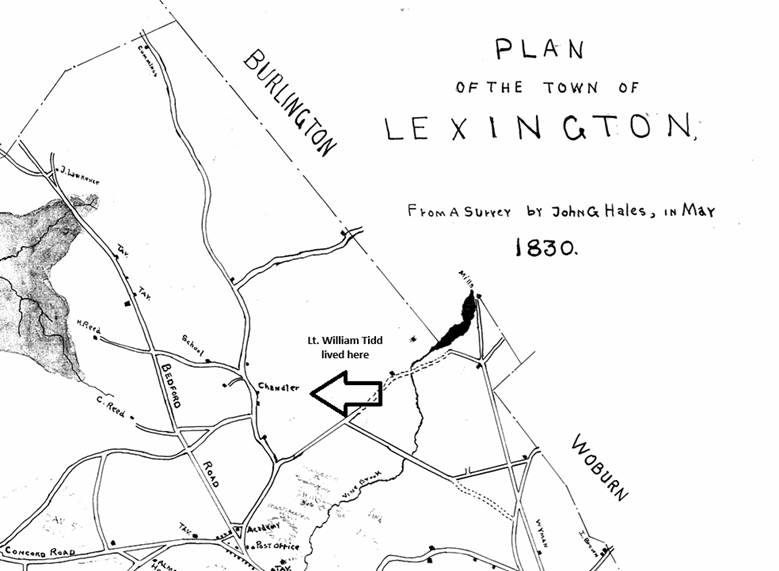
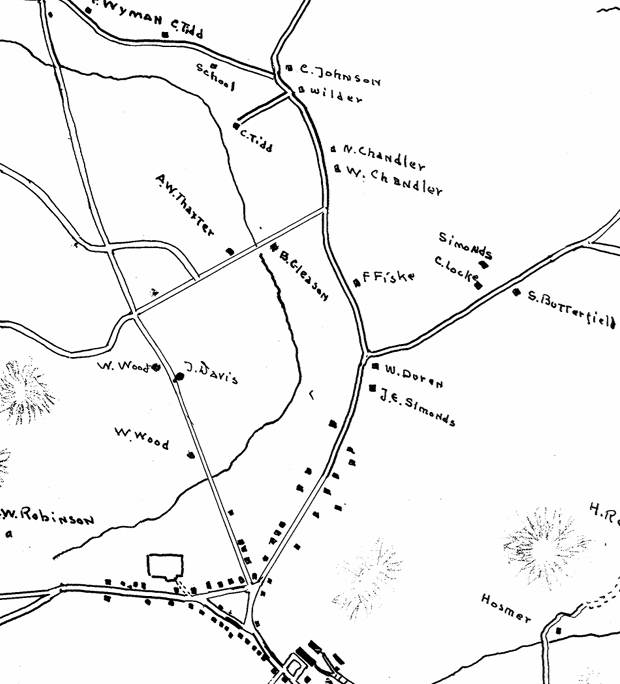
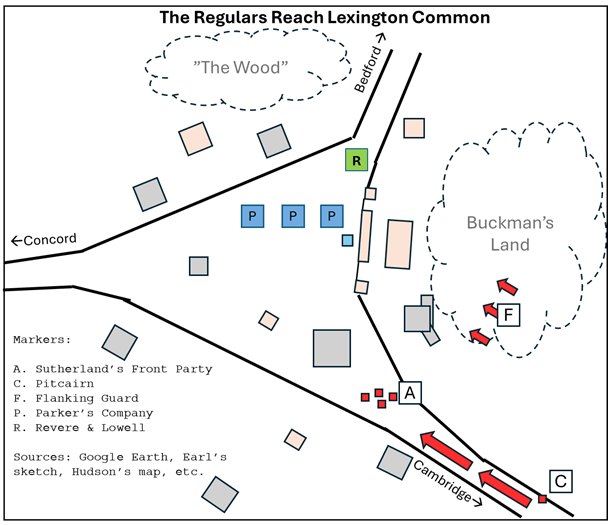
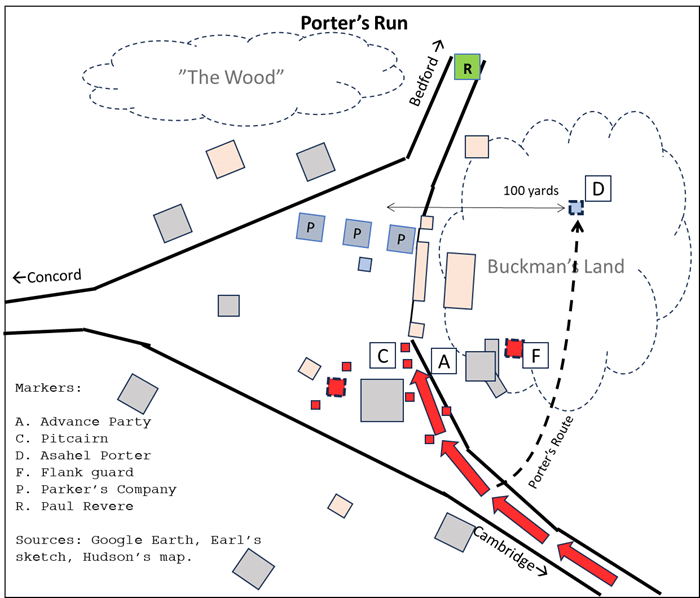
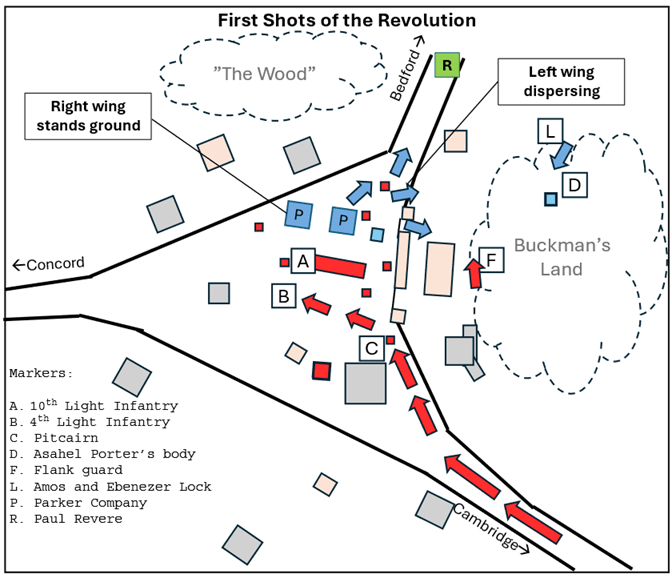
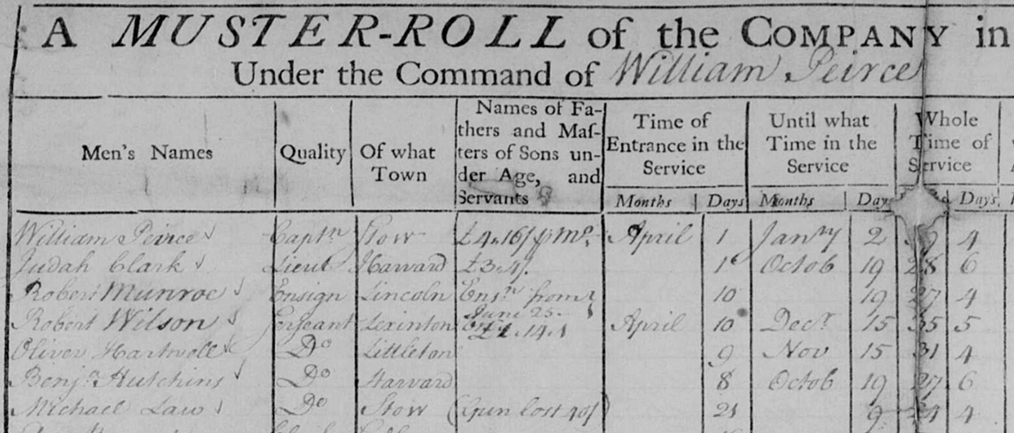
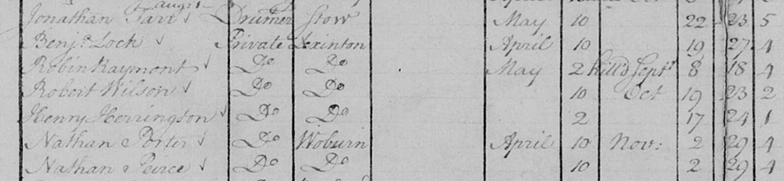
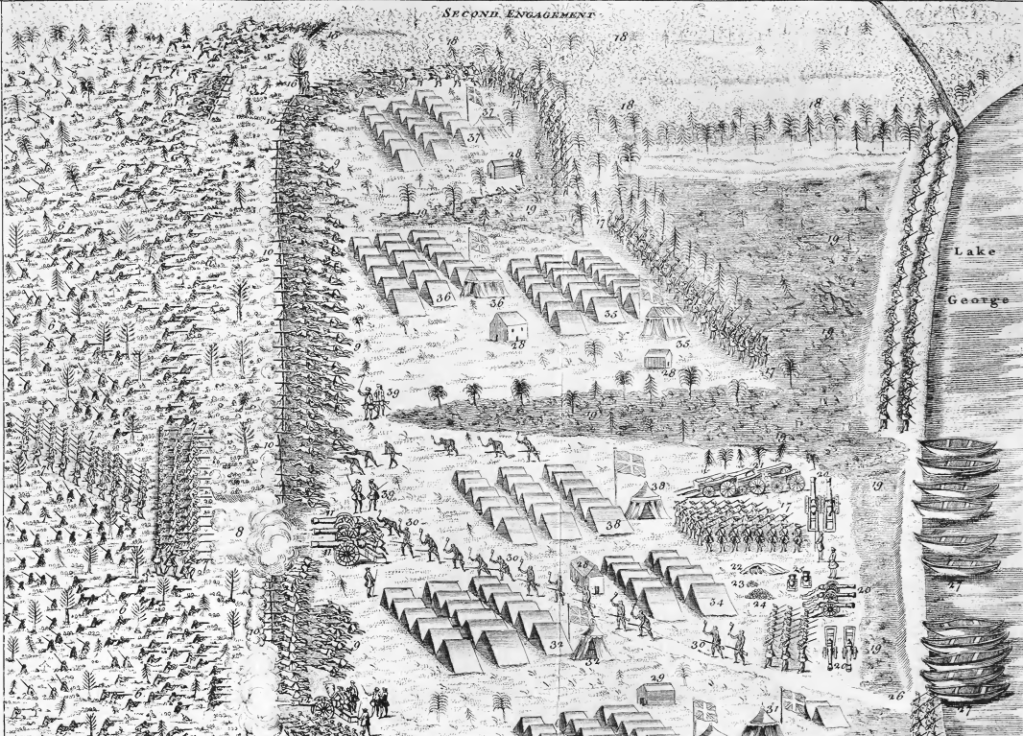
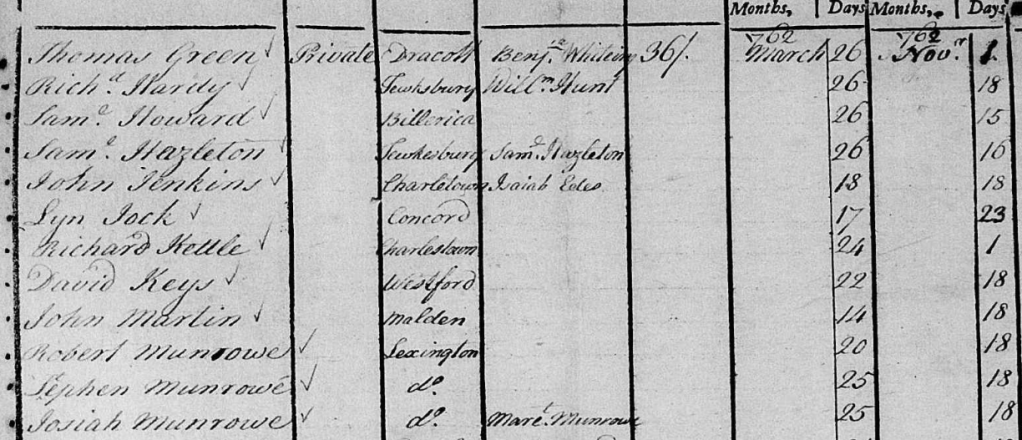
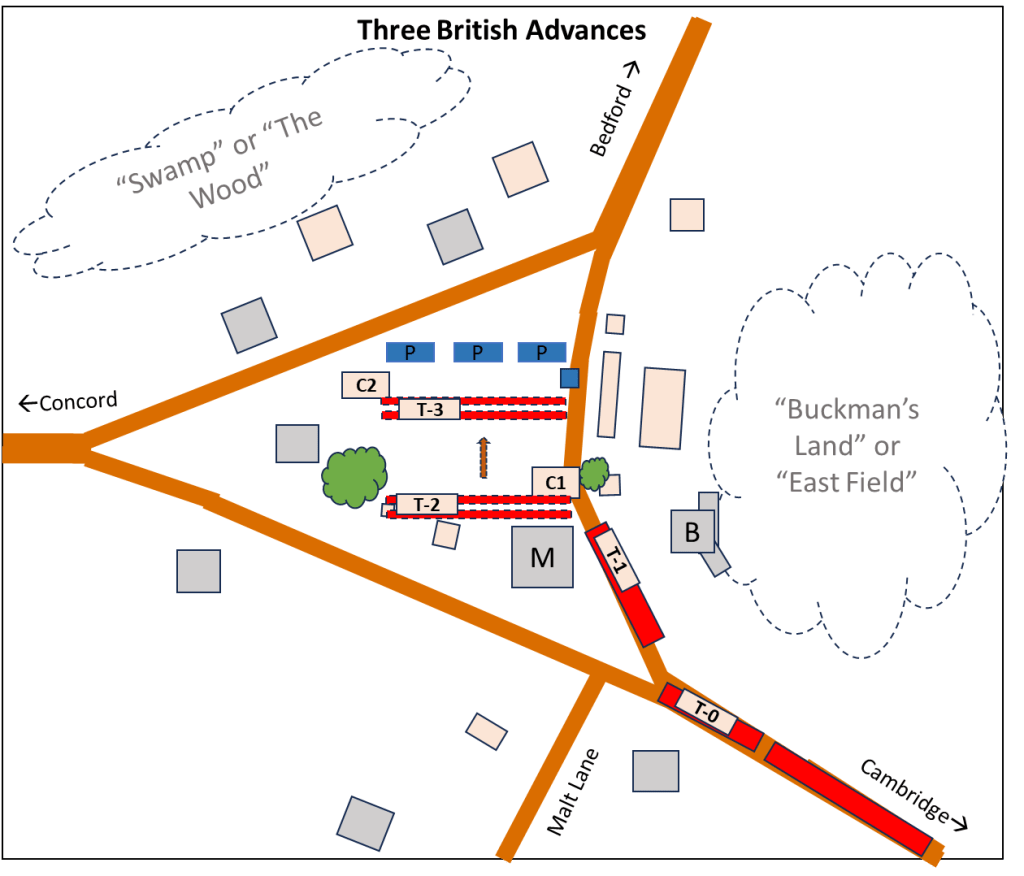
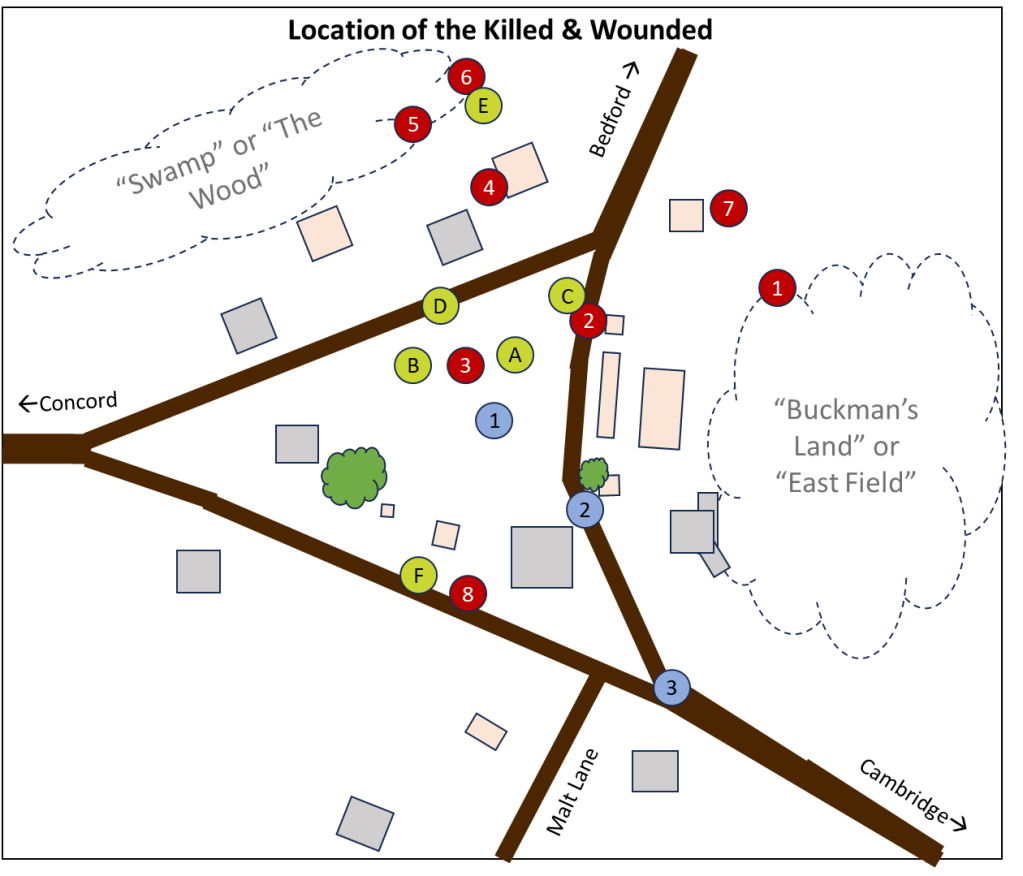
 The Lexington Fight