
On the morning of 19 April 1775, Lt. William Tidd called out the Lexington militia on news the British regular army was marching up the road. He stood on the town green beside Captain Parker as their band of “sixty or seventy” faced hundreds of trained soldiers. Once the shooting started, Tidd was one of the first handful of Americans to fire his gun.
This post presents evidence that the lieutenant’s 1775 lived a half mile up Bedford Road (now Hancock St) from the Clark home, where Hancock and Adams stayed that night, and also that the Tidd residence may well still be standing today.
First, we establish the location of the land on today’s Hancock Street once owned by Lt. Tidd’s grandmother, widow Lydia Carley Tidd.
We then establish that a house on this land was owned in 1868 by Lt. William Tidd’s grandson, Nathan Chandler, who said his grandfather Tidd lived there before him. We also present an eyewitness record stating that Tidd lived in an old colonial, not a new construction built after the Revolution.
Finally, we have a house still standing today at this location with a “Circa 1730” plaque on it. Is this the house Lt. William Tidd lived in on 19 April 1775, and perhaps for his entire life?
Here is what the record says.
Widow Tidd’s Land
According to Hudson, Lt. William Tidd’s paternal grandparents, Daniel and Lydia Carley Tidd, married 4 Dec 1694 and had two children, Daniel Jr and Mary. Daniel Sr, who is on the early Cambridge Farms proprietor lists with his father and two (of three) brothers, died 29 Feb 1996—Feb 1697 on modern calendars—leaving Lydia a widow.
Where did Lydia live? The Tidds, like most families who settled from Woburn, inhabited the northern part of Lexington. Despite her age, the young widow appears to have lived independently, since in 1699 the town granted her a license to run a public house. (This was a common practice at the time since it provided a source of income and kept widows without another trade from becoming dependent on the town for support.)
Where specifically did Lydia reside? Pages 13-14 of Michael J. Canavan’s notes on the Cambridge Farms Proprietor’s records include a 1703 report of the plan to lay out the town highway that became Hancock Street. It states that the new highway crossed the road leading from Concord to Woburn, then
“. . .through Jos. Symonds, his land, and so along Lydie Teed’s land and from there to Benj. Bates fenced on both sides and through sd [said] Bates’ land fenced on both sides to Jno. Hancock’s land and through it, fenced on both sides, and so along upon Benj. Muzzy’s land on the westerly side of Muzzy’s fence that now is until we came to Country Road by the Meeting house.”
Therefore, going north along Hancock Street from the meetinghouse, the landowners along what became Bedford Road in 1775 and Hancock Street today were: 1) Benjamin Muzzy, 2) Reverend John Hancock, 3) Benjamin Bates, and then 4) Lydia (Carley) Tidd.
It appears this Benjamin Bates owned land on both sides of Hancock Street. This appears to be the land that Jonas Parker and Dr. Joseph Fiske lived on in 1775. Lydia Tidd, by contrast, may have not owned the land on the other side of the road.
Another town meeting note from 27 February 1715, that appears to relate to planning for the road that became present-day Adams Street, shows Widow Tidd still owned the land years later. It states:
“Beginning at the town way that leads from the meetinghouse to the widow Liddia Teeds, and so to run north easterly. . .”
These notes appear to clearly place Lydia Tidd’s land one farm (Bates’) away from the Clark-Hancock Parsonage.
From Lydia Tidd to Lt. William Tidd
How do we know Lt. William Tidd resided on his grandmother’s land? The first piece of evidence comes from the process of elimination. Lydia’s only son Daniel would have inherited her property (Lydia and Daniel Sr.’s only other child, Mary, is mentioned in her grandfather 1702 will but afterwards she disappears from the record.) It is possibly no coincidence that no further references to Widow Tidds land appear in town meeting records after 1716, about the year Daniel Jr would have turned 21.
That said, Lydia Tidd lived another decade. On 31 March 1721, the town approved payment for her care of her own sister, Rachel Carley. The town approved additional payments in August 1724, Feb 1724/5, March 1725, and Jan 1725/6. Hudson’s Gen. Record, p242, says Lydia died 15 Aug 1727, age 55.
William had three brothers. The eldest, Daniel 3rd, died during the French War. Amos was also older, but for some reason worked for Parson Clark and then left town, eventually ending up in a boarding house in Hopkinton. William’s younger brother Samuel also moved away.
William, the only son left, therefore inherited his father’s home. Alone this might not be convincing, but there is fortunately a great deal of further evidence.
The Home of Lt. William Tidd’s Grandson
We can pin down Lt. William Tidd’s residence with greater certainty by working in the other direction. Hudson’s History (p42) says “The [1868] home of Mr. Nathan Chandler was originally a Tidd place.” This presumably means the Nathan Chandler living in 1868 whose father, Nathan Chandler Sr. had the same name.
Page 38 of Hudson’s Genealogical Record says Nathan Chandler Sr. married Ruth Tidd, only child of Lt. William and Ruth Tidd, who “lived on Hancock street, where Nathan Chandler [Jr] now resides, it being the homestead of his father-in-law.”
Further, page 41 says Nathan Chandler Jr, who was still living in 1868 at age 76, resided “on the old Tidd place on Hancock St. where his grandfather Tidd resided.”
So, Hudson was convinced Lt. William Tidd lived where the Chandlers did later. However, he provides no further details that would help pinpoint the location of Nathan Chandler’s house.
Fortunately, John Hales 1830 map shows “Chandler” lived on Hancock Street a little further up from the Common than present-day Revere Street. This was probably Nathan Chandler Sr, who was a state senator during those years and one of the most respected members of the community. Notably, Lt. Tidd’s widow, Ruth Munro Tidd, was still living in 1830 and probably resided with her only child, Chandler’s wife (also Ruth).
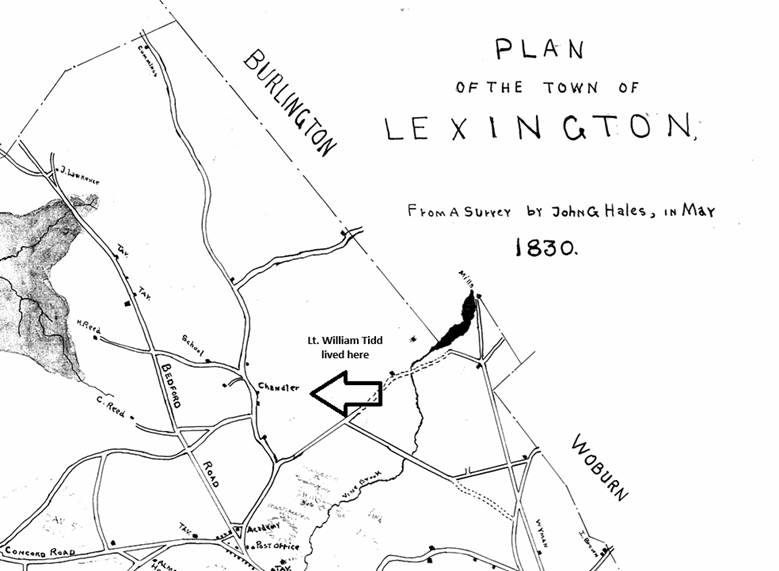
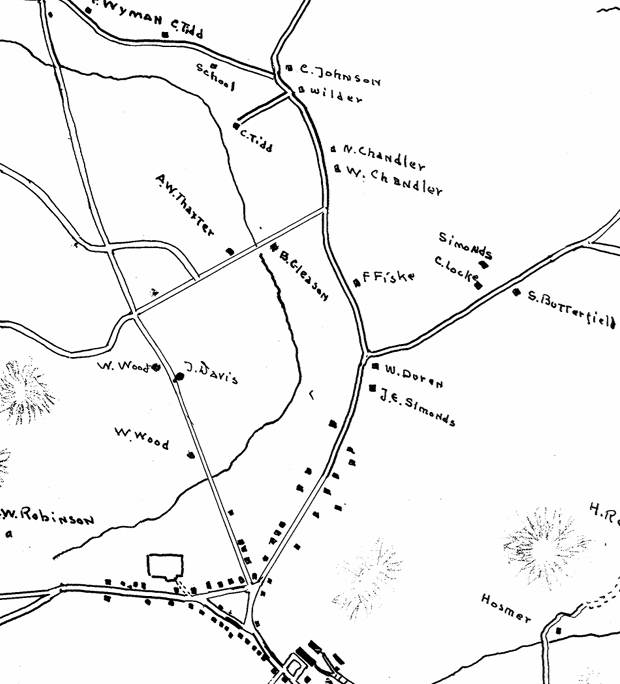
It’s worth noting the 1830 map shows two homes. We found the same two homes on H.F. Walling’s 1853 map, which shows the northerly home belonged to “N. Chandler” and the southerly home belonged to “W. Chandler”. (Nathan Jr’s brother William died in 1848, so this W. Chandler was probably William Chandler Jr, Nathan Jr’s nephew.) Therefore Lt. Tidd lived in the northerly home.
A. B. Muzzey’s Description of William Tidd’s Home
A final piece of evidence that William Tidd resided there comes from A.B. Muzzey’s 1882 “Reminiscences & Memorials” [p374-5], who remembered that, for one season, he walked by William Tidd’s farm on his way to school. Both the 1830 and 1853 maps show a school on what became North Hancock Street. If A.B. Muzzy walked to that school from his father’s house on Cambridge Road, he would have walked up Hancock Street past the Tidd farm.
Notably, Muzzey described Tidd’s home as “a venerable mansion of the ancient, rectangular style.” This suggests Tidd did not live in a new home he built on his land later in life, but rather in an old colonial that was already “venerable” in the early 1800s when A.B., born in 1802, passed as a boy.
Such a home still exists today.
A House Matching All the Facts
There is a pre-revolution colonial standing on Lydia Tidd’s old land. It is privately owned, so I will not show a photo or provide an exact address, but the building in question bears a plaque “Circa 1730”.
Assuming that is true, how likely is it that a two-story colonial built on Lydia Tidd’s land within a few years of her death was not the residence of her only son, town selectman and provincial army officer Daniel Tidd? How likely is it that this then-new mansion house was not also the home Lt. William Tidd grew up in? How likely is it that, in 1775, Lt. William was not living in the house his father gave him prior to writing his 1773 will?
Muzzy and Chandler’s statements suggest Tidd almost certainly lived there later in life. Perhaps some unreviewed deeds or family letters will surface that confirm he also grew up in this house and lived there in 1775 when he was called out in the middle of the night to muster the militia.
The odds appear high that he spent most, perhaps all, of his ninety years there. Perhaps “Circa 1730” should be changed to
“The home of Lt. William Tidd, who stood beside Captain Parker on Lexington Common on 19 April 1775, and was one of the first Americans to fire back at the British in the War of Independence.”
 The Lexington Fight