
There are many stories about the shots that kicked off the American Revolution on 19 April 1775, but so far the version presented here is the only one that agrees with all eyewitness statements. For details on how this “best-fit” narrative was reconstructed, read this.
For reference, the map below illustrates the progression of the British troops toward the American line. For map construction methodology and building labels, see here.
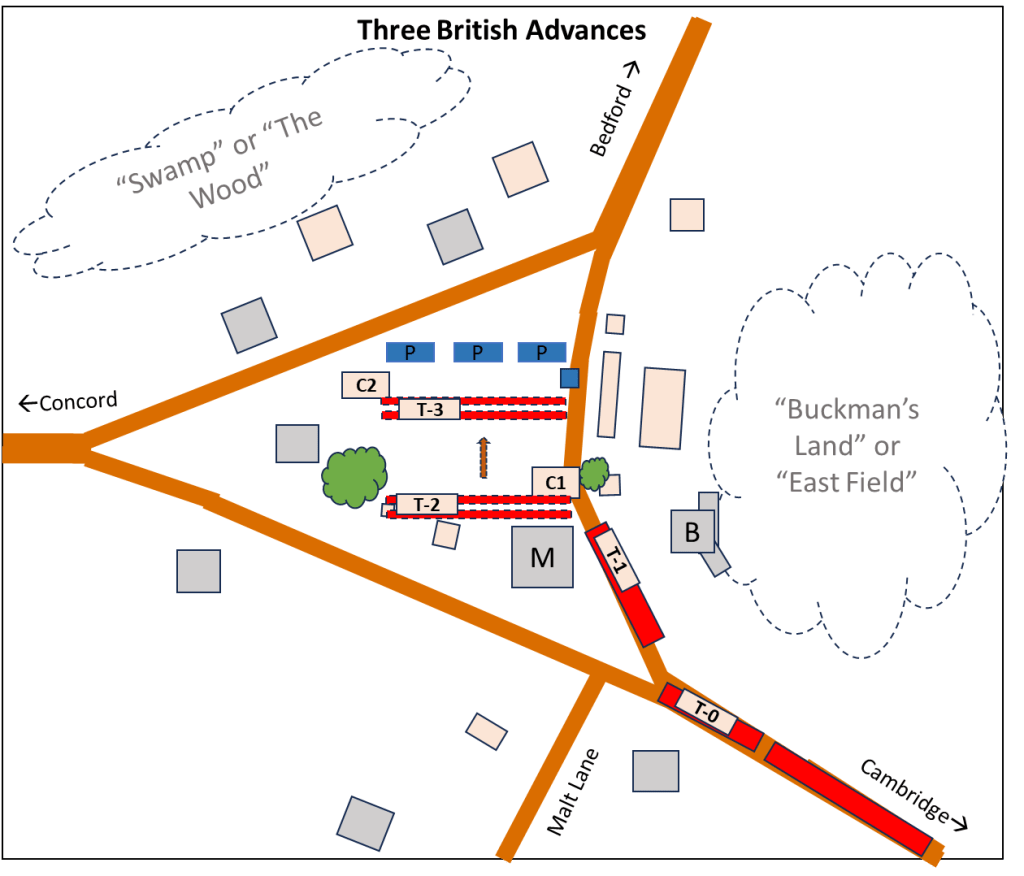
The basic scene of the confrontation, touched on by many eyewitnesses, went largely undebated. The Americans lined up on the north end of the green. Their position is marked on the map below with the label “P”. The militia captain, John Parker, ordered his men to “not fire unless fired upon.” Many spectators watched from the sidelines and nearby houses.
The British marched up to the southeast corner of the green, where they halted at the crossroad south of Buckman Tavern near the position marked on the map with the label “T-0”. Minutes earlier the British commander, Major Pitcairn, told them to “not shoot, or even attempt it, without orders.”
Picking up from there, the “best fit” narrative reconciles all eyewitness statements as follows:
Event #1: A British officer, possibly second-in-rank Major Mitchell, plus several “aides” looped around the meetinghouse on horseback in an apparent scout of the common .
Primary Sources: Levi Harrington (Gordon), 1826 Boston Newsletter.
#2: The senior British commander, Major Pitcairn, led a company of his troops toward the militia, halting in the southeast end of Bedford Road between Buckman Tavern and the town meetinghouse.
The map marks the British van company’s new position with the label “T-1”. This distance measures today to be about 75 yards (95 paces at my stride), which aligns with American statements placing some actions of the British while they were 12-13 rods away (1 rod=5.5 yards). Some sources specifically state the east side of the meetinghouse.
Primary Sources: Reverend Jonas Clark, Nathan Munro, Levi Harrington (1846). Supporting Sources: Ensign DeBerniere, Thomas Price Willard, Paul Revere, Elijah Sanderson (1824), William Munro.
#3: Mounted a little in front of his troops but with an advance guard of 8-10 soldiers close by, Major Pitcairn called out to the Americans to surrender their arms and disperse.
The map marks Pitcairn’s approximate position with the label “C1”.
Primary Sources: Ensign DeBerniere, William Munro. Supporting Sources: Ensign Lister, Elijah Sanderson (1824), Solomon Brown.
#4: Major Pitcairn immediately fired his pistol.
Presumably a warning shot intended to convey the seriousness of his order, so few mention it. No one was hit.
Munro (and others) called the detachment commander “Lt. Colonel Smith”, a name later taken from newspapers. Lee, repeating what he heard from other soldiers, named Pitcairn specifically. Supporting sources reported a pistol shot and smoke in front of the British immediately after they reached the common.
This was probably the first of two firings Joseph Underwood says the British gave before Parker issued his order to disperse.
Primary Sources: William Munro, Private Lee (Soldier’s Talk). Supporting Sources: Levi Mead and Levi Harrington, Paul Revere, Levi Harrington (Gordon), Nathan Munroe, Joseph Underwood.
#5: The American militia did not obey.
Primary Sources: Ensign DeBerniere, Joseph Underwood. Supporting Sources: Ensign Lister, William Munro, Robert Douglass, Solomon Brown.
#6: Pitcairn then ordered his troops onto the green.
Two American witnesses saw Pitcairn speaking with a second officer, a subordinate “commander” who then led the troops onto the field.
Primary Sources: Thomas Price Willard, William Munro.
#7: The British troops lined up along the north side of the meetinghouse, directly across from the American militia, about fifty yards away.
The new position of the van light infantry companies (believed to be the 10th commanded by Captain Parsons and the 4th commanded by Lieutenants Gould and Barker) are marked on the map with label “T-2”. This distance agrees with American estimates that the British halted 8-9rods away (about 50 yards).
The third company in line, the Marines light infantry commanded by Captain Soutar, is believed to have moved to T-1. The other three companies present, including the 52nd light infantry, still stretch past Buckman Tavern near T-0.
Primary Sources: Sylvanus Wood, Levi Harrington (1846). Supporting Sources: Thomas Price Willard, William Draper, Elijah Sanderson (1775), Captain John Parker, John Robbins, John Munroe Jr, Robert Douglass, British Sources: Lt. Colonel Smith*.
#8: Drawing his sword, Pitcairn repeated his orders to the Americans: “Lay down your arms, ye rebels, and disperse!”
Primary Sources: Ensign DeBerniere, John Munroe Jr., Levi Harrington (1846). Supporting Sources: Private Lee “Soldiers Talk”, William Munro.
#9: Several scattered shots were fired by or near the British.
American witnesses said at least one shot came from a British officer, possibly Pitcairn’s second-in-command. Paul Revere reported hearing “a few more guns” but not who fired them.
Separately, British Lieutenant Sutherland said three shots were fired at the British from the corner of Buckman Tavern (that the British ignored, possibly because they were in fact the shots that killed Asahel Porter) that fit during this time interval.
None of these shots appeared to be aimed at anyone. All appear to have been deemed inconsequential by those on the field.
Primary Sources: Benjamin Tidd and Joseph Abbot. Supporting Sources: Lt. Sutherland, Paul Revere, Levi Mead and Levi Harrington.
#10: The American militia still stood their ground.
Primary Sources: Ensign DeBerniere, William Munro, John Munroe Jr., Levi Harrington (1846).
#11. Pitcairn ordered the advance guard of 8-10 soldiers to fire a volley over the heads of the militia.
This was evidently the first of at least two commands to fire issued by a British officer. Since Private Bateman belonged to the 52nd Regiment stationed in the rear (south of Buckman Tavern) this is probably the order to fire he swore he heard.
Primary Sources: Private Bateman, Private Lee “Soldiers Talk”, Elijah Sanderson (1824), Levi Harrington (1846). Supporting Sources: John Munroe Jr., Solomon Brown.
#12: The advance guard fired as ordered.
Some Americans thought they fired only powder. Others thought they fired overhead. Some reported looking down the American line and, after seeing no one hit, concluding the shots were not intended to kill.
Primary Sources: Private Bateman, Benjamin Tidd and Joseph Abbot, John Munroe Jr., Sylvanus Wood, Levi Harrington (1846), Solomon Brown. Supporting Sources: Levi Mead and Levi Harrington, Paul Revere, Levi Harrington (Gordon), Elijah Sanderson (1824).
#13: The American militia captain, John Parker, ordered his company to disperse.
Joseph Underwood specifically stated Parker’s order came after the second time the British fired, which allows its placement in the chronology after Pitcairn’s second gunshot-accompanied demand to “disarm and disperse”.
At this point, some militiamen on the left wing (near Parker) began leaving the field, muskets in hand. Some on the right wing, not hearing the order, didn’t move. It’s possible the order was drowned out by the sound of the British musket volley.
Primary Source: Joseph Underwood. Supporting Sources: Thomas Price Willard, William Draper, Elijah Sanderson (1775), Captain John Parker, Deposition of 34, Deposition of 14, Reverend Jonas Clark, Ebenezer Munroe Jr., Sylvanus Wood, Solomon Brown.
#14: Pitcairn ordered the light infantry to advance, surround and disarm the militia.
Primary Source: Ensign DeBerniere. Supporting Sources: Elijah Sanderson (1775), Reverend Jonas Clark.
#15. The British officers and foot soldiers shouted a “huzzah”.
Thomas Price Willard specifically mentions the officers started the shouts.
Primary Source: Thomas Price Willard. Supporting Sources: William Draper, Elijah Sanderson (1775), John Robbins, Reverend Jonas Clark, 1826 Boston News Letter, Robert Douglass.
#16: The left wing of the American militia kept dispersing.
Primary Sources: Reverend Jonas Clark, Sylvanus Wood. Supporting Sources: Major Pitcairn, Lieutenant Gould, Lt. Colonel Smith*, William Draper, Nathan Munroe.
#17: The huzzaing British foot soldiers rushed across the field.
Several American sources and British Lt. Edward Gould reported the foot soldiers shouted the customary third “huzzah” as they ran. They stopped 10-15 yards from the militia line. The map marks their position with the label “T-3”.
Primary Sources: Lt. Edward Gould, Captain John Parker, Elijah Sanderson (1775). Supporting Sources: Major Pitcairn, Ensign DeBerniere, Lt. Sutherland, Lt. Barker, Ensign Lister. American Sources: William Draper, John Robbins, Thomas Fessenden, Reverend Jonas Clark, William Munro, Ebenezer Munroe Jr, William Tidd, Sylvanus Wood, Robert Douglass, 1826 Boston News Letter.
#18. The second British “commander” rides in front of the advance with other mounted officers.
A second “commander” (not Major Pitcairn, possibly Major Mitchell) and several other officers led the advance on horseback. Sutherland provided a list of six officers plus “some other gentlemen”. This subordinate commander’s approximate position is marked on the map with the label “C2”.
Primary Source: Sylvanus Wood. Supporting Sources: Lt. Sutherland. John Robbins, Thomas Fessenden, Reverend Jonas Clark, 1826 Boston News Letter, Levi Harrington (1846).
#19: The officers in the lead party shouted variants of Pitcairn’s orders to the Americans.
Some militiamen heard “Drop your weapons”, others “Disperse”, etc.
Primary Sources: Lt. Sutherland, Thomas Price Willard, John Robbins, Thomas Fessenden, Reverend Jonas Clark, Ebenezer Munroe Jr., William Tidd.
#20: The left wing of the militia was still dispersing, the right wing still hadn’t moved. None dropped their weapons.
Ebenezer Munroe Jr. says the troops came “directly up our front”, suggesting Parker’s west flank, where Ebenezer was, still had not moved.
Primary Sources: Lt. Sutherland, Timothy Smith, Ebenezer Munroe Jr. Supporting Sources: Thomas Price Willard, John Robbins, Sylvanus Wood, Robert Douglass.
#21: Pitcairn, who remained in the rear by the meetinghouse, shouted “Soldiers, don’t shoot! Surround and disarm them!”
Pitcairn’s report says the meetinghouse was “on our left”, which allows placement. Lt. Sutherland does not list Pitcairn among the leading officers, supporting the conclusion the detachment commander did not ride forward.
Primary Sources: Major Pitcairn, Lieutenant Sutherland.
#22: The forward mounted officers continue attempts to comply with Pitcairn’s orders to surround and disarm the militia. One fires a pistol.
The second British commander, who by now had fired his pistols, brandished his sword while still shouting orders. A second officer at the front of the British troops fired his pistol, possibly yet another shot in the air to convince the militia to comply, although one witness said it was pointed at the militia.
Primary Source: Thomas Fessenden. Supporting Sources: Reverend Jonas Clark, Ebenezer Munroe Jr., Levi Harrington (1846).
#23: At about the same time as #22, an American fired a shot from behind a stone wall east of the common.
The British heard the report and the whizzing of one or two musket balls flying overhead. Since it whizzed as it passed their ears, the shot hit no one.
The one American source stated this shot did not come from anyone in the Lexington company. This shot might have been fired by a member of the neighboring Woburn militia, Ebenezer Lock, whose grandchildren claimed fired the first American shot of the revolution.
Primary Sources: Lt. Sutherland, Captain Soutar, Unknown Private Soldier. Supporting Sources: Major Pitcairn, Ensign DeBerniere, Lt. Barker, Ensign Lister, Lt. Colonel Smith*, Leonard’s Wounded Militiaman, Amos Lock.
#24: The second British commander ordered the front company to fire.
When the soldiers hesitated, the second commander repeated “Fire, God damn you! Fire!”
British Captain Soutar states the front light infantry company fired in response to a “shout” from the “leading company”, presumably a reference to the mounted officers at the front.
Primary Sources: British Captain Soutar, William Draper, Simon Winship, John Robbins, William Munro. Supporting Sources: Reverend William Clark, John Munroe Jr., 1826 Boston News Letter, Sylvanus Wood, Levi Harrington (1846).
#25: The British foot soldiers fired, hitting many Americans and killing several.
Soutar says the van light infantry company “immediately formed, and a fire was given”, which implies the commander’s order was repeated by the company officers.
Ebenezer Munroe Jr was wounded on the west wing at the same time Ensign Robert Munro was shot dead on the east end of the common (evidently climbing the stone wall to escape with his back to the regulars), supporting American reports of a “close and heavy” firing along the entire line. See here for the locations of other killed and wounded.
Primary Sources: Ensign DeBerniere, Lt. Sutherland, Captain Soutar, William Draper, Elijah Sanderson (1775), John Robbins, Deposition of 34, Deposition of 14, Timothy Smith, Levi Mead and Levi Harrington, Thomas Fessenden, Reverend Jonas Clark, William Munro, John Munroe Jr., Ebenezer Munroe Jr., William Tidd, Sylvanus Wood, Levi Harrington (1846). Supporting Sources: Captain Parker, Benjamin Tidd and Joseph Abbot, Paul Revere.
#26: Several Americans fired back, possibly wounding one British soldier.
The private soldier of the 10th was likely hit now, when only a few yards from the Americans, but may have been injured moments later by a lucky shot.
Primary Sources: William Munro, John Munro Jr., Ebenezer Munroe Jr., 1826 Boston News Letter, Robert Douglass.
#27: The field filled with smoke. The British soldiers, possibly only those from the uncaptained 4th light infantry, rushed forward without orders.
One of them bayoneted a wounded American attempting to reload his musket, killing him. Others began a scattered fire on the fleeing Americans. Bullets peppered the stone wall many militiamen jumped onto Buckman’s land.
Primary Sources: Lt. Barker, William Munro, John Munroe Jr.. Supporting Sources: 1826 Boston News Letter, Levi Harrington (1846), Solomon Brown.
The fight had begun.
Soutar’s Marines and possibly others advanced. The British troops killed several more Americans as they retreated in all directions. Some fleeing Americans fired back but didn’t hit anyone. Some other Americans fired a few shots from the town meetinghouse and Buckman Tavern. Major Pitcairn’s horse was hit twice. A second British soldier was wounded in the hand. British soldiers cleared the meetinghouse, killing one American and wounding another.
The fight lasted fifteen minutes. When it was over, eight Americans were dead with many more wounded, some severely. One or two British soldiers were also wounded, plus Pitcairn’s horse.
For details on who fell where, see here.
Recap the highlights: So, Who Shot First?
References
This section lists eyewitness statements used to construct the best-fit narrative with references to the original source used.
Index to Eyewitnesses: Americans
| Eyewitness | Source (See Bibliography) |
| Brown, Solomon | Brown p123-130 |
| Deposition of 34 Eyewitnesses | Force p492-3 |
| Deposition of 14 Eyewitnesses | Force p492-3 |
| Clark, Reverend Jonas | Clark p1-7 |
| Douglass, Robert | Ripley 1832 p35 |
| Draper, William | Force p495 |
| Fessenden, Thomas | Force p495-6 |
| Harrington, Levi | Gordon p1, Harrington p1 |
| Leonard, George (Wounded Militiaman) | French 1932 p57-58 |
| Locke, Amos | Phinney 1825 p38-39; |
| Mead, Levi and Harrington, Levi | Force p494-5 |
| Munro, Orderly Sergeant William | Force p493-4, Phinney p33-35 |
| Munroe, Ebenezer | Phinney 1825 p36-37 |
| Munroe, John Jr. | Force p493-4, Phinney p35-36 |
| Munroe, Nathan | Phinney 1825 p38 |
| Parker, Captain John | Force p491 |
| Revere, Paul | Revere p106-111, Gordon p1 |
| Robbins, John | Force p491 |
| Sanderson, Elijah | 1775: Force p489, 1824: Phinney p31-33 |
| Smith, Timothy | Force p494 |
| Tidd, Benjamin and Abbot, Joseph | Force p492 |
| Tidd, Lieutenant William | Force p492-3, Phinney p37-38 |
| Underwood, Joseph | Phinney 1825 p39 |
| Willard, Thomas Price | Force p489-90 |
| Winship, Simon | Force p490 |
| Wood, Sylvanus | Ripley p35-37 |
Index to Eyewitnesses: British
| Name | Source (See Bibliography) |
| Barker, Lieutenant John | Dana p31-32 |
| Bateman, Private John | Force p496 |
| DeBerniere , Ensign Henry | DeBerniere p214 |
| Gould, Lieutenant Edward | Force p500-1 |
| Lee, Samuel (Soldier’s Talk) | Gordon p1 |
| Light Infantry Private Soldier | Willard, p198 |
| Lister, Ensign Jeremy | Murdock 1931 p17-24 |
| Marr, Private James | Gordon p1 |
| Pitcairn, Major John | French p52-54 |
| Smith, Lt. Colonel Francis* | French p62-63 |
| Soutar, Captain William | Hargreaves p219 |
| Sutherland, Lieutenant William | Murdock 1927 p13-24 |
* While Lt. Colonel Smith was not present for the fight, his statement is included since he claims to have talked to all the officers present. It largely aligns with Pitcairn’s report, but includes a few distinct details.
Bibliography
Beck, Derek W.: “Who Shot First? The Americans!”, Journal of the American Revolution, 16 April 2014
Brown, G. W.: “Sketch of the Life of Solomon Brown”, Lexington Historical Society Proceedings, Vol II, 1900
Clark, Rev. Jonas: “19 April 1776 Sermon”, Appendix, p1-7, 1776
Dana, Elizabeth et al.: “The British in Boston”, 1924
DeBerniere, Henry: “Narrative, &c.”, Collections of the Massachusetts Historical Society, Vol. IV of the Second Series, 1816, p205-215
Force, Peter: “American Archives”, 4th Series Volume II, Undated
French, Allen: “General Gage’s Informers”, 1932
Galvin, John R.: “The Minute Men”, 2nd Edition, 1989
Gordon, Rev. William: “Letter to Englishman”, 17 May 1775, Reprinted by the Philadelphia Gazette 7 June 1775 (Retrieved from Newspapers.com Feb 2024)
Hargreaves, Reginald: “The Bloodybacks”, 1968
Harrington, Levi: “Account of the Battle of Lexington”, Manuscript available from Lexington Historical Society, 1846
Murdock, Harold: “Late News of the Ravages”, 1927
Murdock, Harold: “The Concord Fight”, 1931
Phinney, Elias: “History of the Battle at Lexington”, 1825
Revere, Paul: “A Letter from Col. Paul Revere to the Corresponding Secretary” [The “Belknap Letter”], Collections of the Massachusetts Historical Society For the Year 1798, Series 1, Volume 5, 1798 [Reprinted 1835], p106-111
Ripley, Ezra: “History of the Fight at Concord”, 2nd Edition, 1832
Tourtellot, Arthur B.: “Lexington & Concord”, 1959
Varney, George: “The Story of Patriot’s Day”, 1895
Willard, Margaret Wheeler: “Letters On the Revolution”, 1774-1776, 1925
 The Lexington Fight